• Published on

    Three Germans: The Regiment's Field Officers

    Image description
    Why Germans? The 8th Virginia Regiment of Foot was authorized by the revolutionary Virginia Convention on December 13, 1775. It had no numeric designation yet, but was intended to be unique in two ways. It would be ethnically-based and all of its men would carry rifles. It was conceived as a “battalion” to “be composed of Germans, with German officers.”
     
    The concept may have originated with the Rev. Peter Muhlenberg and Jonathan Clark, both delegates from Dunmore County in the Shenandoah Valley. Dunmore (now called Shenandoah County) was the cultural hub of German life in the Valley. It is inconceivable that the resolution could have been drafted without the involvement of at least Muhlenberg and probably of Clark as well. Muhlenberg was the Rector of Beckford Parish, the geography of which was identical to that of Dunmore County. His church was at Woodstock, the county seat. He was, however, more than just the community’s pastor. He was the son of the patriarch or the Lutheran Church in America, whose church was in the village of Trappe near Philadelphia. Clark was the county’s deputy clerk, an important job, under Thomas Marshall (soon to be colonel of the 3rd Virginia Regiment and father of future Chief Justice John Marshall).

    The Shenandoah Valley’s Germans had nearly all come the way Muhlenberg had: down the Great Philadelphia Wagon Road to Virginia. The road passed through communities that remain heavily German to this day, such as Lancaster, Pennsylvania. Scotch-Irish immigrants followed the same route, but tended to settle farther south in the Valley, around Staunton and Augusta County. 

    Lutheran Germans like Muhlenberg were seen by the Virginia gentry as reasonably reliable and trustworthy. Their theology differed little from the Church of England. Muhlenberg had, in fact, gone to London to be ordained before taking his position in Woodstock. (King George III was himself of German descent and his great grandfather, George I, couldn’t speak English when he took the throne.) The Ulster Irish, however, were less trusted. They were theological dissenters and often politically radical. Their Calvinist faith differed in important ways from Anglicanism. They could, however, be counted on to fight
    The ordinance creating the 8th Virginia and the selection of field officers that followed it suggest that what the convention really meant by calling it “German” was that Germans would command it (and that the Irish would not). Muhlenberg was the perfect candidate for such a role. He and Clark both served as officers in the regiment, something that may well have been predetermined. Muhlenberg would be the top officer and Clark would command one of Dunmore County’s two companies (the German one).
    Picture

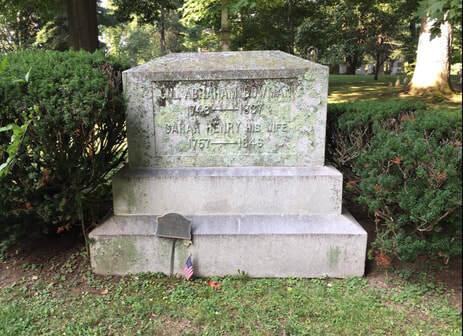
    The lichen-encrusted grave of Abraham Bowman in Lexington, Kentucky. No portraits of Bowman or Helphenstine survive. Though Helphenstine is known to be buried in the Lutheran section of Winchester's Mount Hebron Cemetery, there's no surviving marker. It may be that his destitute widow was not able to afford a stone memorial. (author)

    “And be it farther ordained,” read the resolution, “That of the six regiments to be levied as aforesaid, one of them shall be called a German regiment, to be made up of German and other officers and soldiers, as the committees of the several counties of Augusta, West Augusta, Berkeley, Culpeper, Dunmore, Fincastle, Frederick, and Hampshire (by which committees the several captains and subaltern officers of the said regiment are to be appointed) shall judge expedient.”
    Picture

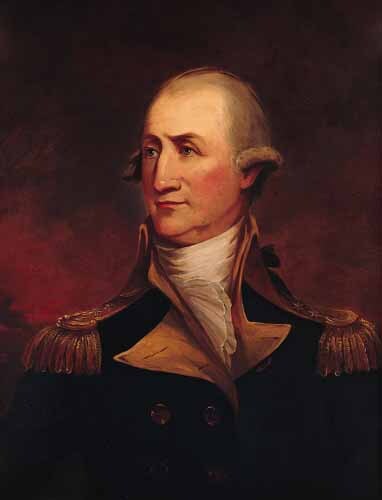
    Peter Muhlenberg portrayed at the end of the war as a brevet Major General.

    Muhlenberg and Bowman were both too young to have participated in the French and Indian War as most of Virginia’s other senior officers had. Muhlenberg had spent some time in a British military unit after dropping out of seminary in Germany years before. Bowman had experienced at least one dangerous encounter with Indians as a teenager. It is fairly clear that in choosing them the Convention prioritized their ability to rally and unite the Shenandoah Valley over their fairly meager military experience. Patrick Henry was the only other appointed colonel who had no real military experience.

    When they received their commissions Muhlenberg was twenty-nine years old and Bowman was twenty-six. The regiment’s major was Peter Helphenstine, a German from Winchester in Frederick County. He was about twice Bowman’s age, in his middle fifties. He had commanded a company in the governor’s division during Lord Dunmore’s War in 1774. He was a respected tradesman and an active Lutheran.
    Below them, the officers of the ten companies—captains, lieutenants and ensigns—were a diverse group. English, German, and Scotch-Irish were most common. Capt. Abel Westfall of Hampshire County was Dutch, though his family had been in America for generations. Lieut. Jacob Rinker was Swiss. Lieut. Isaac Israel was Jewish. Religiously, though it is hard to trace, they were mostly Anglican, Lutheran, German Reformed, Presbyterian, and probably Baptist. If there were no Methodists, some of them—including Capt. Westfall—would become Methodists soon.
    ​`
    The diversity of the officers reflected the diversity in the rank and file. The 8th Virginia was a microcosm of the Continental Army at large. It was America’s original “melting pot.” Originally divided by race and religion, their shared hardships would soon make them a band of brothers.

    ​The committees were generally dominated by English elites and could be counted on to appoint the right kind of company officers. Only two of ten companies had Irish captains: Fincastle County and the West Augusta district (both on the frontier) selected James Knox and William Croghan. Both were capable and loyal officers.


    The choice of field officers, however, was up to the Virginia Convention and it chose three Germans as it had planned. Each was from a different down in the lower (northern) Shenandoah Valley. Muhlenberg was appointed to be the colonel. Abraham Bowman of Strasburg (also in Dunmore County) was appointed to be the lieutenant colonel. Bowman came from a prominent family. His grandfather, Jost Hite, had led the first group of German settlers into the valley from Pennsylvania in 1731.  

    More from The 8th Virginia Regiment

    Picture
    Picture
    Picture
  • Published on

    The Murder of Joseph Carman

    Picture

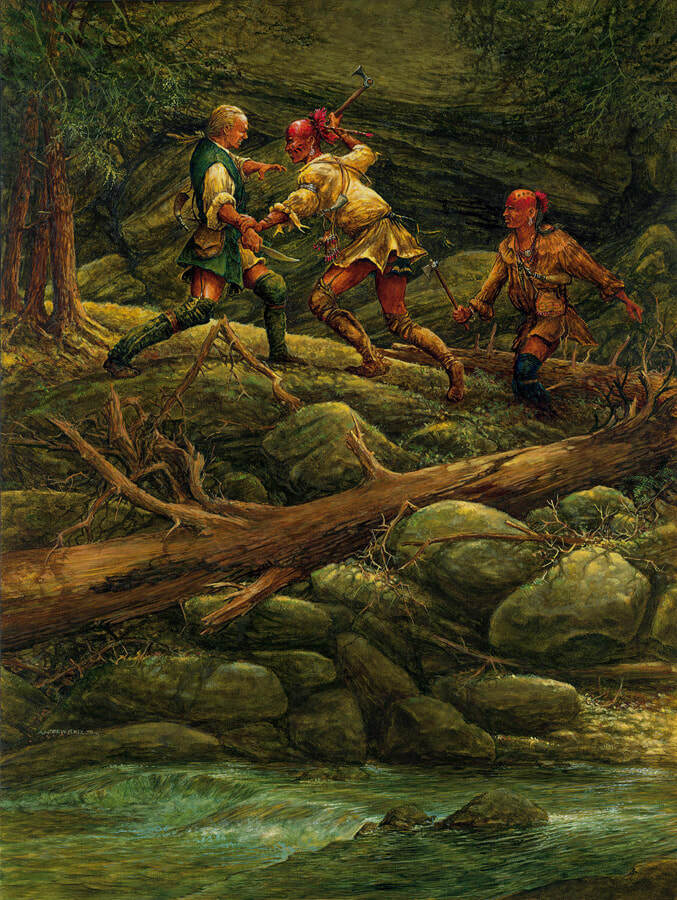
    Joseph Carman survived the Revolution, but did not surviver postwar life on the frontier. (Image: "Andrew Poe and Bigfoot" by Andrew Knez, www.andrewknezjr.com)

    ​Joseph Carman was thirty years old when he enlisted in Captain William Croghan’s company of the 8th Virginia. He joined at Fort Pitt, then claimed by Virginia, early in 1776. He was from Bordentown New Jersey but had gone west for reasons that aren’t known. Croghan was the Irish-born nephew of the controversial Indian agent, trader, and land speculator George Croghan. Abraham Kirkpatrick, the company’s senior lieutenant, had fled Maryland as a youth after killing a man in a fight.
     
    When we think of the “wild west” we are far more likely to think of Arizona than Pennsylvania. Yet, the distinction is really one of time, not of geography. No place illustrates this better than Pittsburgh. When the Revolutionary War broke out, and for years after, it was a virtual “Dodge City.” It was full of sketchy characters with fluid loyalties. People there were often just “passing through.” It was already known for violence and would soon be better known for whiskey. Its very existence was, in a sense, illegal under British rule. Fort Pitt was there to guard the frontier, but it was beyond the 1763 Proclamation Line and people were not supposed to settle there.
    The great event of the pre-Revolutionary frontier was the 1774 Indian war known as Lord Dunmore’s War. Carman had been a soldier in that war in the division of the army personally commanded by Dunmore—the royal governor. Dunmore’s division had arrived too late at Point Pleasant to join in the victory there on October 10. Negotiations to formalize terms with the defeated Indians were just about to begin when Croghan’s men marched out of town a year later. They marched southeast along Braddock's old road toward Winchester, en route to the provincial capital at Williamsburg and an intended final destination at Suffolk.
     
    The unique story of Croghan’s company in 1776 has been told here already. After another missed rendezvous, they were reassigned to the 1st Virginia Regiment for the year. Carman died too soon to leave a narrative of his specific experiences in the war. None of his five messmates are known to have left a record either. (They were Michael Martin, Moses Martin, George Martin, Daniel Viers, and John McDonald.) It is likely that he crossed the Delaware with Washington on Christmas Day for the attack on Trenton. Though most were too ill after the Trenton adventure he may also have been at the battles of Assunpink Creek and Princeton in early January. United at last with the 8th Virginia in the spring, he was very likely at the Battles of Brandywine and Germantown. Muster rolls confirm he was present and healthy during this time. His Continental service concluded when his two-year enlistment expired near the end of the winter encampment at Valley Forge
     
    Meanwhile, back in Pittsburgh, the Indian peace broke down again and there was plenty to keep the militia (every fighting-age male) busy. An expedition across the Ohio under Col. Edward Hand failed about the time Carman was discharged. If Carman returned directly to Pittsburgh, he may have participated in one or both of the campaigns led by Gen. Lachlan McIntosh and Col. Daniel Brodhead in 1778 and 1779.
     
    Though Pittsburgh itself was on the frontier Colonel Brodhead reported in 1780, “The Emigrations from this new Country to the Settlements on Kentucke & the Falls [of the Ohio—later Louisville] are incredible….” Joseph Carman and his family were among the thousands of pioneers headed to Kentucky, though the date of their move could fall anywhere between 1778 and 1787.
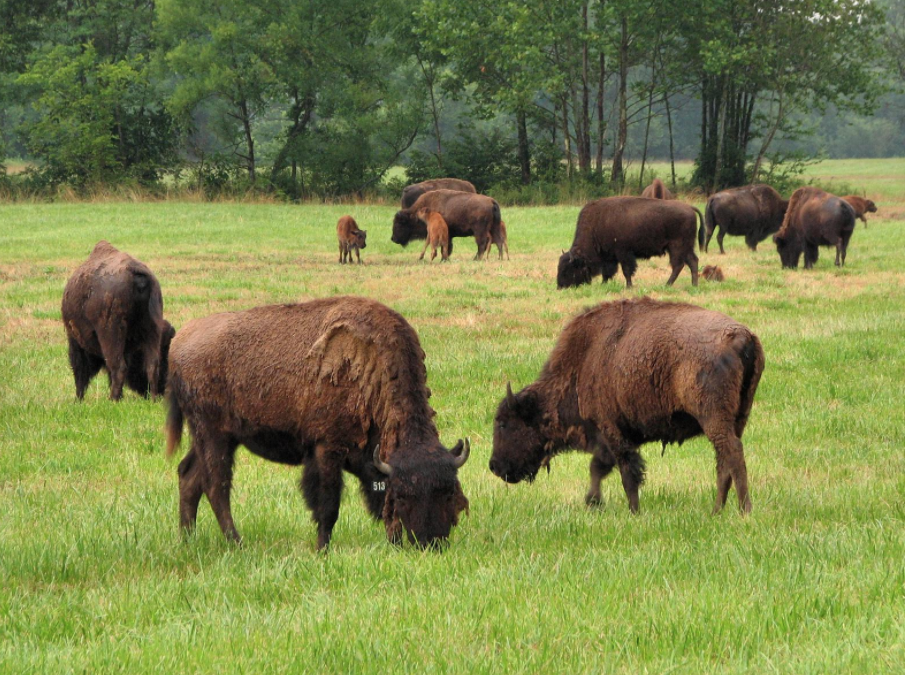
    Seven years later Carman was living at Well’s Station. This was a frontier Kentucky settlement located about half way between Louisville and Frankfort. Well's Station was near the home of storied longhunter, frontiersman, and former 8th Virginia Captain James Knox. The town of Shelbyville would appear close by in 1792. In the fall of 1787, Carman and two companions—Vincent Robbins and Aaron Van Cleve— set out on a buffalo hunt. Buffalo were still common in Kentucky at the time. They headed a few miles north toward Drennon’s Lick, a saltwater spring that attracted large game. The site is known today as Drennon Springs.
    Picture

    American buffalo were once common in Kentucky. The last herd was seen in about 1820. (Image: Art Lander)

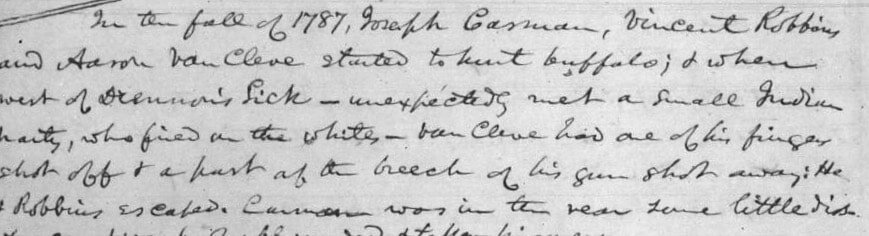
    They were ambushed there by a party of Indians—probably Shawnee—who fired on them. Van Cleve had a finger and part of the breech of his gun shot off. Though wounded, he and Robbins were able to escape. Carman was not so lucky. Van Cleve and Robbins raced to the settlements along the Bullskin Creek for help. Robbins then led a rescue party that set off after Carman and his captors. From the site of his capture they followed a trail of blood for about two hundred yards to the place where the Indians had been camping.  There they found Carman’s body “dismembered and hung about on saplings. They gathered it up and took it back to Well’s Station, his home, for burial.” He may have been tortured, though the record doesn’t say and there may have been no way for his neighbors to know.
    Carman left behind a wife, Mary, and six children. Though little more than courage can be discerned from our sources about Joseph Carman’s character, the fact that one of his sons was named “Isaac Newton Carman” is intriguing. Carman's fate was not an unusual one at that time on the frontier. A final "peace" with the Shawnee would not be achieved until after William Henry Harrison's victory at Tippacanoe in 1811 and the collapse of Tecumseh's Confederacy following the Battle of the Thames in 1813.
    Picture

    An account of the death of Joseph Carman from the Draper Manuscripts. (Courtesy of Duane Carter)

    ​(Thanks to Duane Carter for sharing information about his ancestor.)

    More from The 8th Virginia Regiment
    Picture
    Picture
    Picture
  • Published on

    From Canada to Florida? Yes, and Maybe.

    Image description
    As an old man, Daniel Anderson wanted to spend his last years in prayer. He said he would “ever pray for the success and prosperity of his native state and country.” He would pray “to secure the liberties of which in his younger days he voluntarily encountered the perils of war and shed his blood in her service.” These were not platitudes. The bloodshed was real and there is no reason to doubt that his prayers were just as authentic. He was a humbled man. He was disabled by his war wounds and obliged to use the few resources he had caring for his wife and three physically and mentally handicapped adult children.
     
    Surprisingly, the unique contours of Anderson’s war service resolve a persistent question.  The men of the 8th Virginia fought almost everywhere during the Revolution. I have sometimes described them as having served “from New York to Georgia,” but wished I could say “from Canada to Florida.” The regiment didn't range that far, but I have long suspected that some of its men did over the course of the war.
     
    The Florida question remains unsolved. In 1776, Maj. Gen. Charles Lee took the regiment south to  attack the Tory haven at St. Augustine. They made it to  Sunbury, Georgia before the expedition was called off. The malaria-stick regiment was posted there at Fort Morris, on the Medway River, for some time. Did they ever cross the St. Mary’s River into what was then the colony of East Florida? 
     
    The governor of Florida reported in October of 1776 that “depredations were made by the Rebels as far [across the border] as Saint John River,” forcing him to commandeer a boat for defense. The main body of the 8th Virginia was probably gone by then, but had any of them gone scouting across the river before the raid? Quite a few men also remained behind to recover from sickness and some--like William Gillihan and Collin Mitchum--transferred to the 5th South Carolina Regiment. Did any 8th Virginia men participate in the foray to the St. John’s River that summer or fall? Probably. Maybe. We may never know.
    Image description
    The Canada question, on the other hand, is now settled. The very first companies of Congress-authorized “Continental” troops included two companies of riflemen raised in the Shenandoah Valley in July of 1775. I have hoped to find just one 8th Virginia soldier who was in Capt. Daniel Morgan’s Frederick County company. But was there one? Yes. Daniel Anderson enlisted in Morgan’s rifle company in July of 1775 and was with him at Boston and the attack on Quebec. He was wounded at Quebec in the chest and the right arm, captured, and held prisoner for months. He was eventually exchanged and then discharged at Elizabeth, New Jersey. 
     
    In February 1777 he enlisted again under Morgan, who was now the colonel of the 11th Virginia. There is no record of Anderson in the 11th Virginia rolls, however, because he was promoted to sergeant and transferred into Capt. Thomas Berry’s company of the 8th Virginia. Anderson was with the 8th through Germantown, Whitemarsh, Valley Forge, and Monmouth. He was discharged on February 2, 1779. He then received a state commission as a lieutenant in the Western Battalion of Virginia state troops (state regulars—not militia and not Continentals), probably fighting Indians as far west as Indiana under Col. Joseph Crockett.  Other 8th Virginia men were on the frontier as well, serving as far west as Illinois. After the war, Anderson settled in Shenandoah County, Virginia and lived the rest of his life there.
     
    So what can we claim for the length and breadth of the regiment’s service? “From Canada to Florida” is still a stretch beyond what we can prove. To the Florida line? Still too far. Until we can prove more, we’ll have to settle for “From Canada nearly to Florida.” Can we also say, “From the Atlantic to the Mississippi?” Not yet, but it’s entirely plausible. Regardless, the range of the 8th Virginia’s men is impressive. Almost all of that movement was covered on foot.

    In retirement, Daniel Anderson’s wounds kept him from performing hard labor—even the work of a subsistence farmer. Still, he somehow had to support his wife and three disabled children. “I am by occupation a farmer,” he said in 1820, “but owing to wounds and age I am unable to follow it. I have my wife living with me, aged 57 years; 1 daughter, aged 23 years, a cripple; and two dumb children, both simple, one a girl aged 14 the other a boy aged 27. The reason for his older daughter’s disability was her being “so much afflicted with Cancers that she has not been out of the house for 16 months.” The word "dumb" in those days still meant "mute." "Simple" meant intellectually disabled.

    There were no federal pensions yet, but he applied to the Virginia legislature for pension on the basis of his own service-connected disability. He made his case before a judge. His conclusion was recorded by the court in the third person: “The prayer of your petitioner therefore is that your honorable body will pass an Act allowing such pension as in your wisdom you may deem sufficient to enable him to end his few remaining days in praying, as he will ever pray for the success and prosperity of his native state and country to secure the liberties of which in his younger days he voluntarily encountered the perils of war and shed his blood in her service.”

    The date of his petition isn’t shown, but it was supported by notes from doctors and a letter from Daniel Morgan in 1796: “The bearer of this Dan’l. Anderson Inlisted a soldier with me in the year 1775 march’d with me to Boston & from thence to Quebec – was with me in the storm of the garison, on the last Day of Dec’r. when Gen;l Montgomery fell. He Rec’d two wounds in the action, one in the Breast & one in his Arm which Doctor senseny & Doctor Balwin certyfies that said wounds has so disabled him as to Rendered unfit for Hard Labour & thinks Him a proper object for a Pension.”

    "Doctor Balwin" was Cornelius Baldwin, the former surgeon of the 8th Virginia. Anderson received his state pension and later received federal support as well. He died on November 6, 1840.

    ​UPDATE: Thanks to Carolyn Brown Butler who alerted us to the pension of her ancestor William Smith. Smith, after his time in the 8th, served under George Rogers Clark and (former 8th VA captain) George Slaughter. He was sent by Clark as an express rider to the Iron Banks, six miles below the mouth of the Ohio on the Mississippi. So now we can say that at least one 8th Virginia man served from "the Atlantic to the Mississippi."

    More from The 8th Virginia Regiment
    Picture
    Picture
    Picture
  • Published on

    ​The Fort Gower Resolves: “We can live weeks without bread or salt”

    See "The Fort Gower Resolves" (August 3, 2022) for a longer essay on this subject.
    Image description
    Long after the Revolution, Col. John Stuart of Greenbriar County recalled the Virginia Militia army that defeated the usually victorious Shawnee at the Battle of Point Pleasant in 1774.
     
    General Lewis’s army consisted chiefly of young volunteers, well trained to the use of arms, as hunting, in those days, was much practised, and preferred to agricultural pursuits by enterprising young men. The produce of the soil was of little value on the west side of the Blue Ridge— the ways bad, and the distance to market too great to make it esteemed. Such pursuits inured them to hard ships and danger. We had more than every fifth man in our army killed or wounded in the battle,— but none were disheartened ; all crossed the river with cheerfulness, bent on destroying the enemy;- and had they not been restrained by the Governor’s orders, I believe they would have exterminated the Shawanese nation.
     
    Stuart said this after noting that the Shawnee were the tribe that had (often with allies) repeatedly defeated Virginian and American armies on the frontier: those of Gen. Edward Braddock (1755) and Major James Grant (1758) in the French and Indian War; colonels John Todd and Stephen Trigg at the Battle of Blue Licks (1782) in Kentucky; and against generals Josiah Harmar (1790) and Arthur St. Clair (1791) in Ohio.
     
    The victory at Point Pleasant was a very big deal. Moreover, though Lord Dunmore (the governor of Virginia) had raised and led the army, the victory had been won without him by the other of two divisions. An army of frontier Virginia marksmen, many of them occasional subsistence hunters, had proven what they could do.
     
    Dunmore headed back to Williamsburg. His officers, cognizant of political events, convened on November 5 at Fort Gower (modern Hockingport, Ohio) on the Ohio River. Among those present were many men who would be important in the Revolution, including William Campbell, George Rogers Clark, Simon Kenton, Andrew Lewis, Daniel Morgan, William Russell, and Adam Stephen. An unidentified officer (possibly Adam Stephen) addressed the group. Having concluded the campaign against the Indians, he said, “it only remains that we should give our country the strongest assurance that we are ready, at all times, to the utmost of our power, to maintain and defend her just rights and privileges.”
     
    He was careful to deny that the army had any revolutionary intentions while also making it clear where their real loyalties lay.  “We have lived about three months in the woods without any intelligence from Boston; or from the Delegates at Philadelphia. It is possible, from the groundless reports of designing men, that our countrymen may be jealous of the use such a body would make of arms in their hands at this critical juncture. That we are a respectable body is certain, when it is considered that we can live weeks without bread or salt; that we can sleep in the open air without any covering but that of the canopy of Heaven; and that our men can march and shoot with any in the known world. Blessed with these talents, let us solemnly engage to one another, and our country in particular, that we will use them to no purpose but for the honour and advantage of America in general, and of Virginia in particular. It behooves us then, for the satisfaction of our country, that we should give them our real sentiments, by way of resolves, at this very alarming crisis."
     
    A committee was formed to draft the resolves, which were published soon after. Like other documents of the period immediately before the war, it proclaims loyalty to the King and the governor, but in a way that implied a threat.
     
    Resolved, That we will bear the most faithful allegiance to his Majesty King George the Third, whilst his Majesty delights to reign over a brave and free people; that we will, at the expense of life, and every thing dear and valuable, exert ourselves in support of the honour of his Crown and the dignity of the British Empire. But as the love of Liberty, and attachment to the real interests and just rights of America outweigh every other consideration, we resolve that we will exert every power within us for the defence of American liberty, and for the support of her just rights and privileges; not in any precipitate, riotous, or tumultuous manner, but when regularly called forth by the unanimous voice of our countrymen.
     
    Resolved, That we entertain the greatest respect for his Excellency the Right Honourable Lord Dunmore, who commanded the expedition against the Shawanese; and who, we are confident, underwent the great fatigue of this singular campaign from no other motive than the true interest of this country.
     
    Signed by order and in behalf of the whole Corps,
     
    BENJAMIN ASHBY, Clerk.

     
    Lord Dunmore, whose motives for leading the campaign came to be suspected, fled Williamsburg just a few months later.
     
    Little is remembered about Benjamin Ashby, who signed the document on behalf of the unanimous officers. The ink he put to paper had an impact, however. Just three years later his nephew, George Ashby, a private in the 8th Virginia, would be scrambling about the ground during the Siege of Fort Mifflin collecting and recycling hot cannonballs as his comrades’ ammunition ran low.
    Picture

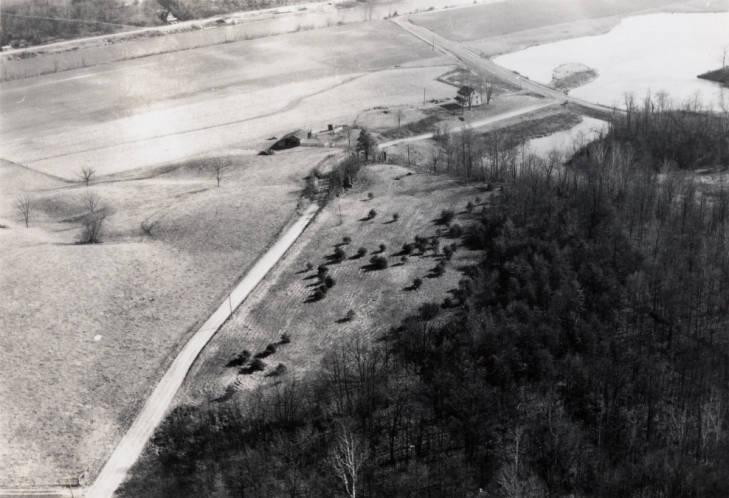
    The site of Fort Gower in a 1974 photograph. The exact location is now evidently under water. (Ohio History Connection)

    More from The 8th Virginia Regiment
    Picture
    Picture
    Picture
  • Published on

    The Regiment's Eight Counties

    Image description
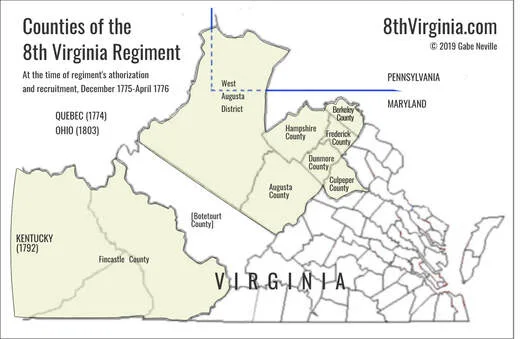
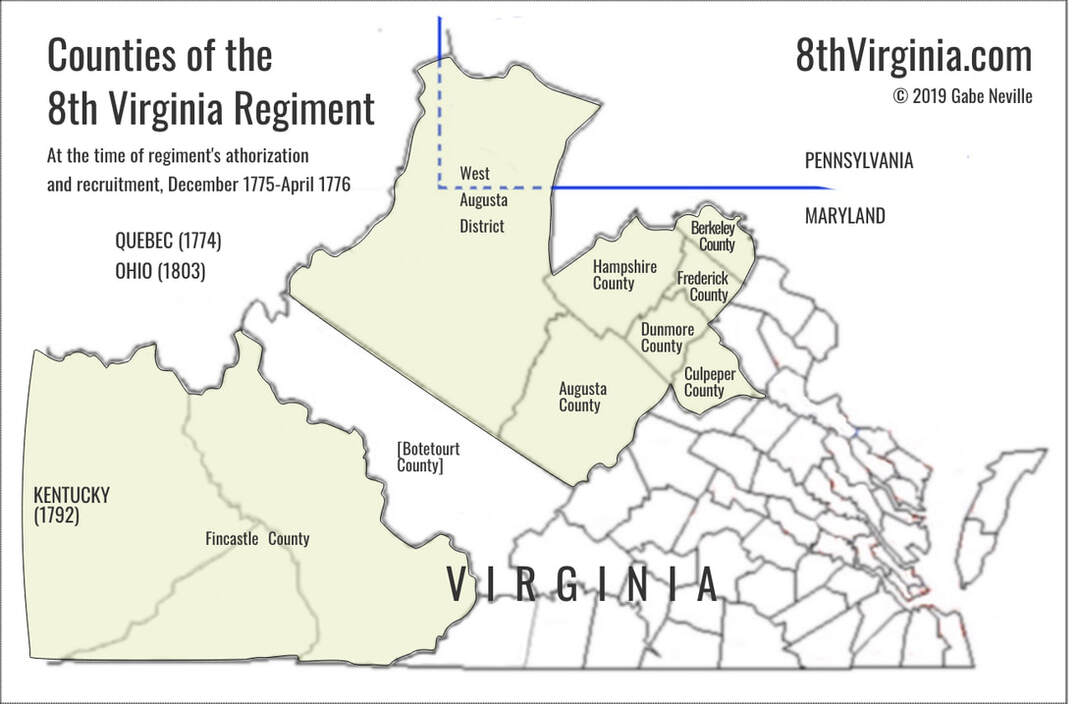
    A newly-created map of the 8th Virginia's recruiting counties shows that the regiment was largely composed of frontiersmen and pioneers. It is helpful to visualize how the regiment raised its ten companies in the westernmost settled areas of the province (Virginia wasn't a state, yet). This made the regiment unique in several ways. They were ethnically and religiously different from the rest of Virginia. Soldiers, some of whom were subsistence hunters, were typically better marksmen than the average soldier. Their motives for fighting were less focused on taxes and trade and more focused on their desires to head west--something the King had forbidden. 

    Political geography has changed. All of these counties have been divided, some within months of the regiment's formation. West Virginia, which is not shown, was created in 1863 and would occupy the left-center of the map. The disputed northeast part of the Augusta District is now southwest Pennsylvania, including Pittsburgh. Western Fincastle County became Kentucky County in 1776 and the Commonwealth of Kentucky in 1792. Most Americans are unaware that beginning in 1774, Ohio and lands west of it were part of the Province of Quebec. This, technically at least, extended holdover French civil institutions to the border of settled Virginia. Quebec had no elected legislature and had been allowed to keep its Catholic institutions. Both facts were seen by Virginians as sure signs of creeping tyranny.

    The Soldiers Page lists the various companies and the counties from which they came. In brief: the West Augusta District and Dunmore County each raised two companies. Augusta, Berkeley, Culpeper, Fincastle, Frederick, and Hampshire counties each contributed one. Initially called the "German Regiment" and long remembered that way, the map also shows how wide-ranging and diverse the zone of recruitment was. The lower (northern) Shenandoah Valley counties of Berkeley, Frederick, and Dunmore had significant populations and all three field officers were from that area. Culpeper, the only Piedmont county, had a smaller German population that descended from the Germanna Colony. The other counties were predominantly Scotch-Irish and English.
    Picture
  • Published on

    What Were They Thinking?

    Picture

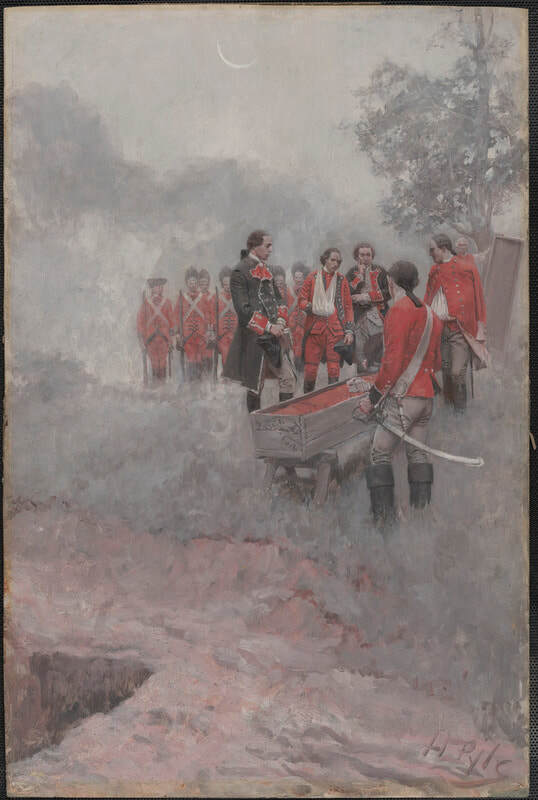
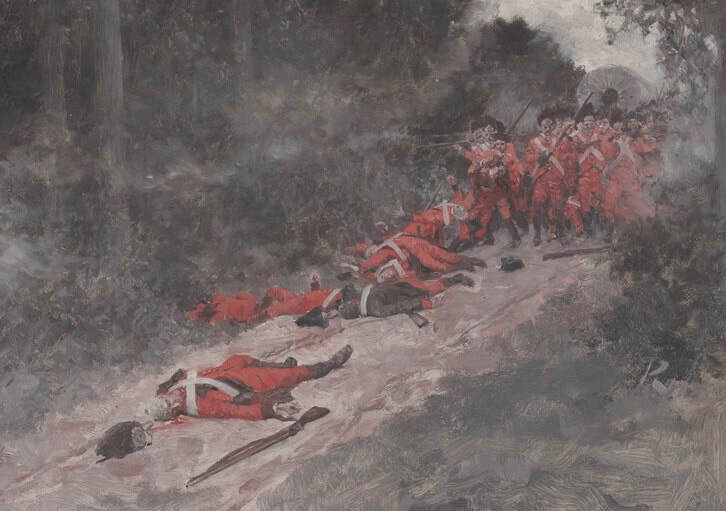
    The burial of Gen. Edward Braddock, by Howard Pyle. (Boston Public Library)

    In 1775, the North American colonies had no professional armies and few leaders with significant military training. What possessed them, then, to believe they could take on the mighty British Empire? Politics and principles aside, two experiences led the Americans to believe they could stand up to the British: the 1745 Siege of Louisbourg and the 1755 Battle of Monongahela. The first dispelled any notion that they were powerless against professional forces. The second dispelled the notion of British invincibility.

    In the 1740s, the maritime French colony of Île-Royale and its fortress at Louisbourg guarded the mouth of the St. Lawrence River. Today, the two main islands of Île-Royale are known as Prince Edward Island (Canada’s smallest province) and Cape Breton Island (part of Nova Scotia). The French and the Wabanaki Indians were a constant threat to New England.

    Multiple conflicts occurred in the pre-Revolutionary northeast, including such little-remembered wars such as King William's War, Queen Anne’s War, and Father Rale’s War. Louisbourg was (and is) positioned on the east coast of Cape Breton and directly east of the modern state of Maine, which was then part of Massachusetts. Louisbourg itself was a threat to New England: it was a center for privateering and well positioned to interfere with New England’s economically crucial fishing industry.

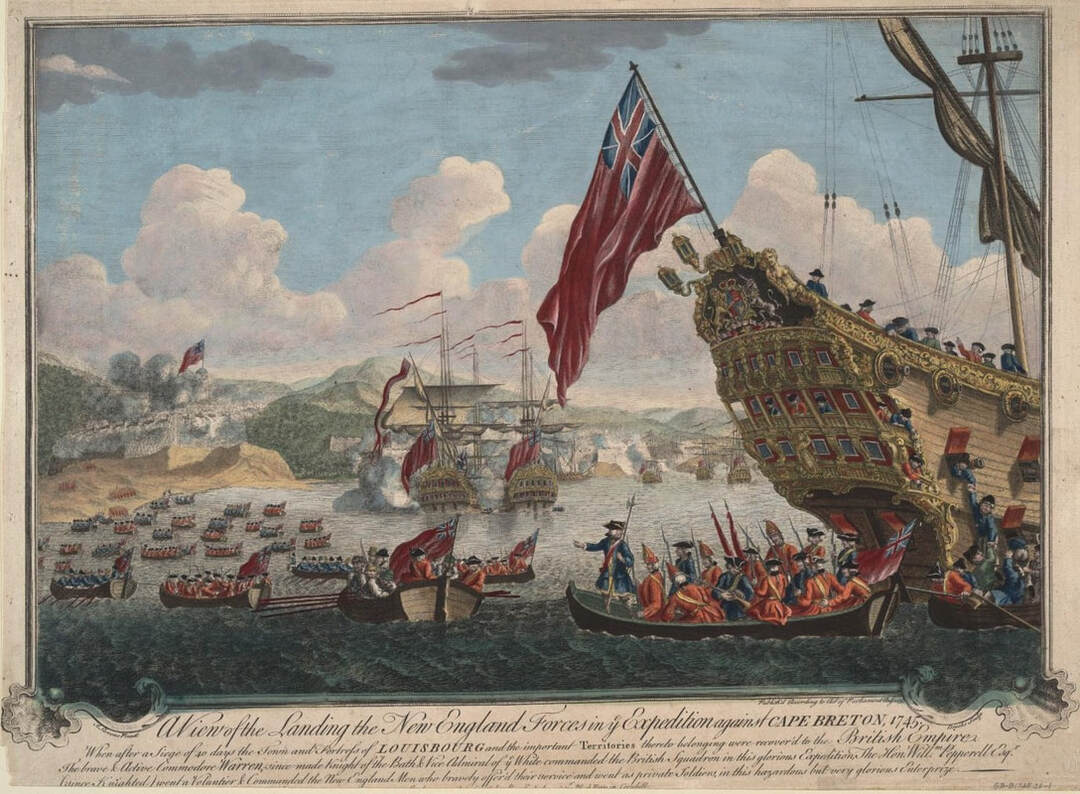
    ​At the start of King George’s War (known in Europe as the War of Austrian Succession) in 1744, a Franco-Indian force raided and destroyed the British fishing village at Canso, in nearby Nova Scotia. In 1745, Massachusetts Governor William Shirley organized a response. Militia from Massachusetts, Connecticut, and New Hampshire set off on an expedition supported with funds and supplies from Rhode Island, New York, and Pennsylvania. While there were no professional soldiers involved, the force did have support from the British Navy.


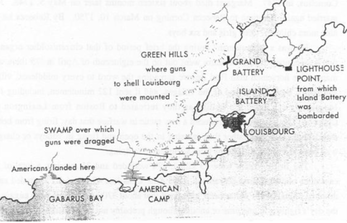
    The Fortress of Louisbourg was thought to be impenetrable from the sea. A land approach, however, provided hilly terrain that allowed for the erection of siege batteries. After a siege of several weeks and a number of raids and skirmishes, the fortress surrendered on June 27, 1745. While the French forces had suffered from poor morale and other issues, the stark fact remained that American militia had taken on and defeated a professional army sheltered in a major fortification. This was well enough remembered that in 1774, the First Continental Congress noted in its Address to the People of Great Britain that it was "chiefly by" the "vigorous efforts" of the people of Massachusetts that "Nova-Scotia was subdued in 1710, and Louisbourg in 1745."
    A decade later, early in the French and Indian War, General Edward Braddock suffered his better-remembered defeat near the banks of the Monongahela. The lesson the American learned from this event was that British redcoats were not invincible. In a report to his mother, Washington wrote, “The Virginia troops showed a good deal of bravery, and were near all killed; for I believe out of three companies that were there, there are scarce 30 men left alive. … In short, the dastardly behavior of those they call regulars exposed all others that were inclined to do their duty to almost certain death; and, at last, in despite of all the efforts of the officers to the contrary, they broke and ran as sheep pursued by dogs; and it was impossible to rally them.”
    Picture

    New England militia land on Cape Breton Island, initiating the Siege of the Fortress of Louisbourg in 1745.

    ​While the British army was humiliated, Washington’s own reputation for heroism was bolstered, in part because of his own reports. “I luckily escaped without a wound,” he wrote, “though I had four bullets through my coat, and two horses shot under me.”

    Louisbourg (1745), Monongahela (1755), and the outbreak of the Revolution itself in 1775 are milestones in the colonists’ increasing confidence in their own military capabilities. Though Louisbourg was remote from Virginia, it was not remote from those who began the war in Massachusetts. Braddocks’ defeat was very much front-of-mind to all Virginians at the start of the war. This must have been especially true for men like the 8th Virginia's Maj. Peter Helphenstine and Capt. Thomas Berry of Winchester (Washington's headquarters during the French and Indian War) and Captains John Stephenson and William Croghan who filled their companies with men from the settlements near the site of the general’s failure.
    Twenty years after Monongahela, Massachusets’ 1775-1776 experiences at Lexington and Concord, Bunker Hill, Ticonderoga, and the Siege of Boston reinforced New England’s view that militia could take on professional troops. Victories won by militia and green provincial troops at Great Bridge and Sullivans Island indicated the same to Virginia and the south.
    Picture

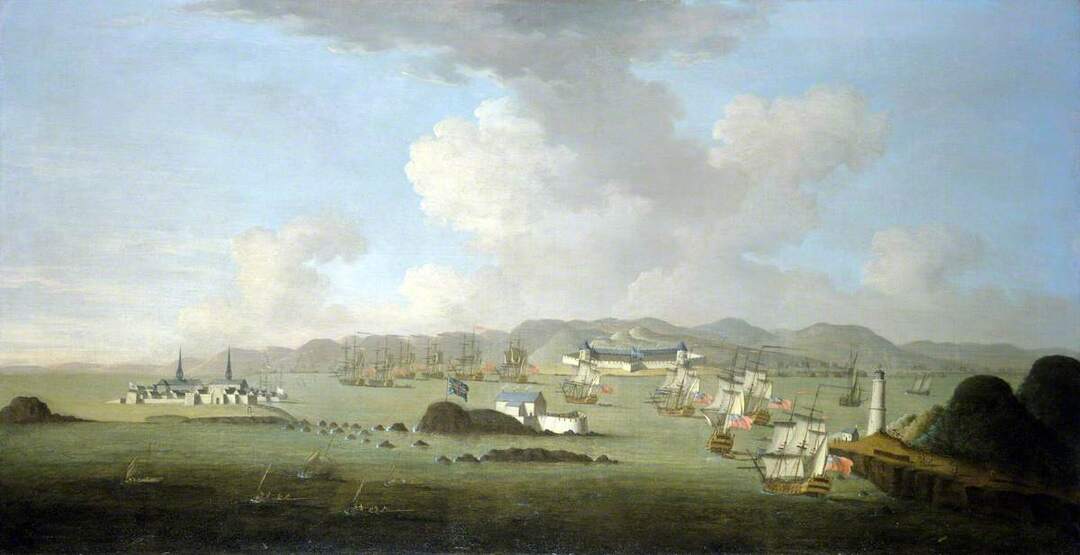
    Sea View of the Siege of Louisbourg by Peter Monamy.

    This elevated view of their militias’ capabilities must be viewed as an important factor in the colonists’ decision to take up arms against the Crown.  It is even more important in view of the prevalent Anglo-American dislike of standing or “regular” armies. Oliver Cromwell had used his “New Model” army to rule by martial law. King James II had attempted to use a standing, professional army to restore the monarchy’s supremacy over parliament. For this is he was deposed and replaced by William and Mary, who accepted a Declaration of Rights (enacted as a “Bill of Rights” in 1689) that specifically forbade standing armies on British soil in peace time.
    Picture

    Map of the Siege of Louisbourg. (Wikimedia Commons)

    When Britain decided to leave a standing army in America after the French and Indian War, the colonists reacted in a way that should have been predictable. Peace-time standing armies had been illegal in Britain for nearly a century, universally seen as a threat to the “rights of Englishmen.” And yet there they were, posted in the colonies and quartered in private homes. Colonial charters had guaranteed the rights of Englishmen to the colonists. This was a clear violation. Virginia’s 1606 charter read, for example:
    "Also we do ... DECLARE ... that all and every the Persons being our Subjects, which shall dwell and inhabit within every or any of the said several Colonies and Plantations, and every of their children, which shall happen to be born within any of the Limits and Precincts of the said several Colonies and Plantations, shall HAVE and enjoy all Liberties, Franchises, and Immunities, within any of our other Dominions, to all Intents and Purposes, as if they had been abiding and born, within this our Realm of England, or any other of our said Dominions."

    Among the 27 indictments against the King in the Declaration of Independence was the charge that “He has kept among us, in times of peace, Standing Armies without the Consent of our legislatures.” When the war began, it was a war between American militia and British regulars. While some might have seen this as an uneven fight, many more saw it as proof of the justice and moral superiority of the American cause.
    The British Army was the most powerful in the world, and there may have been a time when the colonists would not have dared to fight them. In 1775, after the Siege of Louisville, after Braddocks defeat, and with God and Justice on their side, the Americans believed they could win. And they did win, but not until the Continentals themselves were professionalized. Still, consistent with principle, the Continental Army was disbanded at the end of the war.


    Picture

    Braddocks Defeat depicted by Howard Pyle. (Boston Public Library)

    More from The 8th Virginia Regiment