• Published on

    The Battle of Drake's Farm

    Picture

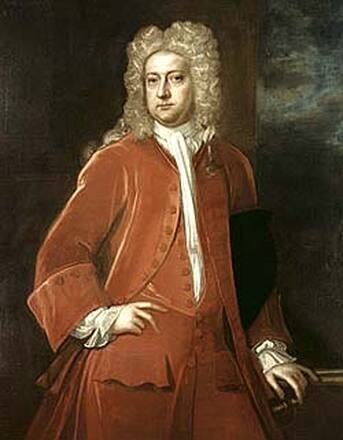
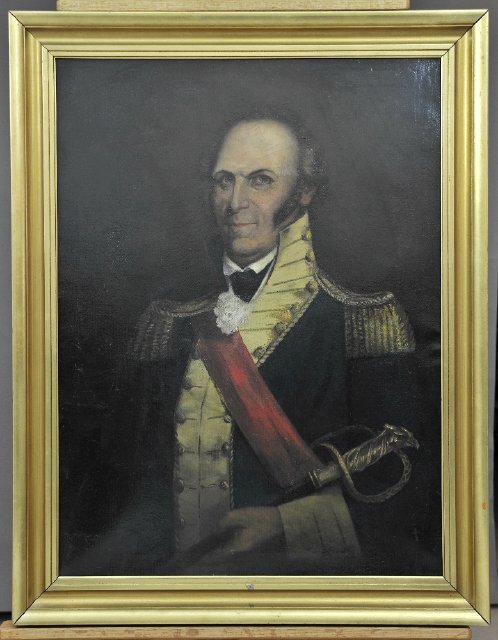
    Col. Charles Scott, depicted here many years later, commanded the Virginia troops at the Battle of Drake's Farm on February 1, 1777. His bold leadership there contrasted sharply with that of Connecticut Col. Andrew Ward, who did not or could not get his troops to engage. Scott was promoted soon after to brigadier general. The 8th Virginia served in his brigade at the battles of Brandywine and Germantown. He later served as governor of Kentucky. (Kentucky Historical Society)

    Thomas McCarty spent his first two days in Morristown drunk. It was January 1777 and he was one of the many 8th Virginia men detached to the 1st Virginia in New Jersey. The regiment was in bad shape. The field officers were all wounded or dead. Captain Croghan had been sick in Philadelphia for months. Lieutenant Kirkpatrick was in command, but even he had been wounded at Princeton. Now the remnant of Washington's army was in Morristown for the winter. Reinforcements would come, but for now most of the army was gone. The remaining men were mostly Virginians on long enlistments and Adam Stephen, newly a general, led the Virginia brigade.

    ​After sobering up, McCarty spent Monday and Tuesday—January 13 and 14—organizing and distributing supplies to the men. He was, he wrote, “sick, most excessive bad.” It wasn’t the first time he wrote that in his diary. Wednesday and Thursday he spent resting in the sergeant major’s quarters. Then he ran to Chatham “about some business” on Friday. On Sunday, he felt the lure of alcohol again. He “took a walk through the country with Mr. Depoe, and bought a barrel of cyder.”
    After a couple of quiet days in quarters, McCarty was ordered to have the men ready to march with three days’ provisions. They marched on Thursday, January 23, to Springfield, where McCarty was able to acquire a store of new shoes, stockings, and breeches. The men, some of whom were barefoot, lined up in the snow for the desperately-needed gear. On Saturday evening, his tasks completed, McCarty once again “took a walk to the country, where I got some cyder and a very good supper.” Quartermastering had definite perquisites. Again, on Sunday, he went “into the country,” took some lodgings and “stayed all day.”

    On Monday, Stephen’s severely understrength brigade headed out to look for the enemy.  McCarty followed behind, responsible for the wagons. “Our Virginia troops had marched, and I got orders from General Stephen to follow on, and I marched to Westfield, and then to Scotch Plains, it being in the night and very muddy. I got lodgings at one Mr. Halsey’s.” There was was a regiment of Connecticut men in the field as well, commanded by Col. Andrew Ward. These were one-year men whose enlistments would be up in May. Ward's men had been begging to go home since December, however, and were beginning to desert. McCarty and his wagons caught up with the Virginians, commanded by Col. Charles Scott, and joined them in taking quarters at Quibbletown, a village known today as New Market. 
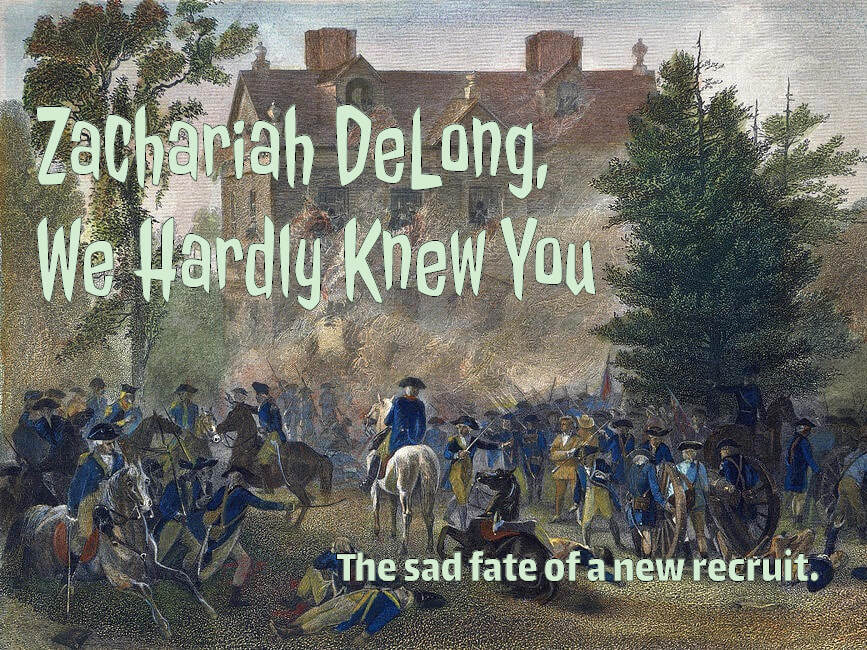
    The next couple of days were spent scouting for enemy foraging parties. Part of Washington's winter strategy was to prevent the British from collecting hay. Less hay over the winter would mean fewer horses for them in the spring—and armies needed horses. Finally, on Saturday, February 1, the Virginians found the fight they had been looking for. They spotted five British light horsemen. They captured an officer, but seventy or eighty balls of lead failed to stop any of the others as they rode away. 

    ​Scott and his ninety or a hundred men were walking into a trap set by the enemy, who had grown tired of having their foraging parties ambushed. Though their officer was not meant to be captured, the small group of mounted men had done their job. The Virginians pursued them to Drake’s Farm, near Metuchen, where they "discovered their main body where they were loading hay.” It was not immediately apparent to the Virginians that they were approaching a much larger force than had previously been sent out to guard foragers. Colonel Ward’s surly Connecticuters were nearby, but it is not clear why and command was not unified. 

    ​Scott was a popular and aggressive officer and his Virginians attacked immediately. They soon realized they were facing two brigades of British and Hessian troops supported by eight artillery pieces. The Continentals were heavily outnumbered, but fought hard anyway, counting on Ward’s men to back them up. They boldly attacked the enemy line and drove back a battalion of grenadiers. “We attacked the body, and bullets flew like hail,” McCarty wrote. The enemy artillery checked their momentum, but they kept fighting anyway for several minutes. “We stayed about 15 minutes, when we retreated with loss. We drove them first, but at our retreat the balls flew faster than ever.”
    Picture

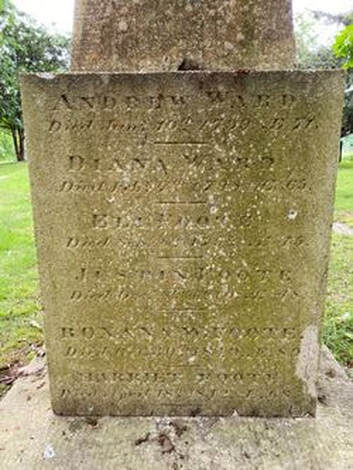
    The grave of Col. Andrew Ward V in Guilford, Conn. Ward's great-great grandfather came to New England with John Winthrop in 1630. He was a veteran of the 1745 Siege of Louisbourg (assisting his father as a boy) and the Battle of Lake George in 1760. Though his regiment fought at White Plains, Trenton, and Princeton, his miserable and poorly-equipped men were deserting and begging to go home as early as December when he wrote to Gov. Jonathan Trumbull asking him to prevail upon Washington to let them go home. He appears to have completely lost control of his regiment by March. Ward left Continental service in May but was later made a brigadier general in the Connecticut militia. He voted against the U.S. Constitution at the state ratification convention in 1788. (Findagrave.com)

    McCarty, like the other Virginians, was furious that Ward’s men didn't support them. “There was a body of above 400 men that never came up to our assistance till we retreated. Then they came up, but too late, and only some.” Their anger was soon directed back at the enemy when it was discovered that some wounded Americans had been murdered on the field. Several enemy soldiers (officers, according to McCarty), “went to the field where we retreated from, and the men that was wounded in the thigh or leg, they dash out their brains with their muskets and run them through with their bayonets, made them like sieves. This was barbarity to the utmost.”

    The murder of the wounded Virginians is confirmed by several sources. General Stephen wrote directly to British general Sir William Erskine to complain that six Virginians “slightly wounded in the muscular parts, were murdered, and their bodies mangled, and their brains beat out, by the troops of his Britannic Majesty.” He warned that such conduct would “inspire the Americans with a hatred to Britons so inveterate and insurmountable, that they never will form an alliance, or the least connection with them.”

    Stephen could think of no better threat than a reprise of Gen. Edward Braddock’s defeat in the French and Indian War. Stephen used his credentials as a survivor of that battle to insult and to intimidate the British general with over-the-top threats of Indian cannibalism.

    I can assure you, Sir, that the savages after General Braddock’s defeat, notwithstanding the great influence of the French over them, could not be prevailed on to butcher the wounded in the manner your troops have done, until they were first made drunk. I do not know, Sir William, that your troops gave you that trouble. So far does British cruelty, now a days, surpass that of the savages.

    In spite of all the British agents sent amongst the different nations, we have beat the Indians into good humour, and they offer their service. It is their custom, in war, to scalp, take out the hearts, and mangle the bodies of their enemies. This is shocking to the humanity natural to the white inhabitants of America. However, if the British officers do not refrain their soldiers from glutting their cruelties with the wanton destruction of the wounded, the United States, contrary to their natural disposition, will be compelled to employ a body of ferocious savages, who can, with an unrelenting heart, eat the flesh, and drink the blood of their enemies. I well remember, that in the year 1763, Lieutenant Gordon, of the Royal Americans, and eight more of the British soldiers, were roasted alive, and eaten up by the fierce savages that now offer their services.


    The fundamental British strategy in the Revolution was to empower Loyalists and to pacify rebels and persuade them to accept offers of amnesty. The plan clearly wasn’t working. Shortly after the Battle of Drake’s Farm, a loyalist wrote home: “For these two month[s], or nearly, we have been boxed about in Jersey, as if we had no feelings. Our cantonments have been beaten up; our foraging parties attacked, sometimes defeated, and the forage carried off from us; all travelling between the posts hazardous; and, in short, the troops harassed beyond measure by continual duty.”
     
    The Forage War was a brilliant (and still-unheralded) success for the Americans. Denying the enemy forage and forcing them to live in close quarters for several months had a cumulatively severe impact on them. Howe had more than 31,000 troops at New York on August 27, 1776. When spring came, he had lost between forty and fifty percent of those men to death, desertion, capture, or disease. That was not sustainable.
    Picture

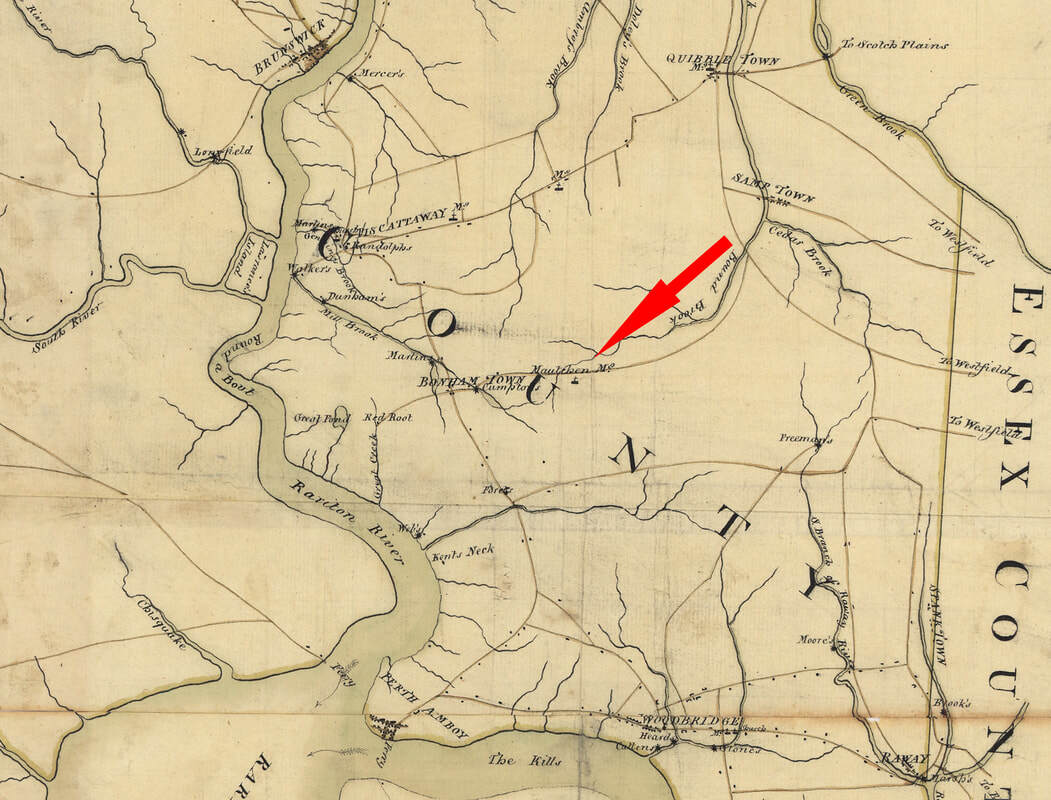
    The Battle of Drake's Farm occurred at nor near Metuchen, N.J., half-way between major British outposts at New Brunswick and Perth Amboy. This 1781 map was drawn four years after the engagement. This map is oriented ninety degrees to the right of standard orientation, with the right facing to the north. (Library of Congress)

    More from The 8th Virginia Regiment
  • Published on

    Three Centuries of Violence

    Picture
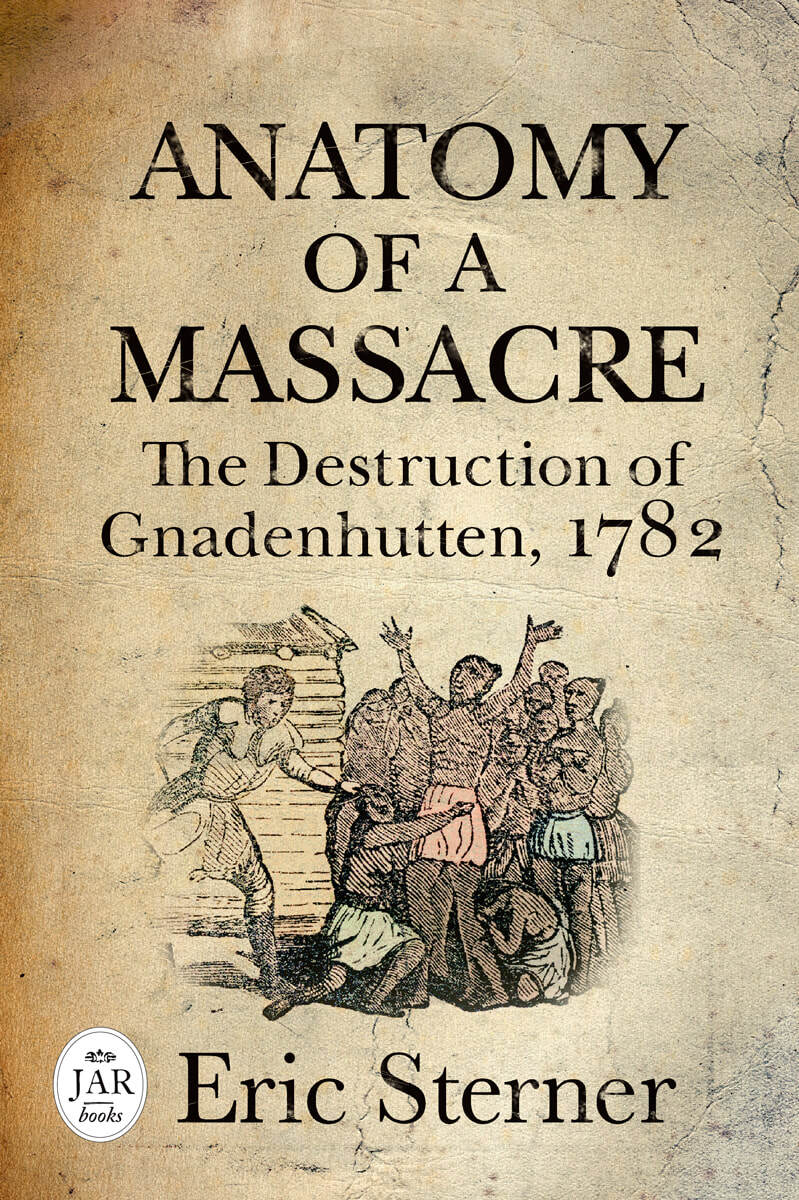
    Anatomy of a Massacre: The Destruction Gnadenhutten, 1782
    Eric Sterner (Yardley, Pa: Westholme, 2020)
    Picture
    In his first book, Anatomy of a Massacre: The Destruction of Gnadenhutten, 1782, Eric Sterner has taken on a difficult subject. Racial violence is something many writers would shy away from while others might delight in the chance to condemn the perpetrators. Mr. Sterner, laudably, does neither. Instead, he seeks to understand what happened.

    It is worth noting that the first known massacre of Indians by white men in what is now the United States occurred long before the events in the book. It happened near Jamestown, Virginia in 1610 when Virginia’s governor, Thomas West, 3rd Baron de la Warr, ordered an attack on the Paspahegh Band of Powhatans. Seventy men attacked the village, killing between 65 and 75 Paspaheghs and kidnapping the village leader’s wife and children. Rowing away, the colonists decided to kill the children, “w[hi]ch was effected by Throweinge them overboard and shoteinge owtt their Braynes in the water.” Three centuries of violence ensued.
    Lord de la Warr’s name appears frequently in Mr. Sterner’s story. His name was given to the Delaware River, which in turn lent its name to the Lenape people who have long been known to English speakers as the Delaware Tribe. Mr. Sterner has provided the definitive account of the worst atrocity of the Revolutionary War. In 1782 more than eighty white settlers clubbed, killed, and scalped ninety-six peaceful, Christian Indians as they prayed and sang hymns. The attack on the Moravian mission town of Gnadenhutten (Ohio) was intended as both a punitive and preemptive strike, conducted by settlers whose families and farms had been targeted by other Indians acting as proxies of the British. It is a horrific story that has defied understanding until now.

    ​...continue to Emerging Revolutionary War Era.

    More from The 8th Virginia Regiment

  • Published on

    The Need for Freedom

    Picture

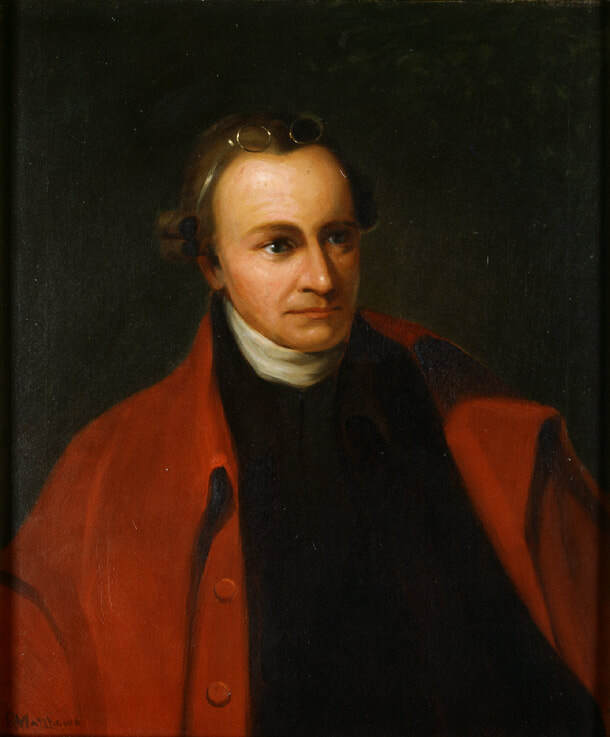
    Patrick Henry was a proponent of religious freedom in Virginia, but also proposed state support for churches.

    The soldiers of the 8th Virginia regiment included Anglicans, Methodists, Lutherans, Reformed, Presbyterians, Baptists. Lieutenant Isaac Israel was probably Jewish. They helped turn Virginia from a religiously intolerant colony with an official, established church into a state that was at the vanguard of establishing religious freedom in America.
     
    The Church of England was deeply integrated into the government and society of colonial Virginia. Property owners paid taxes to support it, and it performed important functions like recording vital statistics and caring for orphans. Non-Anglicans had to pay for marriage licenses, but county clerks were under no obligation to record their marriages.  Dissenting churches were not welcome and their clergy were sometimes imprisoned or physically assaulted. 
    The Old Dominion’s most influential colonial governor, William Berkeley (1642-1652 and 1660-1677) was “bitterly hostile” to religious nonconformists, especially Puritans and Quakers. A law was enacted under his leadership to “preserve the Established Church’s Unity and purity of doctrine” by punishing any dissenting minister who attempted to preach in Virginia. During the reign of William and Mary, the Toleration Act of 1688 allowed non-Catholic ministers to preach under certain conditions, a change that applied to Virginia. When the Revolution broke out nearly a century later, however, religious dissenters in the colony still hadn’t gained much beyond being tolerated. 
    On the western side of the Blue Ridge Mountains, however, things were different. Unlike the tidewater and piedmont areas of Virginia, the Shenandoah Valley was largely settled by German and Anglo- or Scotch-Irish immigrants who came inland on the Great Wagon Road from Pennsylvania. This brought Presbyterian, Lutheran, German Reformed, Quaker, Baptist, and Mennonite congregations into the colony. Collectively they made a regional majority, but their members still had to tithe to the English church, couldn’t hold public office, and had to build their churches in the countryside or on the edge of town.

    The government in Williamsburg allowed these dissenters to settle the Shenandoah Valley because they wanted to create a buffer between the older areas of Virginia and the dangers that existed in the wilderness: the Indians and the French. By the time the Revolution began, the valley was well-settled but culturally distinct from the areas east of the Blue Ridge.
    Picture

    Sir William Berkeley, Governor of Virginia (1642-1652, 1660-1677).

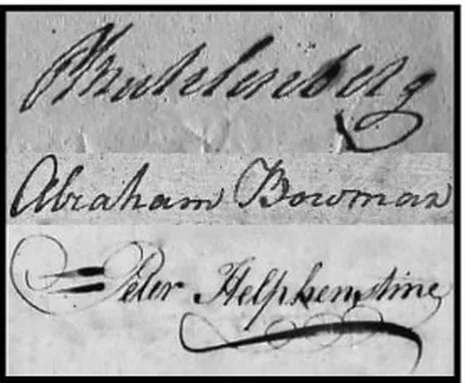
    The selection of Peter Muhlenberg as colonel of the 8th Virginia was clearly an effort to gain the support of the valley’s Germans for the cause. So too was the selection of Abraham Bowman for lieutenant colonel: he was the grandson of Jost Hite, who had led one of the first groups of German settlers to Virginia from Pennsylvania. Major Peter Helphenstine, the oldest but most junior of the three field officers, had immigrated to the valley from Germany as an adult. As residents of Woodstock, Strasburg, and Winchester, respectively, the three men also covered the geography of the heavily German lower (northern) Shenandoah Valley. Settlers in the upper (southern) Shenandoah Valley; the New and Holston river valleys of southwest Virginia; and the region around Fort Pitt in what is now southwestern Pennsylvania were also recruited for the regiment. Scotch-Irish Presbyterians predominated in these areas and were, at least by reputation, already willing to fight.
    Picture

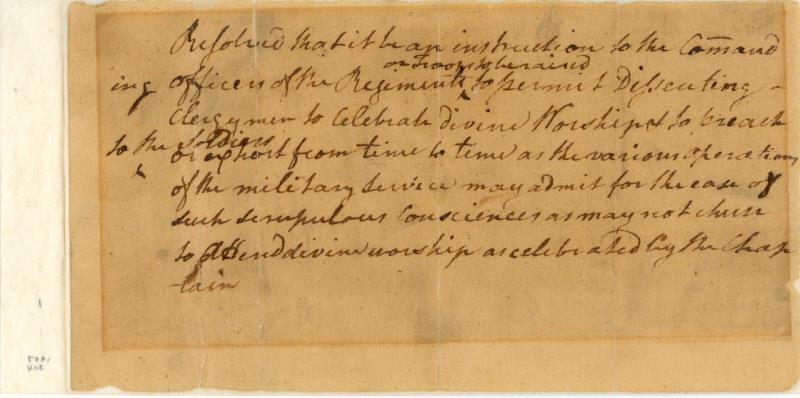
    Patrick Henry's 1775 resolution. (Library of Congress)

    For the first time, Virginia’s coastal elite needed to proactively accommodate and attract the Old Dominion’s western settlers. These western Virginians were typically good marksmen and many of them were experienced warriors with fresh experience from Lord Dunmore’s 1774 war against the Shawnee. The creation of a “German” regiment (which was probably about half Scotch-Irish) was only one way that the revolutionary Virginia Convention accommodated and wooed the colony’s religious minorities.
    On August 16, 1775, several months before the 8th Virginia was authorized, the Third Virginia Convention adopted a resolution offered by Patrick Henry to grant the Baptists’ request to have their own military chaplains and excuse Baptist soldiers from attending Anglican services. The following summer, while the 8th was serving in the Carolinas, the Fifth Virginia Convention adopted the Virginia Declaration of Rights. This precursor to both the Declaration of Independence and the Bill of Rights proclaimed that “all men are equally entitled to the free exercise of religion, according to the dictates of conscience; and that it is the mutual duty of all to practice Christian forbearance, love, and charity toward each other.”
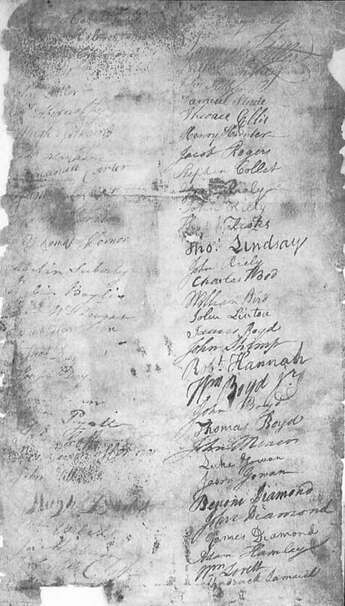
    It would take some time for Virginia’s actions and practices to match the Convention’s words. That fall, ten thousand Virginians signed a petition circulated by the Baptists requesting religious equality and the disestablishment of the Anglican Church in Virginia. The document was 125 pages long, sewn together, and joined with wax seals.
     
    Virginia was not alone in the colonial period in practicing religious (or religiously-based) discrimination. Massachusetts in the 1600s was a virtual theocracy. Four people on three occasions were hanged to death for being Quakers. Many others were flogged and expelled from the colony. Conversely, in Pennsylvania (which had no established church), the Quaker Party—a political faction—clung to power until the Revolution by refusing to create new legislative districts in the colony’s growing western regions. 

    North Carolina and Maryland were the first to disestablish the Church of England, both in 1776. However, Virginia suspended tithes for support of the church the same year and was at the forefront of articulating the importance of religious freedom during and after the Revolution. 
    Picture

    A signature page from the Ten Thousand Name Petition. (Library of Congress)

    The Virginia Statute for Religious Freedom was drafted in 1777 by Thomas Jefferson and enacted into law in 1786, formally disestablishing the Church of England (known thereafter as the Episcopal Church). Massachusetts was the last state to disestablish its state church, a predecessor of today’s United Church of Christ, in 1833.
    The Virginia Statute for Religious Freedom
    [Drafted 1777, Enacted 1786]

     
    Whereas, Almighty God hath created the mind free;
     
    That all attempts to influence it by temporal punishments or burthens, or by civil incapacitations tend only to beget habits of hypocrisy and meanness, and therefore are a departure from the plan of the holy author of our religion, who being Lord, both of body and mind yet chose not to propagate it by coercions on either, as was in his Almighty power to do,

    That the impious presumption of legislators and rulers, civil as well as ecclesiastical, who, being themselves but fallible and uninspired men have assumed dominion over the faith of others, setting up their own opinions and modes of thinking as the only true and infallible, and as such endeavouring to impose them on others, hath established and maintained false religions over the greatest part of the world and through all time;
     
    That to compel a man to furnish contributions of money for the propagation of opinions, which he disbelieves is sinful and tyrannical;
     
    That even the forcing him to support this or that teacher of his own religious persuasion is depriving him of the comfortable liberty of giving his contributions to the particular pastor, whose morals he would make his pattern, and whose powers he feels most persuasive to righteousness, and is withdrawing from the Ministry those temporary rewards, which, proceeding from an approbation of their personal conduct are an additional incitement to earnest and unremitting labours for the instruction of mankind;
     
    That our civil rights have no dependence on our religious opinions any more than our opinions in physics or geometry,
     
    That therefore the proscribing any citizen as unworthy the public confidence, by laying upon him an incapacity of being called to offices of trust and emolument, unless he profess or renounce this or that religious opinion, is depriving him injuriously of those privileges and advantages, to which, in common with his fellow citizens, he has a natural right,
     
    That it tends only to corrupt the principles of that very Religion it is meant to encourage, by bribing with a monopoly of worldly honours and emoluments those who will externally profess and conform to it;
     
    That though indeed, these are criminal who do not withstand such temptation, yet neither are those innocent who lay the bait in their way;
     
    That to suffer the civil magistrate to intrude his powers into the field of opinion and to restrain the profession or propagation of principles on supposition of their ill tendency is a dangerous fallacy which at once destroys all religious liberty because he being of course judge of that tendency will make his opinions the rule of judgment and approve or condemn the sentiments of others only as they shall square with or differ from his own;
     
    That it is time enough for the rightful purposes of civil government, for its officers to interfere when principles break out into overt acts against peace and good order;
     
    And finally, that Truth is great, and will prevail if left to herself, that she is the proper and sufficient antagonist to error, and has nothing to fear from the conflict, unless by human interposition disarmed of her natural weapons free argument and debate, errors ceasing to be dangerous when it is permitted freely to contradict them:
     
    Be it enacted by General Assembly that no man shall be compelled to frequent or support any religious worship, place, or ministry whatsoever, nor shall be enforced, restrained, molested, or burthened in his body or goods, nor shall otherwise suffer on account of his religious opinions or belief, but that all men shall be free to profess, and by argument to maintain, their opinions in matters of Religion, and that the same shall in no wise diminish, enlarge or affect their civil capacities. And though we well know that this Assembly elected by the people for the ordinary purposes of Legislation only, have no power to restrain the acts of succeeding Assemblies constituted with powers equal to our own, and that therefore to declare this act irrevocable would be of no effect in law; yet we are free to declare, and do declare that the rights hereby asserted, are of the natural rights of mankind, and that if any act shall be hereafter passed to repeal the present or to narrow its operation, such act will be an infringement of natural right.

    More from The 8th Virginia Regiment

  • Published on

    Many Men Have Died in Darkness

    Picture
    On January 13, 1777 future President John Adams went for a walk in Philadelphia. He was, at the time, a delegate to the Continental Congress. After returning to his lodgings he wrote:

    "I have spent an hour this morning in the Congregation of the dead. I took a walk into the 'Potter's Field,' a burying ground between the new stone prison and the hospital, and I never in my whole life was affected with so much melancholy. The graves of the soldiers, who have been buried, in this ground, from the hospital and bettering-house, during the course of last summer, fall and winter, dead of the small pox and camp diseases, are enough to make the heart of stone to melt away! The sexton told me that upwards of two thousand soldiers had been buried there, and by the appearance of the grave and trenches, it is most probable to me that he speaks within bounds. To what causes this plague is to be attributed, I don't know--disease had destroyed ten men for us where the sword of the enemy has killed one!" 
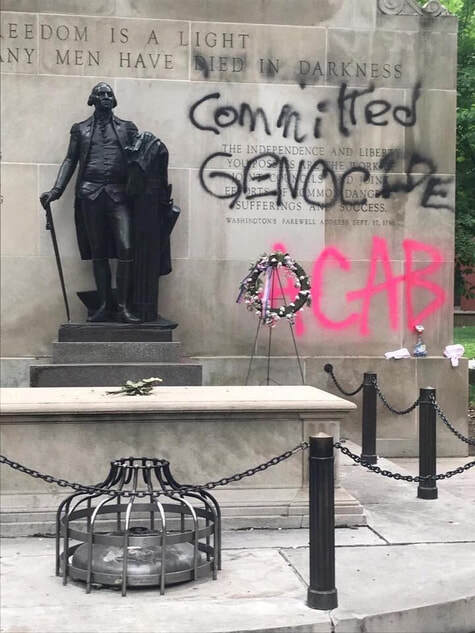
    Philadelphia's recently defaced Tomb of the Unknown Soldier is not a memorial for George Washington (though it is located in Washington Square). It is a memorial for the two or maybe three thousand penniless soldiers who are buried there in mass graves. Each was fighting for freedom at a time when a better understanding of freedom and equality was only just dawning on humanity. The evident majority who died of smallpox suffered more than most modern people can comprehend. They died for the principle that "all men are created equal" (the Declaration of Independence, written in 1776) and so that we might have the right "peaceably to assemble" and to "petition the Government for redress of grievances" (the 1st Amendment, written in 1791).

    "Black lives matter" has essentially the same meaning as "all men are created equal." Both are true statements. The newer slogan, however, is also a Declaration that the "arc of history" has farther to bend until it achieves justice. That is also true. Ask any member of "Mother Emanuel" AME Church in Charleston or the families of Ahmaud Arbery and George Floyd.

    We have a better understanding of freedom and equality today than America's founding generation had. But you have to walk before you can run, and the men buried in Washington Square were among the very first common people on Earth to walk upright and proudly in defense of human and civil rights. Today, most of the world is still trying to catch up.

    ​We can't let up now, however. We have farther to go.

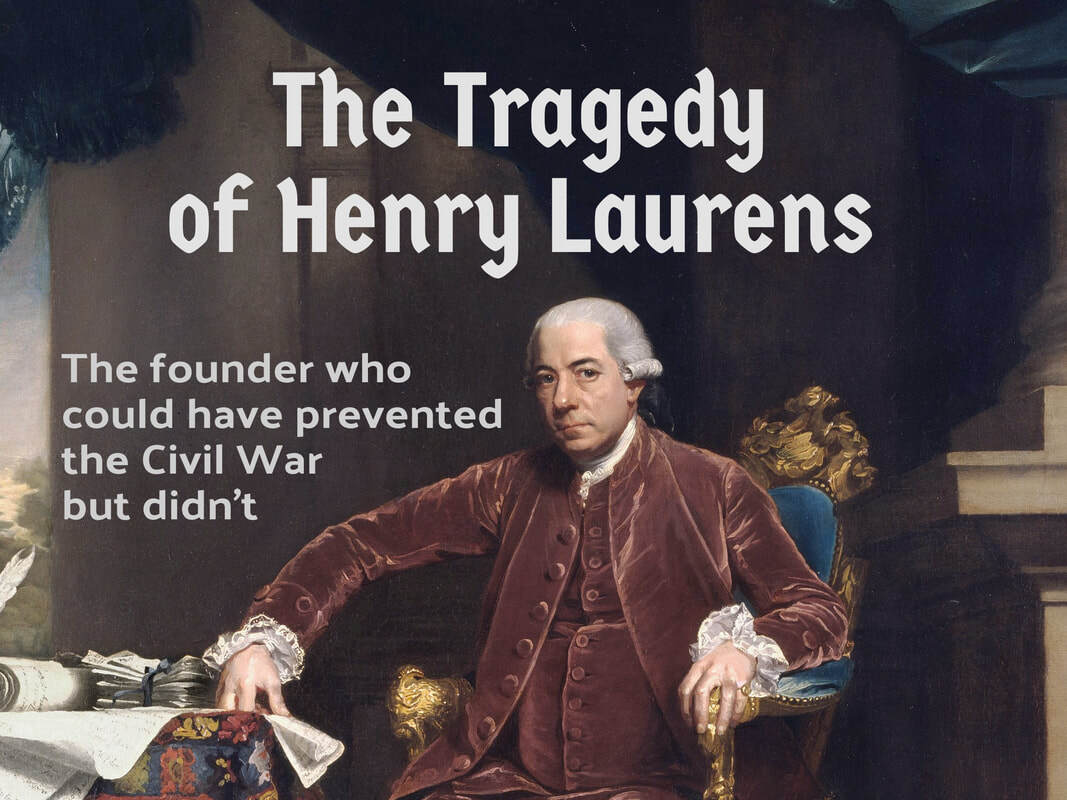
    Read More: "The Tragedy of Henry Laurens" (August 1, 2019)

    More from The 8th Virginia Regiment
  • Published on

    Three Germans: The Regiment's Field Officers

    Image description
    Why Germans? The 8th Virginia Regiment of Foot was authorized by the revolutionary Virginia Convention on December 13, 1775. It had no numeric designation yet, but was intended to be unique in two ways. It would be ethnically-based and all of its men would carry rifles. It was conceived as a “battalion” to “be composed of Germans, with German officers.”
     
    The concept may have originated with the Rev. Peter Muhlenberg and Jonathan Clark, both delegates from Dunmore County in the Shenandoah Valley. Dunmore (now called Shenandoah County) was the cultural hub of German life in the Valley. It is inconceivable that the resolution could have been drafted without the involvement of at least Muhlenberg and probably of Clark as well. Muhlenberg was the Rector of Beckford Parish, the geography of which was identical to that of Dunmore County. His church was at Woodstock, the county seat. He was, however, more than just the community’s pastor. He was the son of the patriarch or the Lutheran Church in America, whose church was in the village of Trappe near Philadelphia. Clark was the county’s deputy clerk, an important job, under Thomas Marshall (soon to be colonel of the 3rd Virginia Regiment and father of future Chief Justice John Marshall).

    The Shenandoah Valley’s Germans had nearly all come the way Muhlenberg had: down the Great Philadelphia Wagon Road to Virginia. The road passed through communities that remain heavily German to this day, such as Lancaster, Pennsylvania. Scotch-Irish immigrants followed the same route, but tended to settle farther south in the Valley, around Staunton and Augusta County. 

    Lutheran Germans like Muhlenberg were seen by the Virginia gentry as reasonably reliable and trustworthy. Their theology differed little from the Church of England. Muhlenberg had, in fact, gone to London to be ordained before taking his position in Woodstock. (King George III was himself of German descent and his great grandfather, George I, couldn’t speak English when he took the throne.) The Ulster Irish, however, were less trusted. They were theological dissenters and often politically radical. Their Calvinist faith differed in important ways from Anglicanism. They could, however, be counted on to fight
    The ordinance creating the 8th Virginia and the selection of field officers that followed it suggest that what the convention really meant by calling it “German” was that Germans would command it (and that the Irish would not). Muhlenberg was the perfect candidate for such a role. He and Clark both served as officers in the regiment, something that may well have been predetermined. Muhlenberg would be the top officer and Clark would command one of Dunmore County’s two companies (the German one).
    Picture

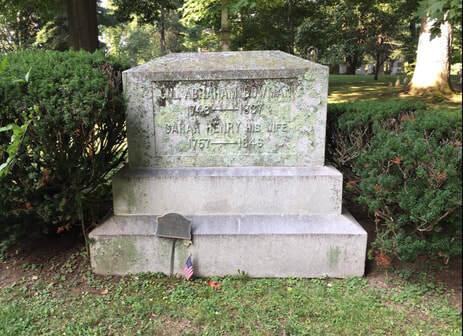
    The lichen-encrusted grave of Abraham Bowman in Lexington, Kentucky. No portraits of Bowman or Helphenstine survive. Though Helphenstine is known to be buried in the Lutheran section of Winchester's Mount Hebron Cemetery, there's no surviving marker. It may be that his destitute widow was not able to afford a stone memorial. (author)

    “And be it farther ordained,” read the resolution, “That of the six regiments to be levied as aforesaid, one of them shall be called a German regiment, to be made up of German and other officers and soldiers, as the committees of the several counties of Augusta, West Augusta, Berkeley, Culpeper, Dunmore, Fincastle, Frederick, and Hampshire (by which committees the several captains and subaltern officers of the said regiment are to be appointed) shall judge expedient.”
    Picture

    Peter Muhlenberg portrayed at the end of the war as a brevet Major General.

    Muhlenberg and Bowman were both too young to have participated in the French and Indian War as most of Virginia’s other senior officers had. Muhlenberg had spent some time in a British military unit after dropping out of seminary in Germany years before. Bowman had experienced at least one dangerous encounter with Indians as a teenager. It is fairly clear that in choosing them the Convention prioritized their ability to rally and unite the Shenandoah Valley over their fairly meager military experience. Patrick Henry was the only other appointed colonel who had no real military experience.

    When they received their commissions Muhlenberg was twenty-nine years old and Bowman was twenty-six. The regiment’s major was Peter Helphenstine, a German from Winchester in Frederick County. He was about twice Bowman’s age, in his middle fifties. He had commanded a company in the governor’s division during Lord Dunmore’s War in 1774. He was a respected tradesman and an active Lutheran.
    Below them, the officers of the ten companies—captains, lieutenants and ensigns—were a diverse group. English, German, and Scotch-Irish were most common. Capt. Abel Westfall of Hampshire County was Dutch, though his family had been in America for generations. Lieut. Jacob Rinker was Swiss. Lieut. Isaac Israel was Jewish. Religiously, though it is hard to trace, they were mostly Anglican, Lutheran, German Reformed, Presbyterian, and probably Baptist. If there were no Methodists, some of them—including Capt. Westfall—would become Methodists soon.
    ​`
    The diversity of the officers reflected the diversity in the rank and file. The 8th Virginia was a microcosm of the Continental Army at large. It was America’s original “melting pot.” Originally divided by race and religion, their shared hardships would soon make them a band of brothers.

    ​The committees were generally dominated by English elites and could be counted on to appoint the right kind of company officers. Only two of ten companies had Irish captains: Fincastle County and the West Augusta district (both on the frontier) selected James Knox and William Croghan. Both were capable and loyal officers.


    The choice of field officers, however, was up to the Virginia Convention and it chose three Germans as it had planned. Each was from a different down in the lower (northern) Shenandoah Valley. Muhlenberg was appointed to be the colonel. Abraham Bowman of Strasburg (also in Dunmore County) was appointed to be the lieutenant colonel. Bowman came from a prominent family. His grandfather, Jost Hite, had led the first group of German settlers into the valley from Pennsylvania in 1731.  

    More from The 8th Virginia Regiment

    Picture
    Picture
    Picture
  • Published on

    Germanna and the 8th Virginia

    Image description
    Virginia was described as the the "most English" of the colonies. It had been consistently loyal to the Crown, even during the era of Parliamentary rule under Oliver Cromwell. The Church of England was integrated into the local government. 

    Virginia's frontier territories were different. When the Revolutionary War started, the Virginia Conventioned designated the 8th Virginia to be a "German" regiment. Thousands of Pennsylvania Germans had settled in the Shenandoah Valley. But how German was it really? There were also many Protestant Irish ("Scotch-Irish") and English settlers in the area, and the actual recruitment territory stretched all the way to Pittsburgh.

    On September 12, Gabe Neville spoke at Virginia's Germanna Foundation to explore the question: "Just how German was the regiment in reality?"
    Picture
    Picture
    Picture