• Published on

    8th Virginia Command Sequence

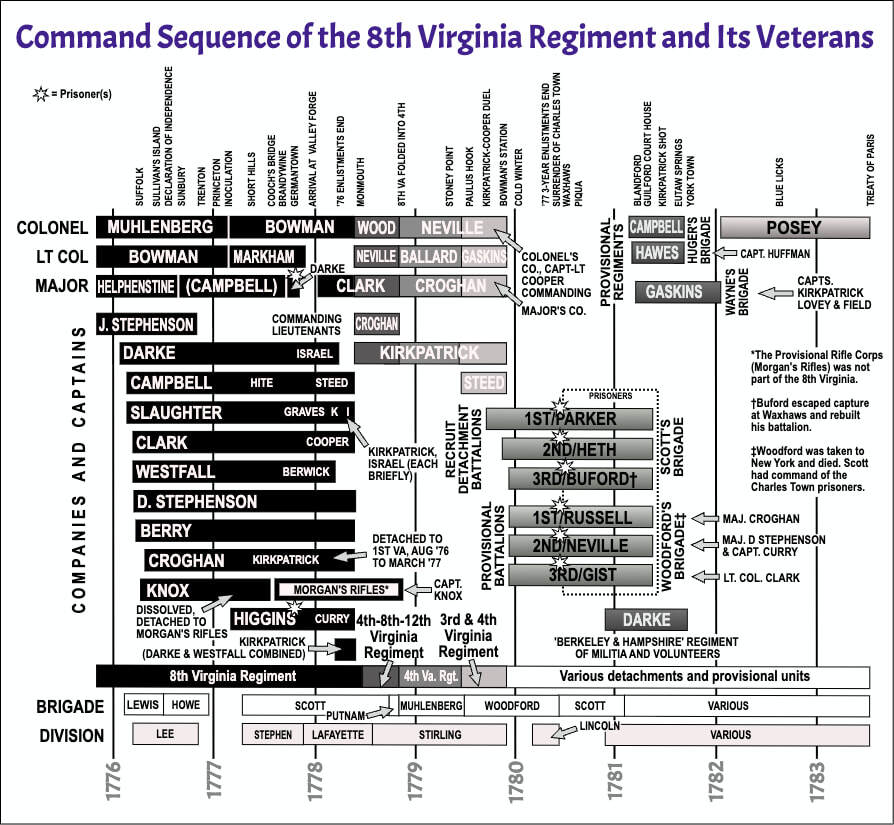
    Promotions, rank disputes, and command changes make tracing the careers of individual soldiers, and even whole companies, difficult. This chart illustrates command changes over the 8th Virginia's existence and continues to the end of the war with the inclusion of various late-war units the regiment's veterans served in. This will be useful reference for anyone reading The Last Me Standing: The 8th Virginia Regiment in the American Revolution.
    Picture

    More from The 8th Virginia Regiment

  • Published on

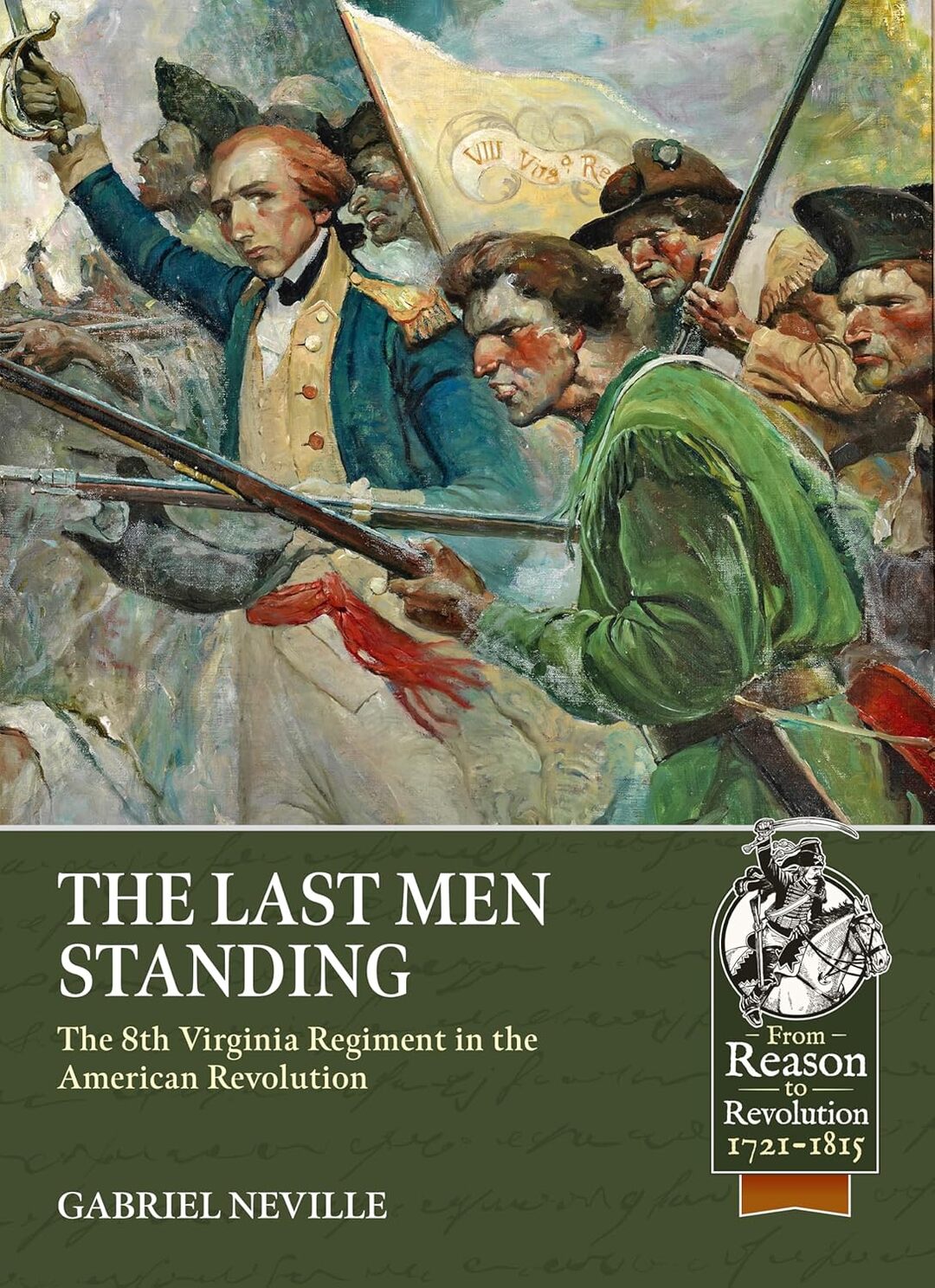
    The Last Men Standing: The 8th Virginia Regiment in the American Revolution.

    Early orders create “buzz,” so consider buying yours now.

    {The final price won't be set until it goes to print and may be lower.}
    After years of research, the complete history of the 8th Virginia Regiment will finally be published this spring. Gabriel Neville’s book The Last Men Standing: The 8th Virginia Regiment in the American Revolution is scheduled for release on May 31. The book will be the first of its kind, focusing on the actual Revolutionary soldiers from their childhoods to their last days on the frontier. Every identifiable man who served in the regiment is listed.
    ​​The 8th Virginia Regiment was unique in the Continental Army, and its story has never been fully told. This is a book that was once thought impossible to write.
    ​The regiment is famous for its first colonel, the “fighting parson,” Peter Muhlenberg. However, there is much more to the story than the well-known story of Muhlenberg’s final sermon. The 8th Virginia was multi-ethnic, and its very existence tied north with south and east with west in a way that contributed meaningfully to national unity. About 800 men signed up to fight early in 1776. By the end of the war, only a few of them remained.
    Their story is different from the usual narrative. They were Western men who cared more about Kentucky and Ohio than the tax on tea. They were the original pioneers, setting cultural precedents that became fixtures in Western movies: fringed shirts, long rifles, migration trails, Conestoga wagons, Indian fighting, dueling, and buffalo hunting. To go west, though, they first had to fight in the east.
    George Bancroft called them "one of the most perfect battalions of the American Army." Major General Charles Lee called them “a most excellent regiment” and chose them first for Continental service “in preference to any other.” Two of its men rose from private to general over the course of their full military careers.
    "I fought in our Revolutionary War for liberty."
    —Sgt. John Vance
    The Virginia Convention initially intended the 8th Virginia to be a "German Regiment." It raised several companies in the Shenandoah Valley, where thousands of Germans had migrated along the Great Wagon Road from Pennsylvania. Thousands of Scotch-Irish immigrants had come the same way, and they enlisted in equal measure. One 8th Virginia man, Sergeant John Vance, declared, "I fought in our Revolutionary War for liberty."

    ​Frequently divided and detached, the regiment’s men served almost everywhere: Charleston, White Plains, Trenton, Princeton, Short Hills, Cooch's Bridge, Brandywine, Saratoga, Germantown, Valley Forge, and Monmouth.  They suffered, and many died from frostbite, malaria, smallpox, malnourishment, musket balls, bayonets, and cruel imprisonment. Their numbers dwindled until only a few remained to help corner Charles Cornwallis at Yorktown. Victorious, those who survived turned west to build the America we know.
     
    The Last Men Standing includes over a hundred color and black-and-white illustrations, twenty maps, and an appendix listing every identifiable man who served. It will be published by Helion & Company and is now available for pre-order. It is available at Amazon and other retailers, or from The Fort Plain Museum at a generous discount.
    "...one of the most perfect battalions of the American Army."
    —George Bancroft
  • Published on

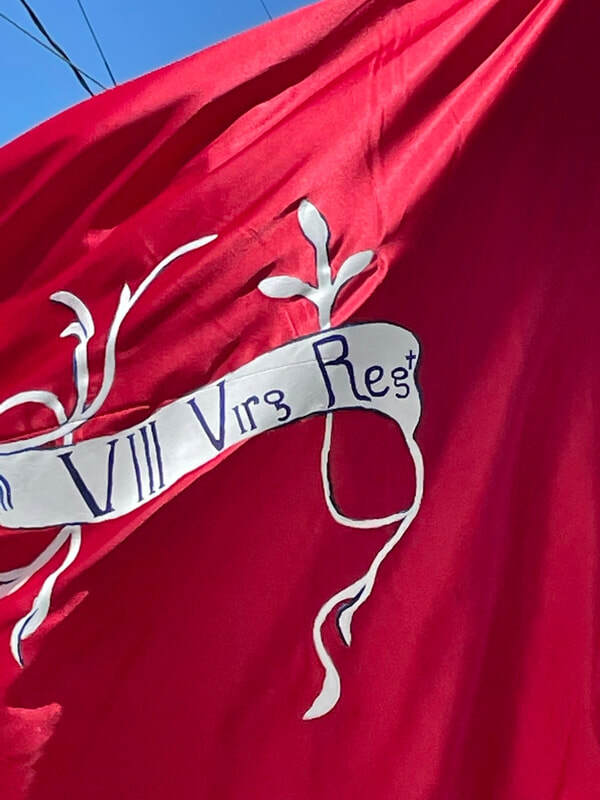
    The “Grand Division Standard” of the 8th Va.

    Picture

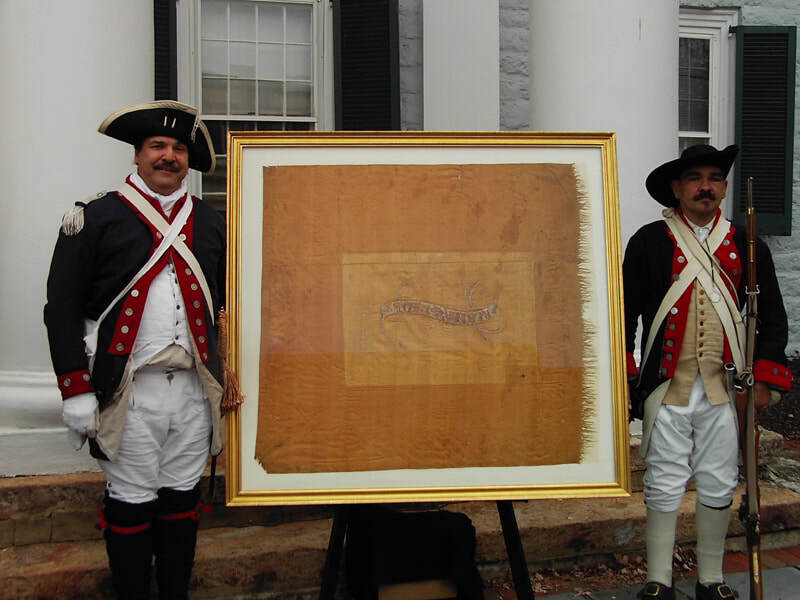
    Rob Andrews and Erik Dorman guard an 8th Virginia division standard in front of the Shenandoah County Courthouse in Woodstock, Virginia in 2012. (Courtesy of Rob Andrews)

    Authentic Revolutionary War-era flags are incredibly rare artifacts, and the ones that survive are sometimes misunderstood. A case in point is a flag associated with the 8th Virginia that is privately owned but currently on public display.
     
    Regimental flags were not just symbols—they were, like fifes and drums, used for command and control on the battlefield. Noise, confusion, and black-powder smoke could make it hard for individual soldiers to know what they were supposed to be doing. Failure to stay in formation could quickly lead to a loss on the battlefield. Large, waving, colorful flags helped prevent that from happening.
    While the Grand Union flag and the Stars and Stripes may have appeared on some battlefields, they were more likely to be seen on forts and ships. Virginia had no state flag until the Civil War. Every regiment, however, had a flag that served important symbolic and battlefield purposes. Regimental flags were unique works of art, often featuring symbols from antiquity or popular culture with mottos in English or Latin. The flags of the 1st Pennsylvania Regiment and Connecticut’s 2nd Continental Light Dragoons are among the very few that survive.

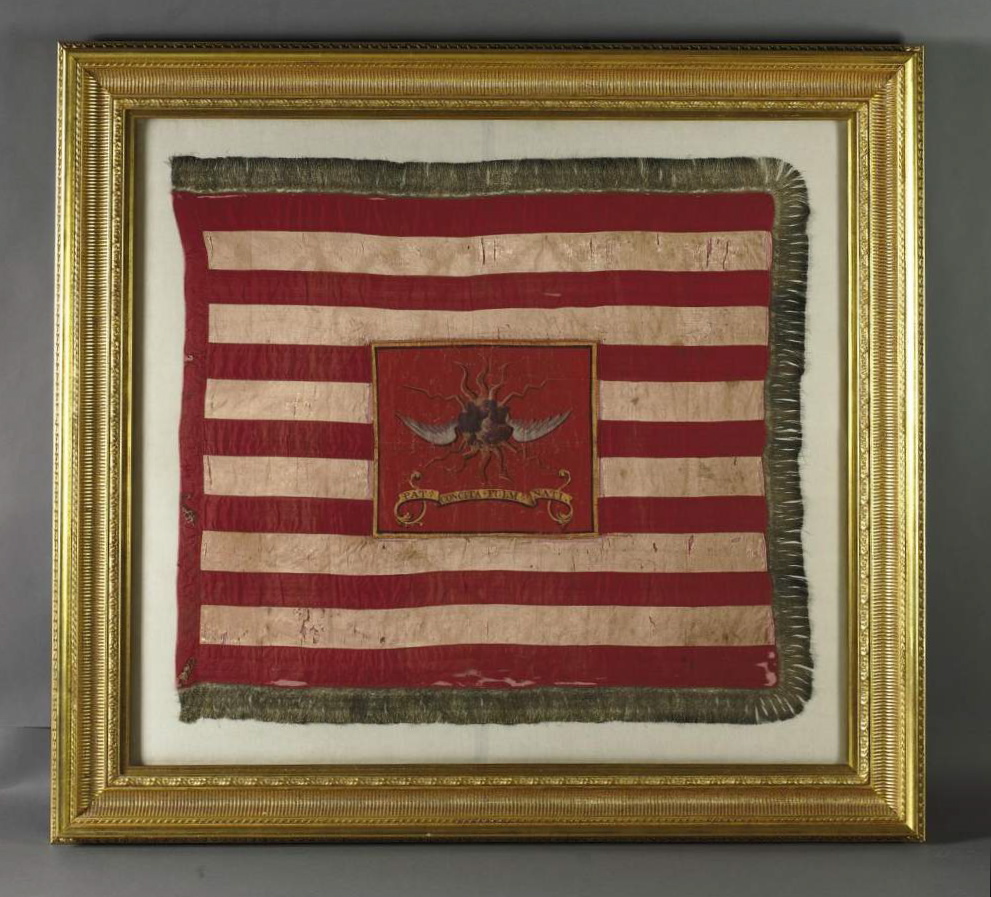
    ​There is, however, an 8th Virginia flag that still exists—but it is not the regimental banner. It is a “grand division standard,” one of two that were used to direct halves of the regiment on the battlefield. These were utilitarian devices with little ornamentation. The most important thing about them was their color. 
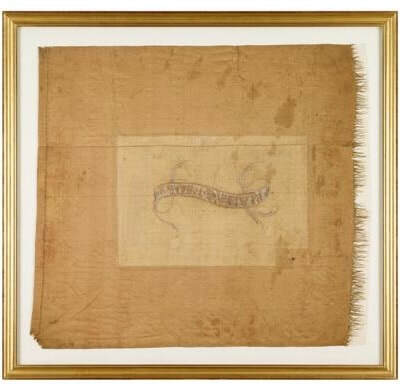
    The surviving 8th Virginia division standard was hidden from public view for 150 years. “The first time I heard of the 8th Virginia Standard was during an internet search on the 8th,” reported Rob Andrews, an SAR member and Revolutionary War reenactor with the 1st Virginia Regiment in 2015. What he found was an 1847 reference in the Richmond Whig.  The newspaper quoted Peter Muhlenberg’s great nephew saying, “The regimental color of this corps (8th Virginia Regiment of the Line) is still in the [my] possession.  It is made of plain salmon-colored silk, with a broad fringe of the same, having a simple white scroll in the centre, upon which are inscribed the words, ‘VIII Virga. Reg’t.’ The spear-head is brass, considerably ornamented.  The banner bears the traces of warm service, and is probably the only revolutionary flag in existence.”
    Picture

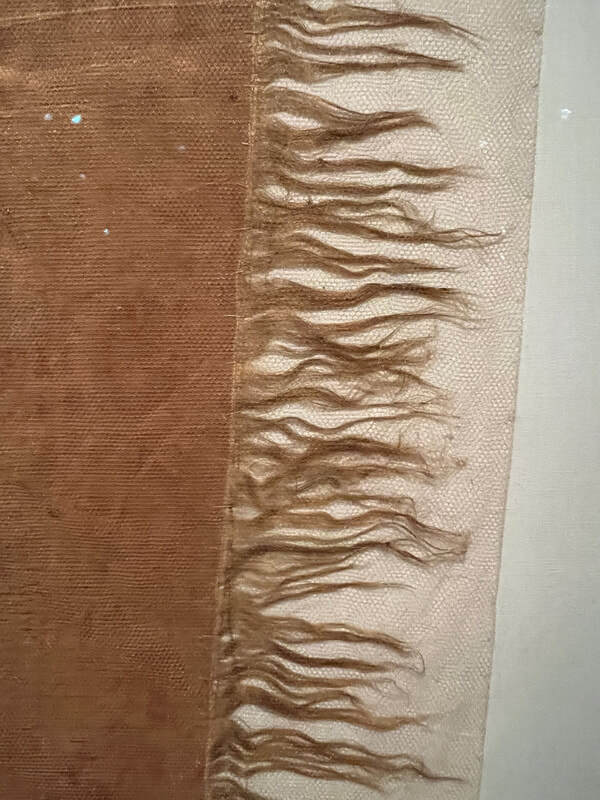
    A close-up of the flag's fringe also shows the netting that is used conserve the flag. (Author)

    Henry A. Muhlenberg was at that time preparing to publish a biography of his great uncle, the still-useful (but occasionally inaccurate) Life of Major-General Peter Muhlenberg of the Revolutionary Army. The younger Muhlenberg was a member of Congress and quite knowledgeable about his pedigree, but his description of the flag as “the regimental color” was wrong.
    Picture

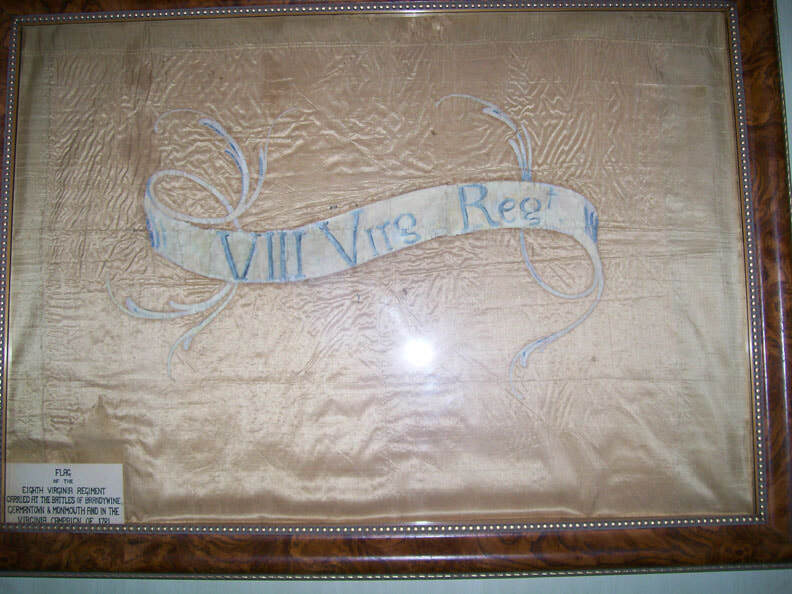
    The repainted side of the flag as displayed before 2012. Exposure to light resulted in a rectangle of faded fabric in the center of both sides of the flag. (Courtesy of R. Andrews)

    Other than the 1847 reference, Rob could find no mention of the flag anywhere. “I emailed the folks at Valley Forge and the Trappe Foundation in Trappe PA, where the Muhlenberg family lived.  Emails bounced around and finally one person said he thought he knew who had it." Then, Rob said, an email "popped into my box with two pictures of the flag.  It was in a frame and had a card at the bottom stating its provenance." The owner of the flag at that time had purchased it at an auction in the 1960s. The flag had not been professionally conserved, had faded where it faced the glass, and was displayed with a card that claimed a service history that followed General Muhlenberg’s career, but not that of the 8th Virginia (which he led for just a year).
    "In 2012, the flag was sold at Freeman’s Auction in Philadelphia. Prior to the auction, Freeman’s brought it to Shenandoah County to be displayed.  I was lucky that I found out about it just a couple of days prior to the event.  I contacted my friend Erik [Dorman] who also was interested in writing about the 8th and we decided to show up in our uniforms.  We caused quite a stir when we walked around the corner of the Courthouse into the square.  We were immediately enlisted to "guard" the flag and unveil it during the event.”
    Rob also shared one important explanation about the flag’s appearance. “As someone in the past painted the flag so that 8th Virginia was visible” the opposite side of the flag is displayed “to show its original condition.  And its years in the frame have led to its faded rectangle appearance.” The flag was purchased anonymously and is once again owned by a private collector. It was briefly displayed again at the Winterthur Museum in Delaware and is presently on display again in Philadelphia.

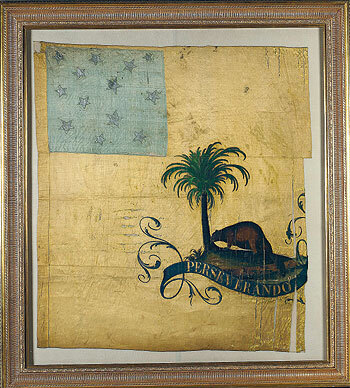
    ​The Muhlenburg flag resurfaced six years after another set of Virginia flags reappeared. The flag of the 3rd Virginia “detachment” was put up for auction in 2006 by a descendent of Banastre Tarlton. It is probably the only surviving Virginia regimental flag and is reportedly the oldest existing 13-star flag. It features a beaver (America) felling a tree (the empire) and the motto Perseverando (“By persevering”) in Latin.
    Picture

    The "3rd Virginia Detachment" banner captured by Banastre Tarlton in 1780.

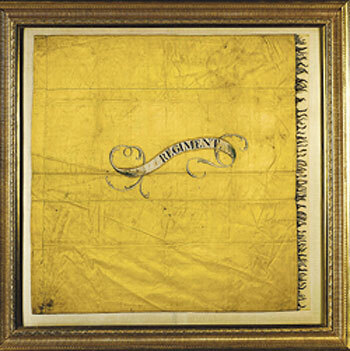
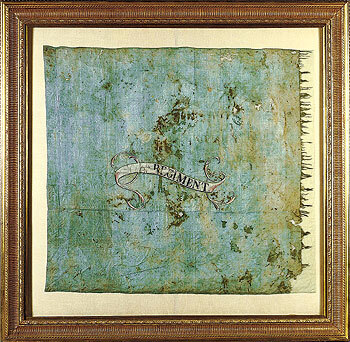
    With it were two smaller, plainer flags of identical design but different colors. The 3rd Detachment was an ad hoc unit cobbled together under Col. Abraham Buford in 1780 from new recruits and soldiers who had avoided capture at Charleston earlier that year. The flags were used at the Waxhaws in South Carolina on May 29 when Tarlton defeated Buford there. It is unlikely that the flags were made specifically for the detachment. The regimental flag is described in detail in a 1778 inventory of then-new flags known as the “Gostelowe Return.” The flags were probably, therefore, inherited from a regiment that was folded into Buford’s detachment. Buford had been colonel of the 11th Virginia, and a number of the men in his detachment were reportedly from the 2nd Virginia. The flag could have come from either of those, or from another.
    Picture
    Picture
    Picture
    The two “grand division” flags from the Buford detachment are almost identical, except for their colors, to the Muhlenberg flag. Buford’s maneuvering flags are blue and yellow. The Muhlenberg flag is a beige color today and was described as a “salmon” color in 1847. A fabric expert advises that the original color was red. The flag has faded considerably just from its time in the frame. It is not hard to imagine it having faded from red to a salmon color over the century or so before it put under glass.

    ​The scrolls on the blue and yellow flags contain only the word "regiment." The word is not centered in the scroll, suggesting that a space was retained to the left  on both flags to be filled in when they were assigned to a specific regiment. The writing in the 8th Virginia's scroll is illegible now. It was retouched on one side by Mr. Goetz or a previous owner to say "VIII Virg Regt." The 1847 account in the Richmond Whig says the scroll was styled a bit differently as "VIII Virga Regt."
    Picture

    The grand division standard as it likely appeared when new, recreated by 8th Virginia Regiment reenactor Nathan Gibson. (Courtesy of Nathan Gibson)

    A comparison of this flag to other Virginia standards could not be done until after it and the Buford flags had all resurfaced. Now that a comparison is possible, it is quite clear that the Muhlenberg flag was in fact one of two divisional standards. Though a maneuvering banner and not the regimental standard, the flag is still a treasure. It was on display at the Museum of the American Revolution in Philadelphia in 2022.

    More from The 8th Virginia Regiment
  • Published on

    A First-Person History of the Regiment

    The narrative that was submitted with veteran James Johnston’s 1832 pension application provides a uniquely clear summary of the 8th Virginia Regiment’s service. The text of it, as transcribed by C. Leon Harris, is presented below with the Harris annotations removed and new explanatory notes by Gabe Neville inserted in italics. New paragraph breaks have been introduced along with a handful of changes to capitalization and punctuation for clarity. Otherwise, the complete text is presented unaltered.

    Pension Application of James Johnston

    State of Virginia
    ​Giles County Ss.

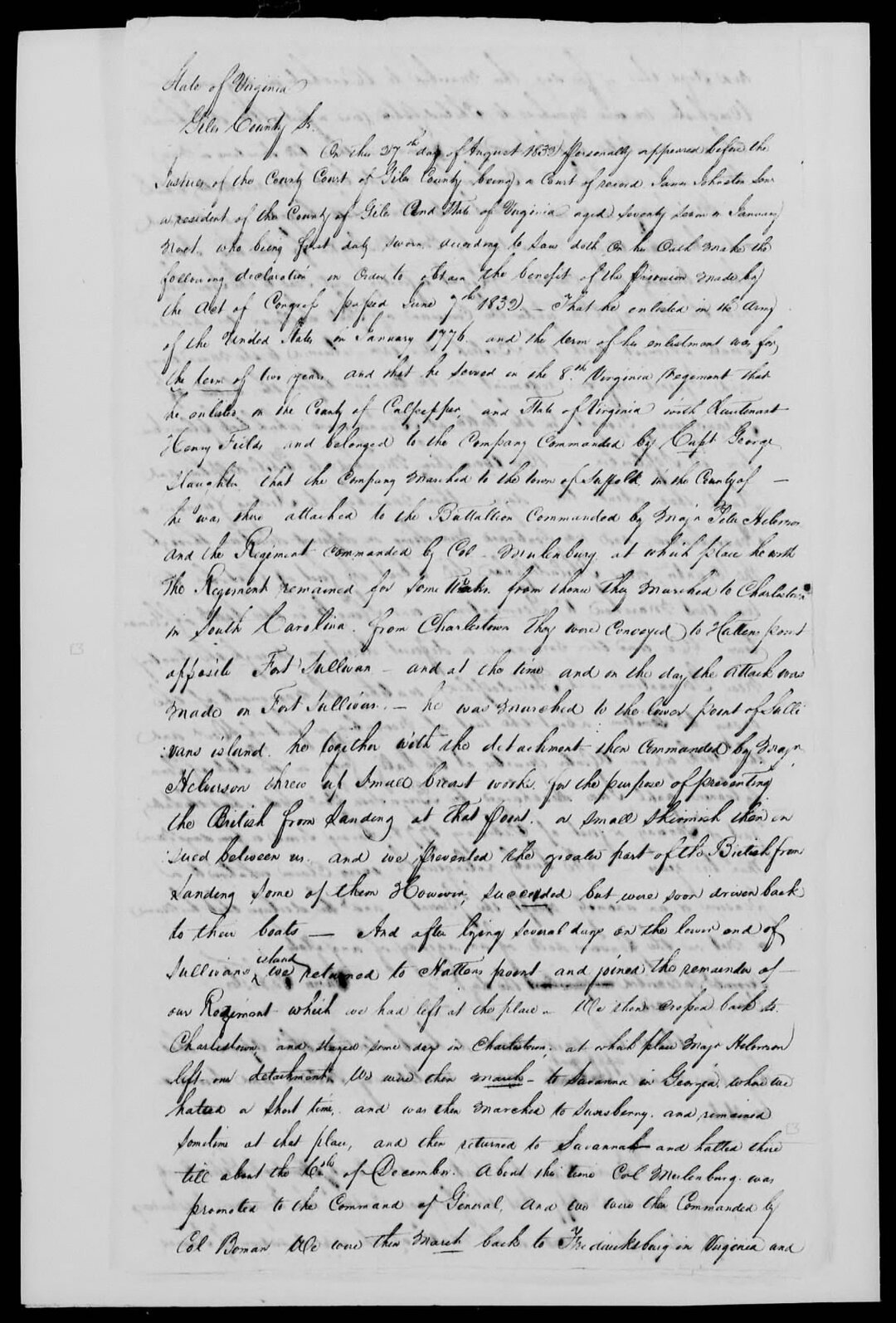
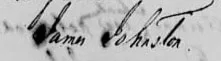
    On this 27th day of August 1832 personally appeared before the Justice of the County Court of Giles County being a Court of record James Johnston Sen’r a resident of the County of Giles and State of Virginia aged Seventy Seven in January next who being first duly sworn according to Law doth on his Oath make the following declaration in Order to obtain the benefit of the provision made by the Act of Congress passed June 7th 1832. ◊ Johnston’s family lived in Culpeper County when the Revolution began but moved, probably after his discharge, to what was then part of Fincastle County. Fincastle was broken up late in 1776 and later divided further into many counties. Giles County was created in 1806 and now borders the bottom of West Virginia.

    That he enlisted in the Army of the United States in January 1776 and the term of his enlistment was for the term of two years and that he served in the 8th Virginia Regiment. ◊ Johnston enlisted on January 26, 1776. Two years was the standard enlistment for Virginia provincial and Continental soldiers in 1776. The 8th Virginia was a provincial regiment when it was created, and was not brought into Continental service until August (retroactively to May).
    Picture

    The first page of James Johnston's 1832 pension application affidavit, filed in Giles County, Va. (Fold3.com)

    That he enlisted in the County of Culpepper and State of Virginia with Lieutenant Henry Fields and belonged to the Company Commanded by Capt George Slaughter◊ Each company officer had an enlistment quota to meet in order to get his commission. Family and friends made the best prospects. Lt. Field was Capt. Slaughter’s wife’s cousin. Her brother and two other cousins were also in the regiment, as was Capt. Slaughter’s nephew, Lawrence Slaughter. The five men from the Abbott family who enlisted in the company were probably Johnston’s cousins.

    That the Company marched to the town of Suffolk in the County of ______. He was there attached to the Battallion Commanded by Maj’r Peter Helverson and the Regiment commanded by Col Mulenburg at which place he with The Regiment remained for some weeks. ◊ Suffolk, a little west of Norfolk, was the designated rendezvous point for the regiment. Suffolk was then in Nansemond County. Battalions were sometimes divisions of regiments, but in the Continental Army were almost always functionally synonymous with regiments. Johnston was detached at least once with Helphenstine, which probably explains his characterization.

    From thence they marched to Charleston in South Carolina. From Charleston they were conveyed to Hattens point opposite Fort Sullivan—and at the time and on the day the attack was made on Fort Sullivan, he was marched to the lower point of Sullivans island. He together with the detachment then commanded by Maj’r Helverson threw up small breast works for the purpose of preventing the British from Landing at that point. A small skirmish then ensued between us and we prevented the greater part of the British from Landing. Some of them, however, succeeded but were soon driven back to their boats. And after lying several days on the lower end of Sullivans island we returned to Hattens point and joined the remainder of our Regiment which we had left at the place. ◊ The regiment left with Maj. Gen. Charles Lee for South Carolina in May, arriving in June. “Hattens Point” is Haddrell’s Point between Charleston and Sullivan’s Island. A number of 8th Virginia men reinforced South Carolina troops on the north end of Sullivan’s Island to fend off an enemy crossing of the “Breach Inlet” while enemy warships bombarded Fort Sullivan (later Fort Moultrie) on the south end. Most accounts discount the action at the Breach Inlet as insignificant, summarizing that the British had misgauged the depth of the water and failed to cross. Johnston, however, indicates that the enemy made a concerted effort to cross and that some succeeded before being driven back.
    Picture

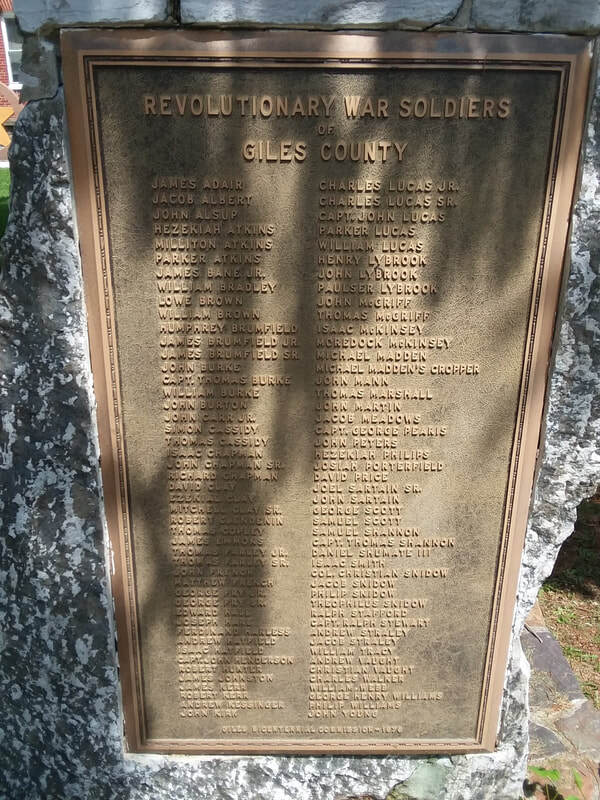
    Johnston's name is included on a marker listing known Revolutionary War soldiers from Giles County. The plaque is located on the courthouse grounds in Pearisburg, Virginia. (HMDB.org

    We then crossed back to Charleston and stayed some days in Charleston, at which place Maj’r Helverson left on detachment. ◊ Helphenstine, along with a great number of soldiers, succumbed to malaria, which was endemic to the region and against which most 8th Virginia soldiers had no developed resistance. Helphenstine resigned and returned to his home in Winchester where he eventually died from complications of the disease.

    We were then march to Savanna in Georgia where we halted a short time, and was then marched to Sunsberry and remained sometime at that place, and then returned to Savannah and halted there till about the 6th of December. ◊ General Lee took the southern army farther south to attack the Tory haven of St. Augustine in the new province of East Florida (acquired from Spain at the end of the French & Indian War). Supply problems, malaria, and Lee’s recall to the north foiled the plan. They made it as far as Sunbury, Georgia. A number of soldiers died in Sunbury of malaria.
    About the time Col Mulenburg was promoted to the command of General, and we were then Commanded by Col Boman We were then march back to Fredericksburg in Virginia and stayed there a few days then marched to Winchester in Virginia. ◊ Col. Peter Muhlenberg was promoted to brigadier general in February 1777, after which Lt. Col. Abraham Bowman was promoted to colonel. The return to Winchester allowed most of the soldiers an opportunity to visit their families.

    From Winchester we were marched to Philadelphia (and a part of the detachment who was inoculated for the small pox remained there till sometime in May). ◊ The entire Continental Army was inoculated early in 1777. Soldiers who had previously had the disease were exempt.

    We were then marched to Bonbrook or Middlebrook not recollected which in New Jersey and was attached to Gen’. Scotts brigade, and continued with the Main Army commanded by Gen’l Washington for some time. ◊ The regiment began collecting together at Boundbrook, N.J. in April and then moved to the camp at Middlebrook on May 25. It was assigned to Brig. Gen. Charles Scott’s brigade, along with the 4th Virginia, the 12th Virginia, Grayson’s Additional, and Patton’s Additional regiments. Scott’s brigade was one of two that made up Maj. Gen. Adam Stephen’s division.

    I was then attached to a Company of Light infantry and sent to the Iron hills near the head of Elk under the Command of Genl. Sullivan we had a small skirmish with the British. We then returned to the main army and I joined my own regiment on the Evening before the battle of Brandywine. I fought in the battle of Brandywine which took place some time in September. ◊ On August 28, each brigade sent  picked men to form a light infantry battalion under Brig. Gen. William Maxwell, who Johnston misidentifies as John Sullivan. Maxwell’s Light Infantry existed for one month and fought in Delaware at Cooch’s Bridge (Iron Hill) on Sept. 3 and Brandywine in Pennsylvania on Sept. 11. “Head of Elk” is now Elkton, Maryland. Johnston reports that he returned to Capt. Slaughter’s company before Brandywine, but does not state the reason.

    We were then marched to Philadelphia and stayed there about two days – then marched to Riding furnace in Pennsylvania and was continued marching in different directions through the country near Philadelphia til about the first of October. ◊ After Brandywine, the army retreated to Chester, Pa. and then crossed the Schuylkill to Philadelphia before heading west along the river to block the enemy from crossing it. The Schuylkill was the last natural barrier between the British and Philadelphia, the seat of Congress. After the “Battle of the Clouds” ended in a torrential downpour, Washington’s army was rested and re-equipped at Reading Furnace, in northwest Chester County (not to be confused with the city of Reading, which is twenty miles to the north). After a feint, the British made it across and took Philadelphia.

    We were then marched to Germantown and I fought in the battle of German town. ◊ The Battle of Germantown occurred on October 4. A chance for victory was ruined in part because of a friendly fire incident between General Scott’s brigade and Anthony Wayne’s Pennsylvania brigade. Maj. Gen. Adam Stephen was blamed for it. Stephen was cashiered and replaced with the Marquis de Lafayette.

    We were then marched in different directions through the country near Germantown and Philadelphia watching the movements of the enemy til sometime about the last of November or first of Dec’r and then took up our Winter quarters at the Vally forge in the state of Pennsylvania until I was discharged by Brigadier Gen’l Scott about the Latter part of January or first of February 1778. having served a few days more than two years. ◊ After Germantown, the army camped at three different places northwest of Philadelphia before a series skirmishes known as the Battle of Whitemarsh early in December. The army then went into winter encampment at Valley Forge on December 19. Johnston’s two-year enlistment expired on January 26, 1778 but he reports remaining a little longer.

    He hereby relinquishes every claim whatever to a pension or an annuity except the present and he declares that his name is not on the pension roll of an agency of any state.
    Image description


    ​James Johnston 
    Except for those who had reenlisted, all of the remaining original 1776 recruits left the regiment during the Valley Forge encampment. Efforts to recruit back to full strength after the southern expedition had fallen short and the regiment was never again back to even half strength. The three Virginia regiments in Scott’s brigade were merged into one unit known as the “4th-8th-12th Regiment” for the Battle of Monmouth in June, 1778. In September, the regiment was folded into the 4th Virginia and ceased to exist. The 12th Virginia was then renumbered and became the “new” 8th Virginia, which causes confusion for genealogists, particularly because many of the men came from the same parts of Virginia.

    More from The 8th Virginia Regiment
  • Published on

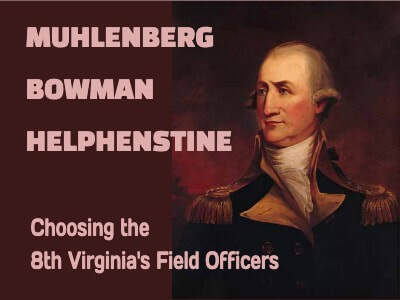
    Three Germans: The Regiment's Field Officers

    Image description
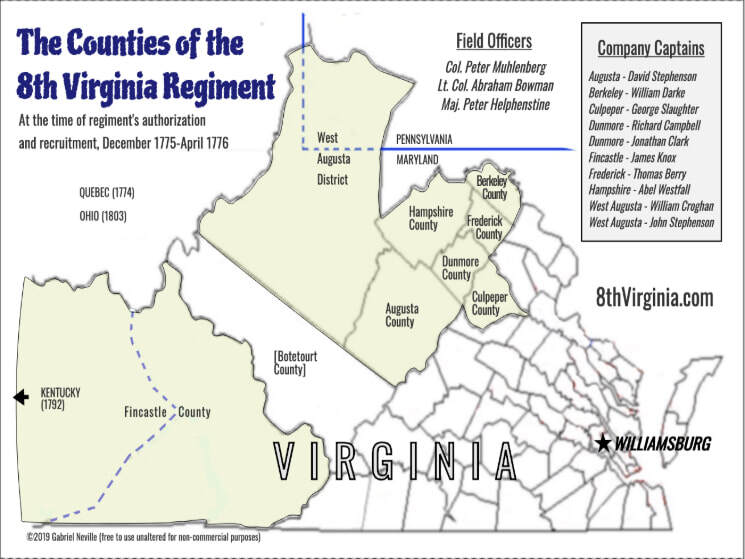
    Why Germans? The 8th Virginia Regiment of Foot was authorized by the revolutionary Virginia Convention on December 13, 1775. It had no numeric designation yet, but was intended to be unique in two ways. It would be ethnically-based and all of its men would carry rifles. It was conceived as a “battalion” to “be composed of Germans, with German officers.”
     
    The concept may have originated with the Rev. Peter Muhlenberg and Jonathan Clark, both delegates from Dunmore County in the Shenandoah Valley. Dunmore (now called Shenandoah County) was the cultural hub of German life in the Valley. It is inconceivable that the resolution could have been drafted without the involvement of at least Muhlenberg and probably of Clark as well. Muhlenberg was the Rector of Beckford Parish, the geography of which was identical to that of Dunmore County. His church was at Woodstock, the county seat. He was, however, more than just the community’s pastor. He was the son of the patriarch or the Lutheran Church in America, whose church was in the village of Trappe near Philadelphia. Clark was the county’s deputy clerk, an important job, under Thomas Marshall (soon to be colonel of the 3rd Virginia Regiment and father of future Chief Justice John Marshall).

    The Shenandoah Valley’s Germans had nearly all come the way Muhlenberg had: down the Great Philadelphia Wagon Road to Virginia. The road passed through communities that remain heavily German to this day, such as Lancaster, Pennsylvania. Scotch-Irish immigrants followed the same route, but tended to settle farther south in the Valley, around Staunton and Augusta County. 

    Lutheran Germans like Muhlenberg were seen by the Virginia gentry as reasonably reliable and trustworthy. Their theology differed little from the Church of England. Muhlenberg had, in fact, gone to London to be ordained before taking his position in Woodstock. (King George III was himself of German descent and his great grandfather, George I, couldn’t speak English when he took the throne.) The Ulster Irish, however, were less trusted. They were theological dissenters and often politically radical. Their Calvinist faith differed in important ways from Anglicanism. They could, however, be counted on to fight
    The ordinance creating the 8th Virginia and the selection of field officers that followed it suggest that what the convention really meant by calling it “German” was that Germans would command it (and that the Irish would not). Muhlenberg was the perfect candidate for such a role. He and Clark both served as officers in the regiment, something that may well have been predetermined. Muhlenberg would be the top officer and Clark would command one of Dunmore County’s two companies (the German one).
    Picture

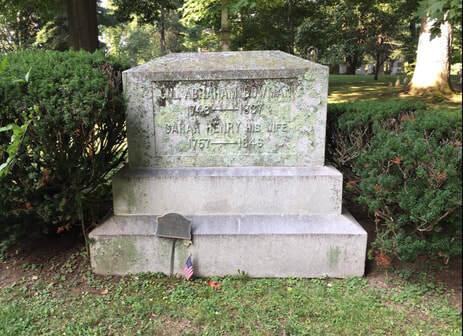
    The lichen-encrusted grave of Abraham Bowman in Lexington, Kentucky. No portraits of Bowman or Helphenstine survive. Though Helphenstine is known to be buried in the Lutheran section of Winchester's Mount Hebron Cemetery, there's no surviving marker. It may be that his destitute widow was not able to afford a stone memorial. (author)

    “And be it farther ordained,” read the resolution, “That of the six regiments to be levied as aforesaid, one of them shall be called a German regiment, to be made up of German and other officers and soldiers, as the committees of the several counties of Augusta, West Augusta, Berkeley, Culpeper, Dunmore, Fincastle, Frederick, and Hampshire (by which committees the several captains and subaltern officers of the said regiment are to be appointed) shall judge expedient.”
    Picture

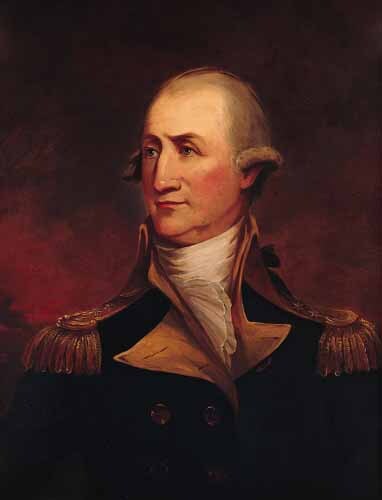
    Peter Muhlenberg portrayed at the end of the war as a brevet Major General.

    Muhlenberg and Bowman were both too young to have participated in the French and Indian War as most of Virginia’s other senior officers had. Muhlenberg had spent some time in a British military unit after dropping out of seminary in Germany years before. Bowman had experienced at least one dangerous encounter with Indians as a teenager. It is fairly clear that in choosing them the Convention prioritized their ability to rally and unite the Shenandoah Valley over their fairly meager military experience. Patrick Henry was the only other appointed colonel who had no real military experience.

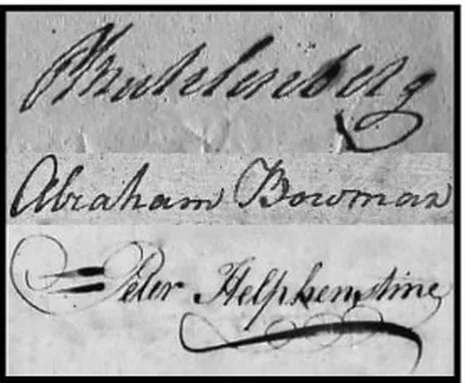
    When they received their commissions Muhlenberg was twenty-nine years old and Bowman was twenty-six. The regiment’s major was Peter Helphenstine, a German from Winchester in Frederick County. He was about twice Bowman’s age, in his middle fifties. He had commanded a company in the governor’s division during Lord Dunmore’s War in 1774. He was a respected tradesman and an active Lutheran.
    Below them, the officers of the ten companies—captains, lieutenants and ensigns—were a diverse group. English, German, and Scotch-Irish were most common. Capt. Abel Westfall of Hampshire County was Dutch, though his family had been in America for generations. Lieut. Jacob Rinker was Swiss. Lieut. Isaac Israel was Jewish. Religiously, though it is hard to trace, they were mostly Anglican, Lutheran, German Reformed, Presbyterian, and probably Baptist. If there were no Methodists, some of them—including Capt. Westfall—would become Methodists soon.
    ​`
    The diversity of the officers reflected the diversity in the rank and file. The 8th Virginia was a microcosm of the Continental Army at large. It was America’s original “melting pot.” Originally divided by race and religion, their shared hardships would soon make them a band of brothers.

    ​The committees were generally dominated by English elites and could be counted on to appoint the right kind of company officers. Only two of ten companies had Irish captains: Fincastle County and the West Augusta district (both on the frontier) selected James Knox and William Croghan. Both were capable and loyal officers.


    The choice of field officers, however, was up to the Virginia Convention and it chose three Germans as it had planned. Each was from a different down in the lower (northern) Shenandoah Valley. Muhlenberg was appointed to be the colonel. Abraham Bowman of Strasburg (also in Dunmore County) was appointed to be the lieutenant colonel. Bowman came from a prominent family. His grandfather, Jost Hite, had led the first group of German settlers into the valley from Pennsylvania in 1731.  

    More from The 8th Virginia Regiment
    Picture
    Picture
    Picture
  • Published on

    Germanna and the 8th Virginia

    Image description
    Virginia was described as the the "most English" of the colonies. It had been consistently loyal to the Crown, even during the era of Parliamentary rule under Oliver Cromwell. The Church of England was integrated into the local government. 

    Virginia's frontier territories were different. When the Revolutionary War started, the Virginia Conventioned designated the 8th Virginia to be a "German" regiment. Thousands of Pennsylvania Germans had settled in the Shenandoah Valley. But how German was it really? There were also many Protestant Irish ("Scotch-Irish") and English settlers in the area, and the actual recruitment territory stretched all the way to Pittsburgh.

    On September 12, Gabe Neville spoke at Virginia's Germanna Foundation to explore the question: "Just how German was the regiment in reality?"
    Picture
    Picture
    Picture