• Published on

    The Regiment's Eight Counties

    Image description
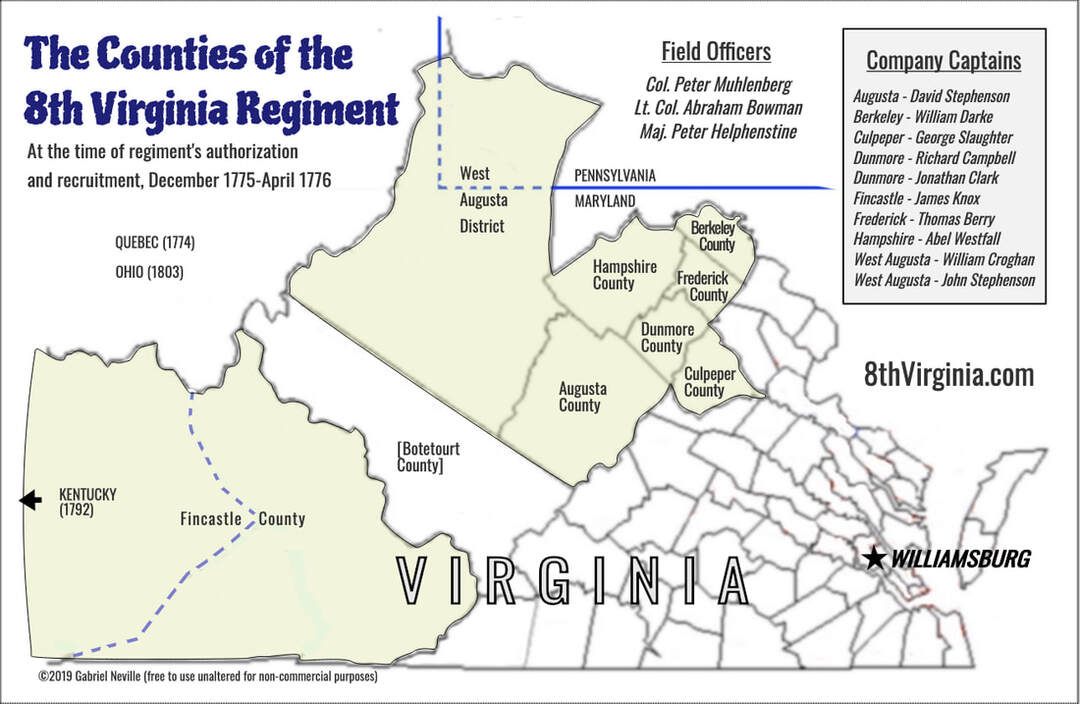
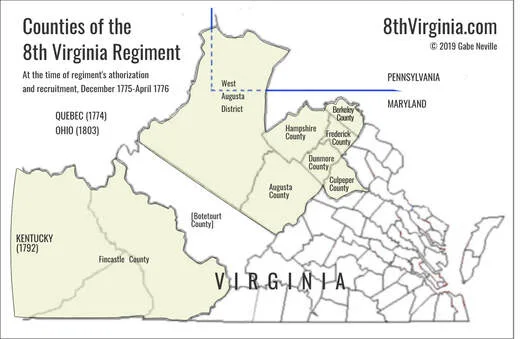
    A newly-created map of the 8th Virginia's recruiting counties shows that the regiment was largely composed of frontiersmen and pioneers. It is helpful to visualize how the regiment raised its ten companies in the westernmost settled areas of the province (Virginia wasn't a state, yet). This made the regiment unique in several ways. They were ethnically and religiously different from the rest of Virginia. Soldiers, some of whom were subsistence hunters, were typically better marksmen than the average soldier. Their motives for fighting were less focused on taxes and trade and more focused on their desires to head west--something the King had forbidden. 

    Political geography has changed. All of these counties have been divided, some within months of the regiment's formation. West Virginia, which is not shown, was created in 1863 and would occupy the left-center of the map. The disputed northeast part of the Augusta District is now southwest Pennsylvania, including Pittsburgh. Western Fincastle County became Kentucky County in 1776 and the Commonwealth of Kentucky in 1792. Most Americans are unaware that beginning in 1774, Ohio and lands west of it were part of the Province of Quebec. This, technically at least, extended holdover French civil institutions to the border of settled Virginia. Quebec had no elected legislature and had been allowed to keep its Catholic institutions. Both facts were seen by Virginians as sure signs of creeping tyranny.

    The Soldiers Page lists the various companies and the counties from which they came. In brief: the West Augusta District and Dunmore County each raised two companies. Augusta, Berkeley, Culpeper, Fincastle, Frederick, and Hampshire counties each contributed one. Initially called the "German Regiment" and long remembered that way, the map also shows how wide-ranging and diverse the zone of recruitment was. The lower (northern) Shenandoah Valley counties of Berkeley, Frederick, and Dunmore had significant populations and all three field officers were from that area. Culpeper, the only Piedmont county, had a smaller German population that descended from the Germanna Colony. The other counties were predominantly Scotch-Irish and English.
    Picture
  • Published on

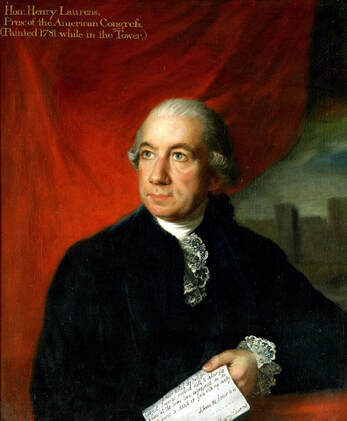
    The Tragedy of Henry Laurens

    Picture

    Laurens was president of the Continental Congress, Vice President South Carolina, and a prisoner of war. He made his fortune in the slave trade but realized it was wrong during the Revolution

    The founder who might have prevented the Civl War but didn't
    It wasn’t really their fault, they said. Slavery, men of the founding generation liked to argue, was brought to the colonies by Britain. It came via Barbados and the other sugar islands of the Caribbean. Thomas Jefferson and Henry Laurens both blamed Britain and wished the colonies could free themselves of the practice. It was ironic, therefore, that American slavery not only outlasted the War for Independence but also outlasted slavery in the British Empire. In truth it was more than ironic: it was a tragedy that led to additional decades of forced labor and the deaths of well over half a million Americans in the Civil War
    Could the abolition of American slavery have come sooner? Maybe. Slavery never existed in the New World without someone also speaking out against it, and antislavery views took a demonstrably large leap forward during the founding era. Christianity, social contract theory, and the very spirit of the Revolution led many Americans to the same conclusion. Even many slaveowners understood it was wrong. “I can only say,” wrote George Washington about slavery in 1786, “that there is not a man living who wishes more sincerely than I do, to see a plan adopted for the abolition of it.”

    Thomas Jefferson memorably condemned slavery in his first draft of the Declaration of Independence. While this language was removed by Congress, Jefferson really did want to effect a change. His concurrent draft of a Virginia constitution would have decreed, “No person hereafter coming into this country shall be held in slavery under any pretext whatever.” A decade later, he wrote that“The whole commerce between master and slave is a perpetual exercise of the most boisterous passions, the most unremitting despotism on the one part, and degrading submissions on the other. Our children see this, and learn to imitate it; for man is an imitative animal.” His concern was not just for Virginia’s children:

    And can the liberties of a nation be thought secure when we have removed their only firm basis, a conviction in the minds of the people that these liberties are the gift of God? That they are not to be violated but with his wrath? Indeed I tremble for my country when I reflect that God is just: that his justice cannot sleep forever: that considering numbers, nature and natural means only, a revolution of the wheel of fortune, an exchange of situation is among possible events: that it may become probable by supernatural interference! The almighty has no attribute which can take side with us in such a contest.

    More from The 8th Virginia Regiment

    Picture
    Picture
    Picture
  • Published on

    George Washington, Indian Diplomat

    Picture

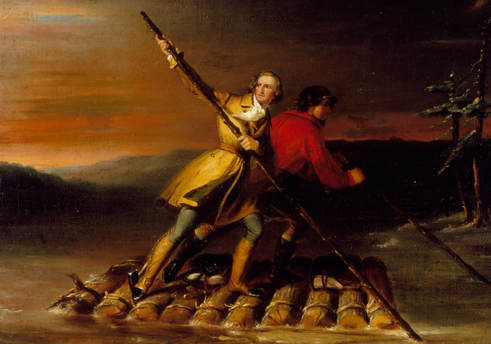
    George Washington and Christopher Gist cross the Allegheny River in 1753. (Attributed to Daniel Huntington, courtesy of mountvernon.org)

    George Washington, like many 8th Virginia men, was an Indian fighter. His first war was the French and Indian War--a war, it is frequently said, he personally started. Washington's last war was the Northwest Indian War, which he oversaw as President and commander in chief. The latter war was bloodier than any other Indian conflict before or after. The Battle of Wabash in 1791 featured higher American casualties than any other battle until Shiloh in 1862. (The 8th Virginia's William Darke played a central role at Wabash and, though injured, made it home.)
    The Revolution itself was an Indian war, especially in 1779. The following Speech to the Delaware Chiefs reveals the importance of Indian relations in the war. It shows a side of Washington we rarely see--the frontiersman, surveyor, and Indian fighter who knows how to communicate with Indians by pushing the right buttons for maximum effect. When he delivered it in New Jersey, many 8th Virginia men had already finished their Continental Army service and moved to Kentucky where Indian warfare was an ever-present threat.

    The Delaware, many of whom were Christians, were the first Native allies of the United States. The Treaty of Fort Pitt even held out the prospect of representation in Congress as a 14th state, but by 1779 the relationship was already starting to weaken. The Oneida and Tuscarora tribes, both part of the Iroquois Confederacy, also allied with the Americans in the war. 

    Head Quarters, Middle Brook, May 12, 1779. 

    Brothers: I am happy to see you here. I am glad the long Journey you have made, has done you no harm; and that you are in good health: I am glad also you left All our friends of the Delaware Nation well. 

    Brothers: I have read your paper. The things you have said are weighty things, and I have considered them well. The Delaware Nation have shown their good will to the United States. They have done wisely and I hope they will never repent. I rejoice in the new assurances you give of their friendship. The things you now offer to do to brighten the chain, prove your sincerity. I am sure Congress will run to meet you, and will do every thing in their power to make the friendship between the people of these States, and their Brethren of the Delaware nation, last forever. 

    Brothers: I am a Warrior. My words are few and plain; but I will make good what I say. 'Tis my business to destroy all the Enemies of these States and to protect their friends. You have seen how we have withstood the English for four years; and how their great Armies have dwindled away and come to very little; and how what remains of them in this part of our great Country, are glad to stay upon Two or three little Islands, where the Waters and their Ships hinder us from going to destroy them. The English, Brothers, are a boasting people. They talk of doing a great deal; but they do very little. They fly away on their Ships from one part of our Country to an other; but as soon as our Warriors get together they leave it and go to some other part. They took Boston and Philadelphia, two of our greatest Towns; but when they saw our Warriors in a great body ready to fall upon them, they were forced to leave them. 

    Brothers: We have till lately fought the English all alone. Now the Great King of France is become our Good Brother and Ally. He has taken up the Hatchet with us, and we have sworn never to bury it, till we have punished the English and made them sorry for All the wicked things they had in their Hearts to do against these States. And there are other Great Kings and Nations on the other side of the big Waters, who love us and wish us well, and will not suffer the English to hurt us. 

    Brothers: Listen well to what I tell you and let it sink deep into your Hearts. We love our friends, and will be faithful to them, as long as they will be faithful to us. We are sure our Good brothers the Delawares will always be so. But we have sworn to take vengeance on our Enemies, and on false friends. The other day, a handful of our young men destroyed the settlement of the Onondagas. They burnt down all their Houses,  destroyed their grain and Horses and Cattle, took their Arms away, killed several of their Warriors and brought off many prisoners and obliged the rest to fly into the woods. This is but the beginning of the troubles which those Nations, who have taken up the Hatchet against us, will feel. 

    Brothers: I am sorry to hear that you have suffered for want of necessaries, or that any of our people have not dealt justly by you. But as you are going to Congress, which is the great Council of the Nation and hold all things in their hands, I shall say nothing about the supplies you ask. I hope you will receive satisfaction from them. I assure you, I will do every thing in my power to prevent your receiving any further injuries, and will give the strictest orders for this purpose. I will severely punish any that shall break them. 

    Brothers: I am glad you have brought three of the Children of your principal Chiefs to be educated with us. I am sure Congress will open the Arms of love to them, and will look upon them as their own Children, and will have them educated accordingly. This is a great mark of your confidence and of your desire to preserve the friendship between the Two Nations to the end of time, and to become One people with your Brethen of the United States. My ears hear with pleasure the other matters you mention. Congress will be glad to hear them too. You do well to wish to learn our arts and ways of life, and above all, the religion of Jesus Christ. These will make you a greater and happier people than you are. Congress will do every thing they can to assist you in this wise intention; and to tie the knot of friendship and union so fast, that nothing shall ever be able to loose it. 

    Brothers: There are some matters about which I do not open my Lips, because they belong to Congress, and not to us warriors; you are going to them, they will tell you all you wish to know. 

    Brothers: When you have seen all you want to see, I will then wish you a good Journey to Philadelphia. I hope you may find there every thing your hearts can wish, that when you return home you may be able to tell your Nation good things of us. And I pray God he may make your Nation wise and Strong, that they may always see their own true interest and have courage to walk in the right path; and that they never may be deceived by lies to do any thing against the people of these States, who are their Brothers and ought always to be one people with them.

    (Updated May 21, 2024)

    More from The 8th Virginia Regiment

  • Published on

    The Shenandoah Valley's Regiment

    Picture
    The 8th Virginia was truly, and uniquely, the Shenandoah Valley's regiment in the Revolution. Unlike any other regiment, the 8th represented nearly the full extent of the greater Shenandoah Valley cultural region and even beyond it from the North Carolina (later Tennessee) line all the way to Pittsburgh (then claimed by the Old Dominion). The only county in the Valley that did not raise a company for the regiment was Botetourt. 
    This vast territory can be characterized in two important ways. First, as the frontier. Second, and just as important at the time, the territory can be described as the part of Virginia populated by newcomers.  Most of them had come inland via Pennsylvania and were neither English nor Anglican. Culturally, the Irish and German men of the regiment had more in common with Pennsylvania than with Piedmont or Tidewater Virginia. Those parts of Virginia--"Old Virginia" or "Tuckahoe Virginia" -- were very homogeneous. Most "nonconforming" churches were barely tolerated in most of Virginia but fared better west of the Blue Ridge. Still, Lutheran-trained Peter Muhlenberg had to go to London to be ordained in the Church of England in order to serve as Beckford Parish rector in Woodstock as late as 1772. Four years later he became the regiment's first colonel. In describing the 8th Virginia as the "German Regiment" and appointing German field officers to lead it, the Virginia Convention was making an effort to make sure the colony was united. At the same time, they were blocking Presbyterian Scotch-Irish from holding senior commands.

    Winchester's Daniel Morgan is the most prominent hero of the Shenandoah Valley, and he is rightly famous. However, other than the 1775-1776 rifle company he led as a captain, the military organizations he led were not true Shenandoah Valley units the way 8th was. In 1776 and 1777 he was colonel of the 11th Virginia, which recruited from Frederick County but also from Prince William, Amelia, and Loudoun counties; his famous Virginia rifle battalion, formed in 1777, was built on merit, not geography. As a general, he led men from even more places.

    The 8th Virginia truly represented the geography and the culture of the Shenandoah Valley.

    ​(Updated April 26, 2020 and May 9, 2024)

    More from The 8th Virginia Regiment

    Picture
  • Published on

    "Irish," "Scotch-Irish," or "Scots-Irish?"

    Picture

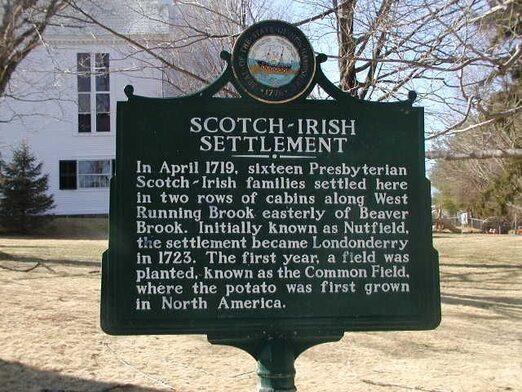
    A sign in New Hampshire marks the place of an early Scotch-Irish settlement.

    'Scotch is a whiskey, Scots are a people." Sometimes I'll get a comment of this sort on a blog or social media post. 

    Many of the enlisted men in the 8th Virginia were "Scotch-Irish." Most often they were simply called "Irish" at that time, even though their ancestors often came from Scotland. They were universally Protestant (Catholics were not allowed to immigrate), but they were Presbyterian--a denomination most British soldiers equated with revolutionary sentiment.  
    The term "Scotch-Irish" was occasionally used during the Revolutionary period as an adjective, but first appeared as a noun in 1789. It became important to distinguish Protestant Irish from the Catholic Irish, who began to come to American in large numbers in the 1840s. Here's an interesting article on the difference between "Irish" and "Scotch-Irish" in American history and culture. I use the term "Scotch-Irish" and "Protestant Irish" and sometimes just "Irish" interchangeably. Occasionally, someone will tell me that the proper term is "Scots-Irish," even though that word first appeared in 1966. I've stuck to "Scotch-Irish" (or just "Irish") because it is correct for the period, traditional, and what I was taught to say as a child.

    To be fair, though, "Scots" is technically older. It dates to the 14th century. It was a contraction of "Scottis," a local (northern) variant of "Scottish." It was revived in Britain in the mid-19th century in reaction to some nasty English vernacular. Even then, though, I suspect it was adapted as an adjective from the plural for "Scot," and therefore not a real continuation of the earlier term. "Scotch" is a contraction of "Scottish" and is plenty old itself, dating back as far as 1590.  It is now distinctly American. If you go to the British Isles they will correct you if you refer to a person that way. But, then, they don't call their whiskey "Scotch," either. They call it "whisky."

    "You say 'tom-AH-to' and I say 'tom-AY-to.'" As an American blog about American history, "Scotch-Irish" seems like the right term here.

    (Revised, May 26, 2021 and May 21, 2024)