• Published on

    John Duncan's Life of Indian Fighting

    Picture

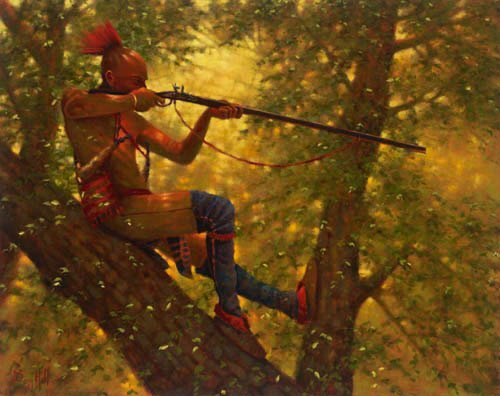
    "Well Positioned" by Doug Hall (doughallgallery.com)

    On March 5, 1833 an old man named John Duncan walked into the Franklin County, Illinois courthouse and applied for a Revolutionary War pension. His father, he said, had been killed by Indians in Washington County, Virginia, when he was nine or ten years old. He recorded his own 20-year story of virtually nonstop Indian fighting, including the famous Vincennes campaign led by General George Rogers Clark (younger brother of 8th Virginia Captain Jonathan Clark). In his own words he had lived "in a country in a constant state of alarm, and liable to be called on at any moment."
    According the the affidavit, “He never was regularly mustered into or out of service," he said. "He never was discharged regularly. He received some little pay, but does not now recollect how much. He is unacquainted with the names of any Regular or Continental officers or companies, nor ever served with any.... He never was regularly enrolled in any company or corps, unless it might be Genl Clark’s or Col Hays’s. He belonged to none at home. He has no documentary evidence of his service; he knows of no living witness who can testify personally as to his service....”
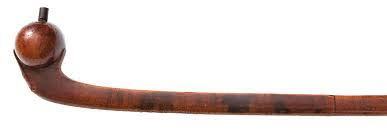
    The death of Duncan's father was noted at the time by Daniel Boone, who collected the ball-head war club that had been used to kill him. War clubs were left by Indians as macabre calling cards beside their victims. Boone gave the club to Maj. Arthur Campbell who wrote to William Preston on October 1, 1774, "Mr. Boone preparing to go in search of the enemy...thinks it is the Cherokees that is now annoying us." This was at the height of Lord Dunmore's War, a conflict fought by Virginia primarily against the Ohio-based Shawnee over control of Kentucky.

    In 1905, David E. Johnston, a descendent of 1778 New River settlers, wrote, "The life of these people was a long and dangerous struggle.... A race of men unused to war and ever present dangers, would have been helpless before such foes as these wild beasts and the Indians. People coming from the old world, no matter how thrifty and adventurous, could not hold their own on the frontier.... Every man from childhood was accustomed to the use of the rifle, and even a boy at twelve years was regarded old enough to have a gun, and was soon taught how to use it. He at least could make a good fort soldier. The war was never ending, for even the times of so-called peace were broken by forays and murders. A man might grow from boyhood to middle age on the border, and yet never recall a single year in which some of his neighbors were not killed by the Indians."
    Duncan’s career of Indian fighting, colorful as it was, did not qualify him for a Revolutionary War pension. Most of it happened after the war was over (he was about 18 at the time of the victory at Yorktown). 
    Picture

    A ball head war club of the type used to kill Duncan's father.

    The pension affidavit, however, is great reading for anyone interested in early frontier history. It was transcribed by C. Leon Harris and is one of thousands Harris and his partners at RevWarApps.com have transcribed and put online. These affidavits have long been largely ignored by historians, who have been suspicious of them as the late memories of old men eager for money. Used carefully, however, they are a great resource to my research—especially when they corroborate each other or fill in blanks in the record. Duncan’s affidavit can be read here. 

    Though he lived for a time in an area that recruited men for the 8th Virginia, Duncan was never connected with the regiment.

    ​(Updated May 31, 2021 and August 28, 2021.)

    More from The 8th Virginia Regiment
  • Published on

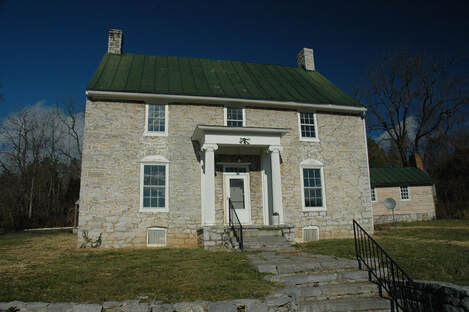
    "Fort Bowman" is really a house. But it's an important one.

    Image description
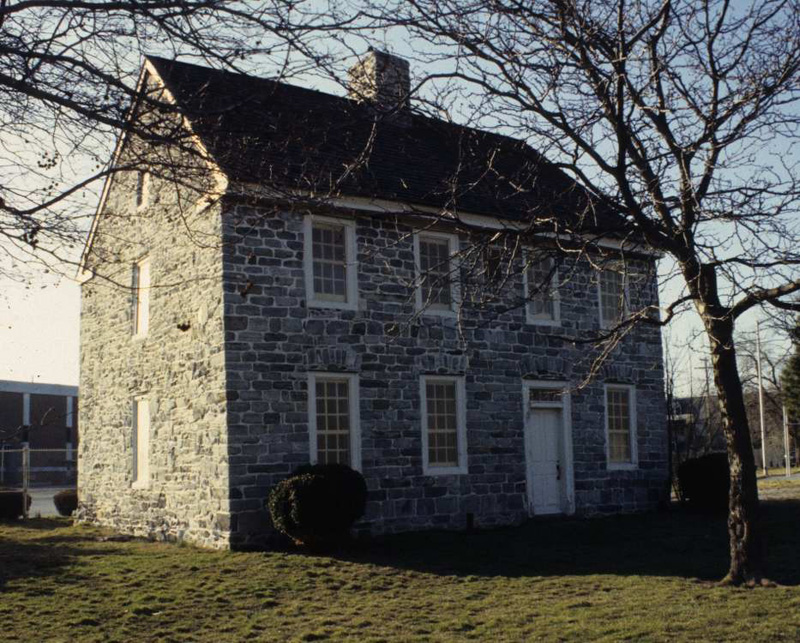
    Hidden in the woods down a long, steep and rocky dirt road near the intersection of Interstate 66 and U.S. Route 11 is a very old Virginia house that seems out of place. If you have an eye for regional architecture, you will notice that it looks much more like a Pennsylvania Dutch farmhouse than a Virginia plantation house. 

    The house was built by George Bowman, a son-in-law of Jost Hite who led George and their extended family to the Shenandoah Valley from Pennsylvania in the 1730s. The house was long believed to have been built in the 1750s but may not be quite that old. The symmetrical features and chimney placements show concessions to dominant English architectural style of the time (Georgian).

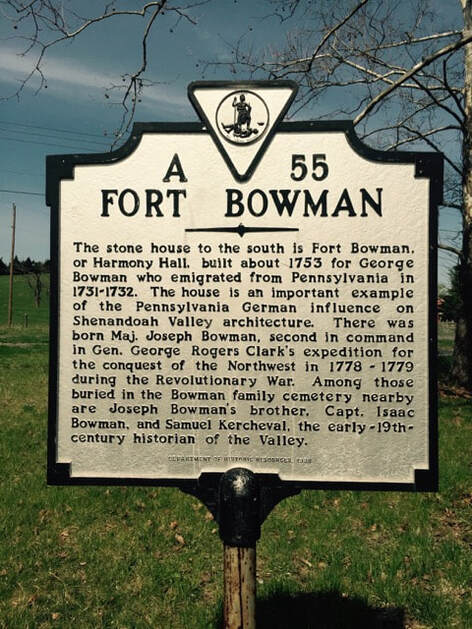
    This is the house Colonel Abraham Bowman grew up in. George was his father. It is a very important early example of Pennsylvania German architecture in the Shenandoah Valley. The Laurence Snapp House (note the central chimney), which is nearby at Toms Brook, is another. The house has been called “Harmony Hall” since before the Revolutionary War. It is sometimes, however, called “Fort Bowman” because according to tradition it was used as a fort during the French and Indian War. Depending on the house's actual age, that history may now be in question.
    Image description
    A nearby Virginia historical marker mentions Abraham's brother, Joseph, but does not mention Abraham. There were in fact four brothers who lived here who served in the Revolutionary War in various capacities. They all had reputations as excellent horsemen, for which reason the siblings were known as the "four centaurs of Cedar Creek" after the nearby stream.

    In 2009, Maral Kalbian and Margaret Peters gave a presentation on the house’s history. 
    Parts 1 through 3 cover the chain of property ownership. If you are not interested in that, you may want to start watching with part 4--which is embedded below. The house is now on property that is part of Cedar Creek & Belle Grove National Historical Park.

    Two more of Abraham Bowman's homes survive. The log house he built after moving to Kentucky in 1779 survives and has been restored, and the much larger plantation house he built after prospering there is also still standing. That house, now known as Helm Place, was later the home of Abraham Lincoln's sister-in-Law (Mary Todd Lincoln's sister).
    (Updated August 20, 2020)

    More from The 8th Virginia Regiment
  • Published on

    The Official Whiskey of the 8th Virginia

    Image description
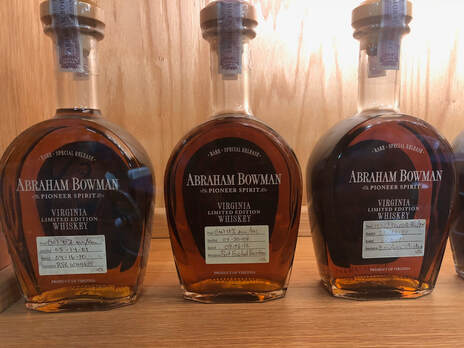
    Abraham Bowman whiskey, which is produced in Fredericksburg, Virginia, is named for the only field officer who commanded the 8th Virginia for its entire two-year existence. Originally distilled by his descendants, the whiskey is an excellent tribute.

    Americans drank rum in colonial times. After the Revolution, however, they drank whiskey. Rum was made from Caribbean molasses, but whiskey was purely home-grown. “The Revolution meant the decline of rum and the ascendancy of whiskey in America,” writes Mary Miley Theobald. “When the British blockade of American ports cut off the molasses trade, most New England rum distillers converted to whiskey. Whiskey had a patriotic flavor. It was an all-American drink, made in America by Americans from American grain.”

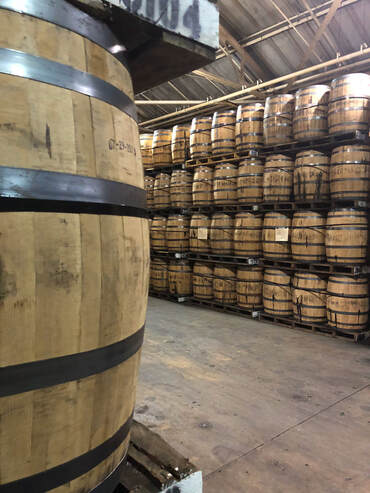
    Nowhere was whiskey more popular than on the Virginia frontier. Whiskey came to America with the “Scotch Irish” who settled the frontier of Virginia, the same areas that produced the 8th Virginia Regiment. After the war, many 8th Virginia men led their families and neighbors into the woods of Kentucky. Abraham Bowman was among the very first to go. They began making whiskey out of corn, aging it in charred oak barrels, and (eventually) calling it "Bourbon." 
    Image description
    Abraham Bowman was commissioned in 1776 to be the 8th Virginia’s original lieutenant colonel. A year later he was promoted to colonel to replace Peter Muhlenberg, who became a general. The Bowmans were not Scotch-Irish; they were German. Abraham was a third-generation American, however, and by his time or soon after there wasn’t much difference. After a few more generations, the Bowmans were back in the Old Dominion, and opened a whiskey distillery the day after Prohibition ended. For many years it was the only legal whiskey distillery in Virginia. 
     
    The historical label is “Virginia Gentleman,” a serviceable bottom-shelf whiskey that is aged for just a few year. A. Smith Bowman Distillery, which was sold by the family to the Sazerac Company in 2003, also has a line of award-winning top-shelf whiskeys named after members of the family’s Revolutionary War generation: Bowman Brothers, Isaac Bowman, and John J. Bowman. These are the labels for the company’s small batch, port barrel finished, and single barrel labels.
     
    The Abraham Bowman label is reserved for experimental whiskeys that are released once or twice a year in small quantities. There have been cider finished, “double barrel,” wheat bourbon, vanilla bean infused, coffee finished, and port wine finished versions. The port finished bourbon won a “world’s best bourbon” award in 2016 and became a regular product under the Isaac Bowman label. Since then, a bottle of Abraham Bowman whiskey has become very hard to acquire. To get one, a person has to stand in line at the distillery on the day of release or win a lottery conducted by the Virginia Alcoholic Beverage Control Authority. 
     
    If you live in Virginia or are ever driving through the state on Interstate 95, can stop in and take a tour of the distillery. You can go home with a bottle of good whiskey, but don’t count on a bottle of Abraham Bowman. It’s a safe bet they’ll be sold out.

    (Updated 1/11/20)
    Picture

    The distillery isn't shy about the awards it has received. (Author)

  • Published on

    The Cost of Fog and Drunkenness

    Picture
    October 4, 1777 was a bad day for the 8th Virginia and the Continental Army.

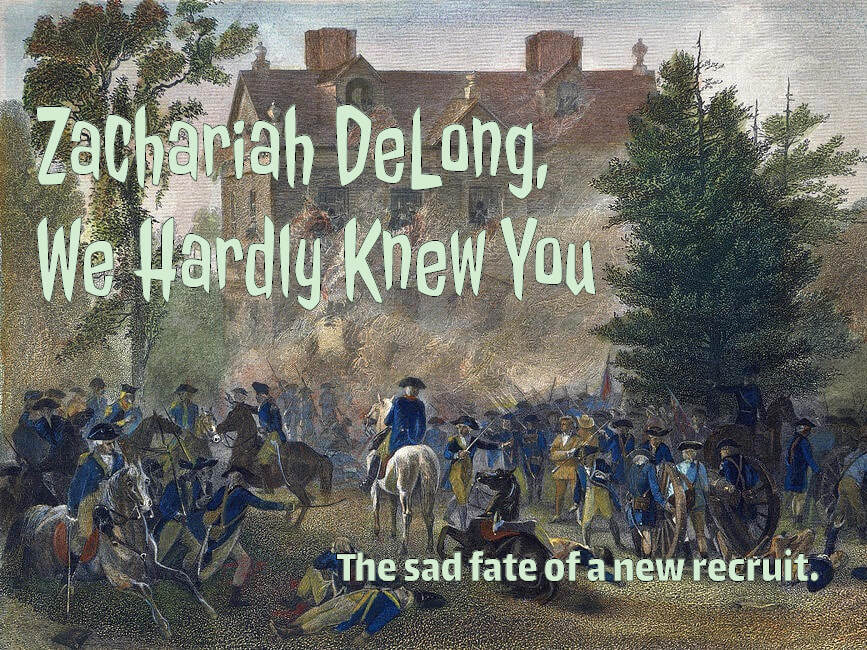
    ​Colonel Bowman’s men had seen combat, most notably at Brandywine—but disease and cold had caused more casualties than enemy musket balls or bayonets. The Battle of Germantown was different. Confused by fog and under the command of an allegedly drunk major general, the 8th Virginia suffered more battlefield casualties in one day than the rest of its service combined.
    Two men, Richard Evans and Henry Saltsman of Captain Croghan’s company, were killed. Eleven men were wounded and three  were never seen again. About forty men were captured, mostly in the companies commanded by captains Westfall, Slaughter, Croghan, and Higgins. 

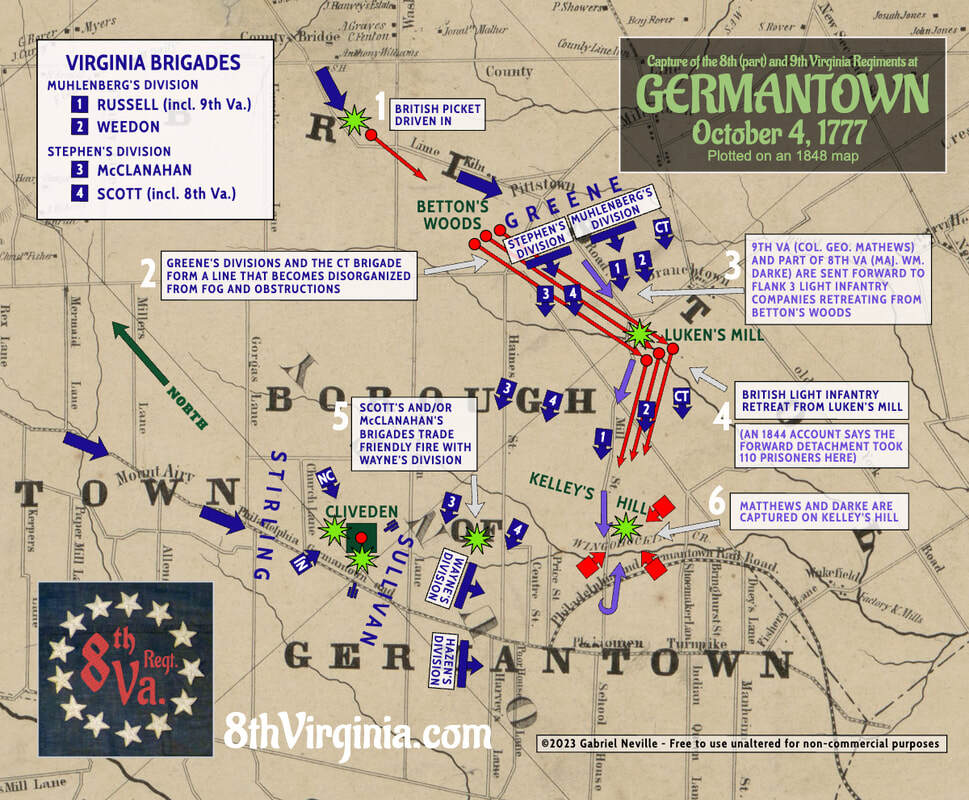
    ​Early in the engagement, Maj. Gen. Adam Stephen sent the 9th Virginia forward to flank three companies of retreating British light infantry. Deciding they needed support, he ordered the 8th Virginia to follow. The regiment's new and untested lieutenant colonel, John Markham from Chesterfield County, balked at the order. William Darke, the regiment's much more seasoned but also newly-promoted major, led half or more of the regiment forward to help their 9th Virginia comrades. They captured 110 of the light infantry (according to one account), but found themselves alone and unsupported as fog, smoke, fences, and friendly fire kept the brigades behind them from advancing in order. Matthews and Darke were captured. A little less than a third of the 9th Virginia was killed and the rest were captured. About  forty 8th Virginia men were captured. We don't know how many of the regiment's other casualties came from his forward detachment or how many (if any) escaped back to the line.

    A lieutenant, Jacob Parrett, said he was "disabled by a wound in his right leg, just above the ancle, and it was with the greatest difficulty he secured himself during the retreat." Wounds in that era were not easy to recover from. In 1818, veteran Jonathan Grant reported that he “was wounded in the leg” at Germantown, “in consequence of which wound I am now rendered incapable of labouring for my support” and living “in reduced circumstances.”

    The men who were captured may have suffered the worst fate. They were carted off to the "new gaol," the Walnut Street Jail, in Philadelphia, where they were left hungry and cold going into winter. Officers were moved after a few days to the second floor of the State House (Independence Hall). Several men died in captivity and others never fully recovered from the experience. When he British gave up Philadelphia in 1778, they took their prisoners with them. There was an exchange of enlisted men in August of 1778, and some men went home (their enlistments had expired). Major Darke was exchanged in the fall of 1780 and made it home in time to participate in the Yorktown campaign.
    After the Battle of Germantown, the 8th Virginia's new lieutenant colonel, John Markham, was charged with "Having left the regiment in time of action ... and also, on the retreat of the same day" and with "Delay when ordered to support the advanced guard." A court martial unanimously found him guilty and he was cashiered. General Stephen was also tried, found guilty of drunkenness and poor leadership, and kicked out of the army.

    [Post Updated 10/5/19 and 1/4/23.]
    Picture

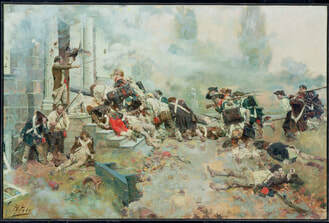
    Artist Howard Pyle's rendering of the attack on Chew House during the Battle of Germantown. The 8th Virginia did not participate in this part of the battle.

  • Published on

    Three Surviving Virginia Regimental Flags from 1776

    See “The Grand Division Standard” (June 20, 2022) for a corrected and updated version of this post.

    Picture
    Picture
    Picture
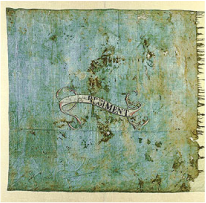
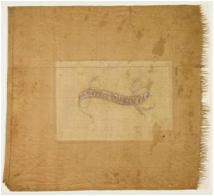
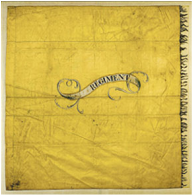
    Here are images of all three known Virginia regimental standards, shown together apparently for the first time. All three flags are in anonymous private collections but have been exhibited publicly. The flag in the middle belonged to the 8th Virginia. One of the other flags reportedly belonged to the 3rd Virginia. The faded rectangle in the center of the 8th Virginia flag is a consequence of light damage resulting from the way in which it was displayed for many years--it was originally one consistent (salmon) color. The flags follow an apparently standard design, but in varying colors. The color was the most important distinguishing characteristic of the flags, which were used to help troops stay organized in the smoke and confusion of battle.

    The scrolls on the blue and yellow flags contain only the word "regiment." This suggests that they were made at the same time, with the intention that regiment numbers would be added when the colors had been assigned to the respective units. (The word "regiment" is not centered in the scrolls; space was retained to the left of the word on both flags.) The writing in the 8th Virginia's scroll is illegible because of light damage. The writing was retouched on the reverse side of the flag to say "VIII Virg Regt." An 1847 account in the Richmond Whig says the scroll contained the words "VIII Virga Regt." This sets it apart from the other two flags. This can be explained by the history of Virginia's Continental regiments.

    ​The 1st and 2nd regiments were authorized by the Virginia convention in 1775 for one-year enlistments. Seven more regiments were authorized in December of 1775 to be formed in 1776 for two-year enlistments, with the expectation that the 1st and 2nd would also continue with new or reenlisted men. Virginia expected all of these regiments to be taken into the Continental Army. Congress, however, initially only authorized seven Virginia Continental regiments. Despite being the first regiment to leave the Commonwealth in Continental service, the 8th drew the short straw and was not recognized immediately as anything other than a provincial (after July 4, "state") regiment. (The same was true of the small 9th regiment, which was created only for Eastern Shore defense.) At the urging of General Charles Lee, Congress later increased the number of authorized Virginia Continental regiments. One consequence of this complicated history may be that the 8th Virginia's regimental standard was not made at the same time as the other banners.
  • Published on

    The Less-Famous Older Brother

    Image description
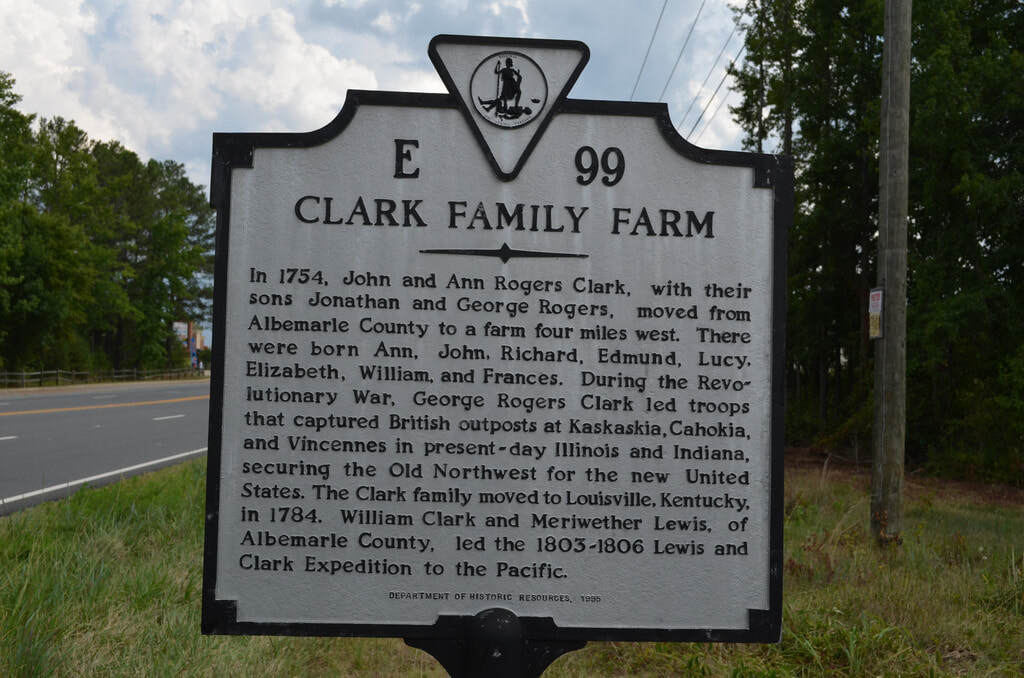
    Jonathan Clark was one of the 8th Virginia’s ten company captains. He was the older brother of the explorer William Clark, famous for the Lewis and Clark expedition. He was also the older brother of George Rogers Clark, the victor of the now-obscure Battle of Vincennes, which won the old “northwest territory” from the British in the Revolution. Did you ever wonder how all the territory east of the Mississippi became American territory after the war, not just the 13 colonies? The answer is George Rogers Clark.

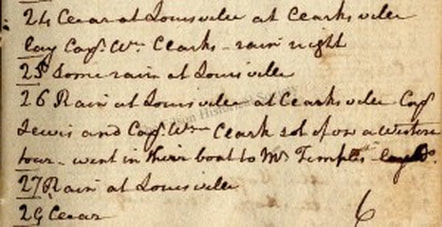
    Jonathan Clark was an important figure in his own right, and left the only comprehensive diary of the 8th Virginia’s experiences in the war. It is frustratingly concise, but also crucially important in piecing the regiment's history together. Jim Holmberg, a Kentucky historian and archivist, wrote a blog post about the eldest Clark brother four years ago on the bicentennial of his death. You can read it here.
    Picture

    More from The 8th Virginia Regiment
    Picture
    Picture
    Picture