• Published on

    The Fort Gower Resolves

    Picture

    "Overlooking the Backtrail" by Doug Hall. (DougHallGallery.com)

    "We will bear the most faithful Allegiance to his Majesty King George III, whilst his Majesty delights to reign over a brave and free People."
    The months before the first shots of the Revolution were full of resolutions and declarations, but only one of them was made by men in arms. The leaders of a victorious militia army, full of bravado on their way back from the frontier, made a statement that was hard to ignore. Like the other declarations, it insisted on American rights while professing continued loyalty to the King. That loyalty was clearly conditional, however, making the document read like a not-so-veiled military threat.
    Virginia, Britain’s oldest and biggest American colony, had charter territory reaching all the way to the Mississippi. While the colony made a genuine effort to respect Indian rights by barring western settlement on land not acquired by treaty, individual settlers ignored these restraints. In 1768, the Treaty of Fort Stanwix extended the settlement line to the Ohio River and opened what are now Kentucky and trans-Appalachian West Virginia to settlement. The treaty was made with the Iroquois, who claimed authority over the region. However, the tribes who actually lived there objected and in 1774 that lead to war.
    Tensions were also starting to boil over between the colonies and the Great Britain. Most Americans strongly objected to Parliament’s levying of “internal” taxes on the colonies because they had no elected representation in London. Parliament clamped down hard on Massachusetts after the Boston Tea Party by blockading Boston Harbor and taking other measures.
    In Williamsburg, Virginia’s House of Burgesses responded by declaring June 1, 1774 a day of fasting, humiliation, and prayer. The Old Dominion’s governor, the Earl of Dunmore, dismissed the legislature. The Burgesses then met at a tavern, where they proposed a non-importation policy against British goods (the word “boycott” did not yet exist), proposed the First Continental Congress, and scheduled the first extralegal Virginia Convention for August 1. The intervening two months were to allow delegates "an Opportunity of collecting their sense of their respective Counties."

    ​[...continue reading at the link below.]
    Picture

    The vicinity of Fort Gower in a 1974 photograph. The exact location is now evidently underwater. (Ohio History Connection)

    More from The 8th Virginia Regiment

  • Published on

    Catholics and the Founding

    Picture
    Our Dear-Bought Liberty: Catholics and Religious Toleration in Early America
    Michael D. Breidenbach (Harvard University Press, 2021)
    Most Americans in pre-revolutionary times had a strong dislike of Catholicism. They believed it to be a religion of ignorance, a religion of tyranny, and the religion of the enemy. The ever-opinionated John Adams attended a mass in Philadelphia in 1774, motivated by “curiosity and good company.” He wrote home to Abigail to describe the “poor Wretches, fingering their Beads, chanting Latin, not a Word of which they understood, their Pater Nosters and Ave Maria’s. Their holy Water—their Crossing themselves perpetually—their Bowing to the Name of Jesus, wherever they hear it—their Bowings, and Kneelings, and Genuflections before the Altar.” 
    He described the priest’s ornate vestments, the beautiful music, and the bloody crucifix above the altar. “Here is every Thing which can lay hold of the Eye, Ear, and Imagination. Every Thing which can charm and bewitch the simple and ignorant. I wonder how Luther ever broke the spell.” He admitted, though, that the sermon was good.

    Protestants’ views of Catholics aside, it was the Church itself, and more specifically the Papacy, that presented a problem for the British Empire. The influential political thinker John Locke asserted in his 1689 Letter Concerning Toleration that a “church can have no right to be tolerated by the magistrate, which is constituted upon such a bottom, that all those who enter into it . . . deliver themselves up to the protection and service of another prince.”[3] By tolerating such a church, a ruler would “suffer his own people, to be lifted, as it were, for soldiers against his own government.”[4] The example he used was Islam, but it was Catholicism he was concerned about.

    ​Michael Breidenbach is a Cambridge University-educated associate history professor at Ave Maria University, an orthodox Catholic school in Florida. His book Our Dear-Bought Liberty: Catholics and Religious Toleration in Early America illustrates the remarkably rapid transformation of Americans’ treatment of Catholics during the Founding Era. Irish Catholics like Capt. John Barry, Lt. Col. John Fitzgerald, and Col. Stephen Moylan played important roles in the Continental Navy and Army. Maryland’s Charles Carroll signed the Declaration of Independence and held a seat on the Continental Congress’s powerful Board of War. Generals Lafayette and Pulaski were both Catholic, as were the French and Spanish empires that came to America’s aid.

    More from The 8th Virginia Regiment

  • Published on

    The “Grand Division Standard” of the 8th Va.

    Picture

    Rob Andrews and Erik Dorman guard an 8th Virginia division standard in front of the Shenandoah County Courthouse in Woodstock, Virginia in 2012. (Courtesy of Rob Andrews)

    Authentic Revolutionary War-era flags are incredibly rare artifacts, and the ones that survive are sometimes misunderstood. A case in point is a flag associated with the 8th Virginia that is privately owned but currently on public display.
     
    Regimental flags were not just symbols—they were, like fifes and drums, used for command and control on the battlefield. Noise, confusion, and black-powder smoke could make it hard for individual soldiers to know what they were supposed to be doing. Failure to stay in formation could quickly lead to a loss on the battlefield. Large, waving, colorful flags helped prevent that from happening.
    While the Grand Union flag and the Stars and Stripes may have appeared on some battlefields, they were more likely to be seen on forts and ships. Virginia had no state flag until the Civil War. Every regiment, however, had a flag that served important symbolic and battlefield purposes. Regimental flags were unique works of art, often featuring symbols from antiquity or popular culture with mottos in English or Latin. The flags of the 1st Pennsylvania Regiment and Connecticut’s 2nd Continental Light Dragoons are among the very few that survive.

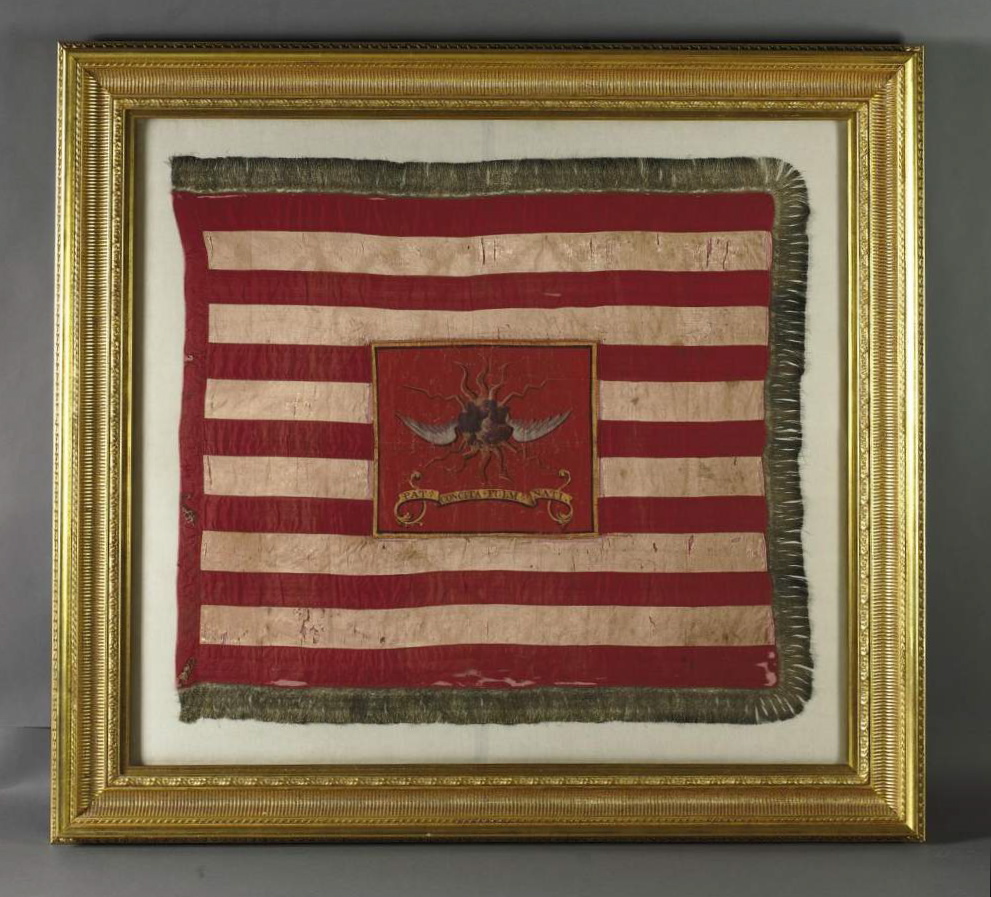
    ​There is, however, an 8th Virginia flag that still exists—but it is not the regimental banner. It is a “grand division standard,” one of two that were used to direct halves of the regiment on the battlefield. These were utilitarian devices with little ornamentation. The most important thing about them was their color. 
    The surviving 8th Virginia division standard was hidden from public view for 150 years. “The first time I heard of the 8th Virginia Standard was during an internet search on the 8th,” reported Rob Andrews, an SAR member and Revolutionary War reenactor with the 1st Virginia Regiment in 2015. What he found was an 1847 reference in the Richmond Whig.  The newspaper quoted Peter Muhlenberg’s great nephew saying, “The regimental color of this corps (8th Virginia Regiment of the Line) is still in the [my] possession.  It is made of plain salmon-colored silk, with a broad fringe of the same, having a simple white scroll in the centre, upon which are inscribed the words, ‘VIII Virga. Reg’t.’ The spear-head is brass, considerably ornamented.  The banner bears the traces of warm service, and is probably the only revolutionary flag in existence.”
    Picture

    A close-up of the flag's fringe also shows the netting that is used conserve the flag. (Author)

    Henry A. Muhlenberg was at that time preparing to publish a biography of his great uncle, the still-useful (but occasionally inaccurate) Life of Major-General Peter Muhlenberg of the Revolutionary Army. The younger Muhlenberg was a member of Congress and quite knowledgeable about his pedigree, but his description of the flag as “the regimental color” was wrong.
    Picture

    The repainted side of the flag as displayed before 2012. Exposure to light resulted in a rectangle of faded fabric in the center of both sides of the flag. (Courtesy of R. Andrews)

    Other than the 1847 reference, Rob could find no mention of the flag anywhere. “I emailed the folks at Valley Forge and the Trappe Foundation in Trappe PA, where the Muhlenberg family lived.  Emails bounced around and finally one person said he thought he knew who had it." Then, Rob said, an email "popped into my box with two pictures of the flag.  It was in a frame and had a card at the bottom stating its provenance." The owner of the flag at that time had purchased it at an auction in the 1960s. The flag had not been professionally conserved, had faded where it faced the glass, and was displayed with a card that claimed a service history that followed General Muhlenberg’s career, but not that of the 8th Virginia (which he led for just a year).
    "In 2012, the flag was sold at Freeman’s Auction in Philadelphia. Prior to the auction, Freeman’s brought it to Shenandoah County to be displayed.  I was lucky that I found out about it just a couple of days prior to the event.  I contacted my friend Erik [Dorman] who also was interested in writing about the 8th and we decided to show up in our uniforms.  We caused quite a stir when we walked around the corner of the Courthouse into the square.  We were immediately enlisted to "guard" the flag and unveil it during the event.”
    Rob also shared one important explanation about the flag’s appearance. “As someone in the past painted the flag so that 8th Virginia was visible” the opposite side of the flag is displayed “to show its original condition.  And its years in the frame have led to its faded rectangle appearance.” The flag was purchased anonymously and is once again owned by a private collector. It was briefly displayed again at the Winterthur Museum in Delaware and is presently on display again in Philadelphia.

    ​The Muhlenburg flag resurfaced six years after another set of Virginia flags reappeared. The flag of the 3rd Virginia “detachment” was put up for auction in 2006 by a descendent of Banastre Tarlton. It is probably the only surviving Virginia regimental flag and is reportedly the oldest existing 13-star flag. It features a beaver (America) felling a tree (the empire) and the motto Perseverando (“By persevering”) in Latin.
    Picture

    The "3rd Virginia Detachment" banner captured by Banastre Tarlton in 1780.

    With it were two smaller, plainer flags of identical design but different colors. The 3rd Detachment was an ad hoc unit cobbled together under Col. Abraham Buford in 1780 from new recruits and soldiers who had avoided capture at Charleston earlier that year. The flags were used at the Waxhaws in South Carolina on May 29 when Tarlton defeated Buford there. It is unlikely that the flags were made specifically for the detachment. The regimental flag is described in detail in a 1778 inventory of then-new flags known as the “Gostelowe Return.” The flags were probably, therefore, inherited from a regiment that was folded into Buford’s detachment. Buford had been colonel of the 11th Virginia, and a number of the men in his detachment were reportedly from the 2nd Virginia. The flag could have come from either of those, or from another.
    Picture
    Picture
    Picture
    The two “grand division” flags from the Buford detachment are almost identical, except for their colors, to the Muhlenberg flag. Buford’s maneuvering flags are blue and yellow. The Muhlenberg flag is a beige color today and was described as a “salmon” color in 1847. A fabric expert advises that the original color was red. The flag has faded considerably just from its time in the frame. It is not hard to imagine it having faded from red to a salmon color over the century or so before it put under glass.

    ​The scrolls on the blue and yellow flags contain only the word "regiment." The word is not centered in the scroll, suggesting that a space was retained to the left  on both flags to be filled in when they were assigned to a specific regiment. The writing in the 8th Virginia's scroll is illegible now. It was retouched on one side by Mr. Goetz or a previous owner to say "VIII Virg Regt." The 1847 account in the Richmond Whig says the scroll was styled a bit differently as "VIII Virga Regt."
    Picture

    The grand division standard as it likely appeared when new, recreated by 8th Virginia Regiment reenactor Nathan Gibson. (Courtesy of Nathan Gibson)

    A comparison of this flag to other Virginia standards could not be done until after it and the Buford flags had all resurfaced. Now that a comparison is possible, it is quite clear that the Muhlenberg flag was in fact one of two divisional standards. Though a maneuvering banner and not the regimental standard, the flag is still a treasure. It was on display at the Museum of the American Revolution in Philadelphia in 2022.

    More from The 8th Virginia Regiment

  • Published on

    The Dunmore & Frederick Resolves

    Picture

    The August 4, 1774 issue of Clementina Rind's Virginia Gazette. Rind was the first woman to run a Virginia newspaper, taking over after her husband passed away in 1773. She is also known for printing Thomas Jefferson's tract A Summary View of the Rights of British America, also in 1774. (Colonial Williamsburg)

    Clementina Rind's Virginia Gazette reported on August 4, 1774 that more than a dozen resolutions had been received from various Virginia counties objecting to the policies of the Crown. "The Northumberland, Orange, King George, Amelia, Frederick, Lancaster, Mecklenberg, Lunenberg, Accomack, King William, Warwick, and a few other resolves, we have received, but couldn't possibly insert them." The four-page newspaper simply couldn't set that much type. Instead, she summarized: "They profess the greatest loyalty and affection towards his majesty, but at the same time, are spirited and determined in the pursuit of their just rights and privileges."

    ​Virginia was half-way to war. When news had arrived in May that Britain was blockading the port of Boston, the House of Burgesses announced that June 1 would be a day of fasting and prayer. Lord Dunmore, the Royal governor, was unhappy about it and "prorogued" (dissolved) the legislature. The burgesses reconvened at the Raleigh Tavern in Williamsburg to organize a "non-importation" agreement (an embargo), to propose the first Continental Congress, and to schedule the first Virginia Convention. The Convention would not meet until August 1 to allow delegates "an Opportunity of collecting their sense of their respective Counties."
    Several counties proceeded to draft "resolves" or resolutions asserting their rights and proclaiming their loyalty to King George III in a sometimes subtly conditional way. Among them was the following declaration from Dunmore County, which was selected from the many at hand by Mrs. Rind for publication. It was drawn up by a committee chaired by Rev. Peter Muhlenberg, the future colonel of the 8th Virginia. Also on the committee were future lieutenant colonel Abraham Bowman, future lieutenant Taverner Beale, and the brother of future captain George Slaughter. They borrowed the text from neighboring Frederick County. The two counties had a shared history: Dunmore was carved out of Frederick in 1772. Muhlenberg may also have felt comfortable borrowing the text in part because Frederick's committee was similarly led by an Anglican clergyman: Rev. Charles Mynn Thruston.

    Rind misspelled Muhlenberg's name two different ways, indicating that he was not yet well known in Williamsburg. The word "votes" was set in capital letters where the word "resolves" would make more sense—another apparent error. Dunmore County was renamed "Shenandoah" County during the Revolution.

    Only one other 8th Virginia county issued resolves that summer. Culpeper County produced its document on July 7, but the text is evidently lost. The document below predates both the First Virginia Convention and the First Continental Congress. More counties issued resolutions after the First Continental Congress adopted the Articles of Association, formalizing a uniform boycott and calling upon county committees in all of the colonies to enforce it. Augusta, Berkeley, Fincastle, and Hampshire counties issued resolutions 1775 and raised companies for the 8th Virginia the following spring. The resolutions from Augusta and Fincastle survive. Fincastle's resolution is famous for being the first to openly threaten war. 

    The Dunmore Resolves

    At a meeting of the freeholders and other inhabitants of the county of Dunmore, held at the town of Woodstock, the 16th day of June, 1774, to consider the best mode to be fallen upon to secure their liberties and properties, and also to prevent the dangerous tendency of an act of parliament, passed in the 14th year of his present majesty’s reign, intituled an act to discontinue in such manner and for such time as we therein mention the landing and discharging, lading or shipping of goods, wares, and merchandize, at the town and within the harbour of Boston, in the province of Massachusetts Bay, in North America, evidently has to invade and deprive us of the same, the reverend Peter Mechlenberg being voted moderator, a committee of the following gentlemen, viz.  the reverend Peter Mechlenberg, Francis Slaughter, Abraham Bird, Taverner Beale, John Tipton, and Abraham Bowman were appointed to draw up resolves to the same occasion, who withdrawing, for a short time, returned with the following VOTES, which had been previously agreed to and voted by the freeholders and inhabitants of the county of Frederick:

    1. That we will always cheerfully pay due submission to such acts of government as his majesty has a right, by law, to exercise over his subjects, as sovereign to the British dominions, and to such only.
    2. That it is the inherent right of British subjects to be governed and taxed by representatives chosen by themselves only, and that every act of the British parliament respecting the internal policy of North America is a dangerous and unconstitutional invasion of our rights and privileges.
    3. That the act of parliament above mentioned is not only itself repugnant to the fundamental laws of natural justice in condemning persons for a supposed crime unheard, but also a despotic exertion of unconstitutional power, calculated to enslave a free and loyal people.
    4. That the enforcing the execution of the said act of parliament by a military power will have a necessary tendency to raise a civil war, thereby dissolving that union which has so long happily subsisted between the mother country and her colonies, and that we will most heartily and unanimously concur with our suffering brethren of Boston, and every other port of North America, that may be the immediate victims of tyranny, in promoting all proper measures to avert such dreadful calamities, to procure a redress of our grievances, and to secure our common liberties.
    5. It is the unanimous opinion of this meeting, that a joint resolution of all the colonies to stop all importations from Great Britain, and exportations to it, till the said act be repealed, will prove the salvation of North America and her liberties; on the other hand, if they continue their imports and exports, there is the greatest reason to fear that power and the most odious oppression will rise triumphant over right, justice, social happiness, and freedom.
    6. That the East India Company, those servile tools of arbitrary power, have justly forfeited the esteem and regard of all honest men, and that the better to manifest our abhorrence of such abject compliances with the will of a venal ministry, in ministering all in their power an encrease of the fund of peculation, we will not purchase tea, or any other kind of East India commodities, either imported now, or hereafter to be imported, except saltpetre, spices, and medicinal drugs.
    7. That it is the opinion of this meeting, that committees ought to be appointed for the purpose of effecting a general association, that the same measures may be pursued through the whole continent, that [the] committees ought to correspond with each other, and to meet at [such] places and times as shall be agreed on, in order to form such [general] association, and that when the same shall be formed and agreed to by the several committees, we will strictly adhere to, and till the general sense of the continent shall be known, we do pledge ourselves to each other, and to our country, that will inviolably adhere to the votes of this day.
    8. Voted, that the reverend Peter Mecklenburg, Francis Slaughter, Abraham Bird, Taverner Beale, John Tipton, and Abraham Bowman, be appointed a committee for the purpose aforesaid, and that they or any three of them are hereby fully empowered to act.

    More from The 8th Virginia Regiment

  • Published on

    Biggs and Brady at Fort McIntosh

    Picture

    Four of Fort McIntosh's early commanders were veterans of the 8th Virginia: Lt. Col. Richard Campbell, Capt. Robert Beall, Capt. Simon Morgan, and Capt. Benjamin Biggs.

    Benjamin Biggs enlisted in Capt. John Stephenson's West Augusta Independent Frontier Company of Provincial regulars in the fall of 1775. The company was soon attached to the 8th Virginia and went south to the Carolinas before the company's one-year enlistments expired. Returning to the Ohio headwaters, Biggs received a commission as a lieutenant in the 13th Virginia and rose to captain in December, 1778. The 13th Virginia (redesigned the 9th in 1778 and later the 7th) was posted at Fort Pitt and commanded by Col. John Gibson and 8th Virginia veteran Lt. Col. Richard Campbell. The 8th Pennsylvania was also posted there. This regiment, commanded by Col. Daniel Brodhead, had been recruited in the same area. Virginia and Pennsylvania both claimed the territory at that time.
     Samuel Brady of the 8th Pennsylvania was a military legend in his own time and the stories of at least some of his exploits have likely been embellished in the retelling. The Biggs and Brady families lived within two miles of each other and were, according to Brady's son, "always o the most intimate term." This story appeared in Graham's Illustrated Magazine in February 1857. The Philadelphia-based magazine did not identify the author. The story is dramatically told, betraying at least some artistic license. There are also some small identifiable inaccuracies (Col. Daniel Brodhead is called "General Richard Brodhead"). While some skepticism is warranted about its details, there is no reason to doubt that the story's basic elements are true. The story was instantly popular, reappearing in numerous publications through the 1880s. Biggs went on to become a general of Virginia militia, playing a role in suppressing the Whiskey Rebellion in 1792. At roughly the same time, Brady was tried in court for murdering Indians, but he was acquitted by the jury.

    The Knife and Tomahawk

    An Unpublished Incident in the Life of Capt. Samuel Brady
    by a Western Man

    Picture

    The illustration that accompanied the story in Graham's Illustrated Magazine, with the caption "Killing the Indians at Bloody Spring."

    About thirty miles below the present city of Pittsburg, stood an ancient fort, known as Fort McIntosh. It was built by a revolutionary general of that name, in the summer of 1778. It was one of a line of forts, which was intended to guard the people who lived south of the Ohio river, from the incursions of the savages to the northward. This fort was one of the favorite resorts of the great Indian spy and hunter, Captain Samuel Brady. Although his usual head-quarters: was Pittsburg, then consisting of a rude fort and a score or two of rough frontier tenements. 

    Brady had emigrated westward, or rather had marched thither in 1778, as a lieutenant in the distinguished Eighth Pennsylvania Regiment, under the command of General Richard Broadhead, of Easton. When, in the spring of 1779, McIntosh retired from command in the West, Broadhead succeeded him, and remained at Pittsburg until 1781. Shortly after his advent to the west, Brady was brevetted Captain. 
    Brady had served at the siege of Boston, fought at Long Island and White Plains, gone through the whole of the terrible campaign of Trenton and Princeton, suffered at Valley Forge, distinguished himself at Germantown and Brandywine, and narrowly escaped death at Paoli. But his tastes led him to the erratic mode of warfare known upon the frontier. Indeed, his early education upon the upper Susquehanna had inculcated and developed those tastes from the very earliest boyhood. Hating an Indian with that instinctive hatred, which is begotten in the bosom of the white race, by long years of contest and outrage, a bitter intensity was imparted to the feeling in his case by the murder of his father and younger brother by the Indians, under trying and terrible circumstances,
    Having premised this much by way of introduction, it brings us to the opening of our story. On the 2lst day of August, 1779, Brady set out from Fort McIntosh, for Pittsburg. He had with him two of his trusty and well-tried followers. These were not attached to the regular army, as he was, but were scouts and spies, who had been with him upon many an expedition. They were Thomas Bevington and Benjamin Biggs. Brady resolved to follow the northern bank of the Ohio. Biggs objected to this, upon the ground, as Brady well knew, that the woods were swarming with savages. Brady, however, had resolved to travel by the old Indian path, and having once made up his mind, no consideration could deter him from carrying out his determination. Bevington had such implicit faith in his ability to lead, that he never thought of questioning his will.
    Picture

    Samuel Brady (Wikipedia).

    Quite a discussion arose between Biggs and his captain at the mouth of Beaver river, about a mile above the fort, and where they must cross the Ohio, if they continued upon the northern side. Biggs finally yielded his objections, and they crossed Beaver, and proceeded with the habitual caution of woodsmen who fully understand their business. They had started early, and by rapid traveling they had reached, ere noon came, the last piece of bottom land on the north side of the river, just below what is known as the Narrows. Upon this bottom a pioneer, more daring than most others, had built a cabin, and opened a small spot of cleared land. He had planted it in corn, and it gave promise of a most abundant harvest. 
     
    But, as they approached the edge of the clearing, just outside of the fence, Brady discovered “Indian signs,” as he called them. His companions discovered them almost as quick as he, and at once, in low tones, communicated to each other the necessity for a keen watch. They slowly trailed them along the side of the fence toward the house, whose situation they well knew, until they stood upon the brow of the bluff bank which overlooked it. A sight of the most terrible description met their eyes. The cabin lay a mass of smouldering ruins; from whence a dull blue smoke arose in the clear August sunshine. They observed closely everything about it. Brady knew it was customary for the Indians after they had fired a settler’s cabin, if there was no immediate danger, to retire to the woods close at hand, and watch for the approach of any member of the family who might chance to be absent when they made the descent. Not knowing but that they were even then lying close by, he left Bevington to watch the ruins, lying under cover, whilst he proceeded to the northward, and Biggs southward, to make discoveries. Both were to return to Bevington, if they found no Indians. If they came across the perpetrators, and they were too numerous to be attacked regularly, Brady declared it to be his purpose to have one fire at them, and that it should be a signal for both of his followers to make the best of their way to the fort. 
    Picture

    Benjamin Biggs' house north of Wheeling, W.V. shortly before it was taken down about 1960. (West Liberty Historical Society)

    All this rapidly transpired, and with Brady to decide, was to act. As he stole cautiously round to the northern side of the inclosure, he heard a voice in the distance singing. He listened keenly, and soon discovered from its intonations, that it was a white man’s. He passed rapidly in the direction whence the sound came. As it approached, he concealed himself behind the trunk of a large tree. Presently a white man, riding a fine horse, came slowly down the path. The form was that of Albert Gray, the stalwart, brave, devil-may-care settler, who had built him a home miles away from the fort, where no one would dare to take a family, except himself.
    Brady wore, as he almost always did, the Indian garb, and had war paint upon his face. He knew that if he showed himself upon the path, Gray would shoot, taking him to be an Indian. He therefore suffered Gray quietly to approach his lurking place. When the time came, he sprang forward ere the settler could have time to prepare, drew his tomahawk, and seizing him, dragged him from his horse. As he did so, he whispered to him: ‘‘I am Captain Brady, for God's sake be quiet.” 
     
    Gray, with the instinctive feeling of one who knew there was danger, and with that vivid presence of mind which characterizes those acquainted with frontier life, ceased at once to struggle. The horse had been started by the sudden onslaught, and sprung to one side. Ere he had time to leap forward, Brady had caught him by the bridle. His loud snorting threatened to arouse any one who was near. The Captain soon soothed the frightened animal into quiet. 
     
    Gray now hurriedly asked Brady what the danger was. The strong, vigorous spy, turned away his face unable to answer him. The settler’s already excited fears were thus turned into realities. “The manly form shook like an aspen leaf, with emotion—tears fell as large drops of water over his bronzed face. Brady permitted the indulgence for a moment, whilst he led the horse into a thicket close at hand and tied him. When he returned Gray had sunk to the earth and great tremulous convulsions writhed over him. Brady quietly touched him upon the shoulder and said, “Come.” He at once arose, and had gone but a few yards until every trace of emotion had apparently vanished. He was no longer the bereaved husband and father—he was the sturdy, well-trained hunter, whose ear and eye were acutely alive to every sight or sound, the waving of a leaf or the crackling of the smallest twig. 
     
    He desired to proceed directly toward the house, but Brady objected to this, and they passed down toward the river bank. As they proceeded, they saw from the tracks of horses and moccasin prints upon the places where the earth was moist, that the party was quite a numerous one. After thoroughly examining every cover and possible place of concealment, they passed on to the southward and came back in that direction to the spot where Bevington stood sentry. When they reached him they found that Biggs had not returned. In a few minutes he came. He reported that the trail was large and broad; the Indians had taken no pains to conceal their tracks—they simply had struck back into the country, so as to avoid coming in contact with the spies whom they supposed to be lingering along the river. 
    The whole four now went down to the cabin and carefully examined the ruins. After a long and minute search, Brady declared in an authoritative manner, that none of the inmates had been consumed. This announcement at once dispelled the most harrowing fears of Gray. As soon as all that could be discovered had been ascertained, each one of the party proposed some course of action. One desired to go to Pittsburg and obtain assistance—another thought it best to return to McIntosh and get some volunteers there—Brady listened patiently to both these propositions, but arose quickly, after talking a moment apart with Biggs, and said, “Come.” 

    Gray and Bevington obeyed at once, nor did Biggs object. Brady struck the trail and began pursuit in that tremendous rapid manner for which he was so famous. It was evident that if the savages were overtaken, it could only be done by the utmost exertion. They were some hours ahead, and from the number of their horses must be nearly all mounted. Brady felt that if they were not overtaken that night, pursuit would be utterly futile. It was evident that this band had been south of the Ohio and plundered the homes of other settlers. They had pounced upon the family of Gray upon their return. 
    Picture

    The grave of Gen. Benjamin Biggs in West Liberty, W.V. The stone is broken, with the top half leaning against the base from behind. (Findagrave)

    When the pursuit began, it must have been two o’clock, at least two hours had been consumed by the spies in making the necessary exploration about the house, ere they approached it, and in examining the ruins. Not a word was spoken upon the route by any one. Their leader kept steadily in advance. Occasionally he would diverge from the track, but only to take it up again a mile or so in advance. The Captain’s intimate knowledge of the topography of the country, enabled him to anticipate what points they would make. Thus he gained rapidly upon them by proceeding more nearly in a straight line toward the point at which they aimed to cross Beaver River. 
     
    At last, convinced from the general direction in which the trail led, that he could divine with absolute certainty the spot where they would ford that stream, he abandoned it and struck boldly across the country. The accuracy of his judgment was vindicated by the fact, that from an elevated crest of a long line of hills, he saw the Indians with their victims just disappearing up a ravine on the opposite side of the Beaver. He counted them as they slowly filed away under the rays of the declining sun. There were thirteen warriors, eight of whom were mounted—another woman, besides Gray’s wife, was in the cavalcade, and two children besides his—in all, five children. 
     
    The odds seemed fearful to Biggs and Bevington; although Brady made no comments. The moment they had passed out of sight, Brady again pushed forward with unflagging energy, nor did his followers hesitate. There was not a man among them whose muscles were not tenseand rigid as whip-cord, from exercise and training, from hardship and exposure. Gray’s whole form seemed to dilate into twice its natural size at the sight of his wife and children. Terrible was the vengeance he swore. 
     
    Just as the sun set, the spies forded the stream and began to ascend the ravine. It was evident that the Indians intended to camp for the night some distance up a small creek or run, which debouches into Beaver River, about three miles from the location of Fort McIntosh, and two below the ravine. The spot, owing to the peninsular form of the tongue of the land lying west of the Beaver, at which they expected to encamp, was full ten miles from that fort. Here there was a famous spring, so deftly and cunningly situated in a deep dell, and so densely inclosed with thick mountain pines, that there was little danger of discovery! Even they might light a fire and it could not be seen one hundred yards. 
     
    The proceedings of their leader, which would have been totally inexplicable to all others, were partially, if not fully, understood by his followers. At least, they did not hesitate or question him. When dark came, Brady pushed forward with as much apparent certainty as he had done during the day. So rapid was his progress, that the Indians had but just kindled their fire and cooked their meal, when their mortal foe, whose presence they dreaded as much as that of the small-pox, stood upon a huge rock looking down upon them. 
     
    His party had been left a short distance in the rear, at a convenient spot, whilst he went forward to reconnoitre. There they remained impatiently for three mortal hours. They discussed in low tones the extreme disparity of the force—the propriety of going to McIntosh to get assistance. But all agreed that if Brady ordered them to attack, success was certain. However impatient they were, he returned at last.
    Picture

    A flat modern marker at the base of Biggs' grave outlines his military and political service. (Findagrave)

    He described to them how the women and children lay within the centre of a crescent formed by the savages as they slept. Their guns were stacked upon the right, and most of their tomahawks. The arms were not more than fifteen feet from them. He had crawled within fifty feet of them, when the snortings of the horses, occasioned by the approach of a wild beast, had aroused a number of the savages from their light slumbers, and he had been compelled to lie quiet for more than an hour until they slept again, 
    He then told them that he would attack them. It was impossible to use fire arms. They must depend solely upon the knife and tomahawk. The knife must be placed in the left hand and the tomahawk in the right. To Biggs he assigned the duty of securing their arms. He was to begin the work of slaughter upon the right, Gray upon the left, and Bevington in the centre. 
     
    After each fairly understood the duty assigned him, the slow, difficult, hazardous approach began. They continued upon their feet until they had gotten within one hundred yards of the foe, and then lay down upon their bellies and began the work of writhing themselves forward like a serpent approaching a victim. They at last reached the very verge of the line, each man was at his post, save Biggs, who had the farthest to go. Just as he passed Brady’s position, a twig cracked roughly under the weight of his body, and a huge savage, who lay within the reach of Gray’s tomahawk, slowly sat up as if startled into this posture by the sound. After rolling his eyes, he again lay down and all was still. 
     
    Full fifteen minutes passed ere Biggs moved; then he slowly went on. When he reached his place, a very low hissing sound indicated that he was ready, Brady in turn reiterated the sound as a signal to Gray and Bevington to begin. This they did in the most deliberate manner. No nervousness was permissible then. They slowly felt for the heart of each savage they were to stab, and then plunged the knife. The tomahawk was not to be used unless the knife proved inefficient. Not a sound broke the stillness of the night as they cautiously felt and stabbed, unless it might be that one who was feeling would hear the stroke of the other’s knife and the groan of the victim whom the other had slain. Thus the work proceeded. Six of the savages were slain. One of them had not been killed outright by the stab of Gray. He sprang to his feet, but as he arose to shout his war cry, the tomahawk finished what the knife had begun. He staggered and fell heavily forward, over one who had not yet been reached. He in turn started up, but Brady was too quick, his knife reached his heart and the tomahawk his brain almost at the same instant. 
     
    All were slain by the three spies, except one. He started to flee, but a rifle shot by Biggs rang merrily out upon the night air and closed his career. The women and children, alarmed by the contest, fled wildly to the woods; but when all had grown still and they were called, they returned, recognizing amid their fright the tones of their own people. The whole party took up their march for McIntosh at once. About sunrise next morning the sentries of the fort were surprised to see the cavalcade of horses, men, women and children, approaching the fort. When they recognized Brady, they at once admitted him and the whole party, 
    In the relation of the circumstances afterward, Bevington claimed to have killed three and Gray three. Thus Brady, who claimed nothing, must have slain at least six, whilst the other two slew as many. The thirteenth Biggs shot. 
     
    From that hour to this, the spring is called the “Bloody Spring!” and the small run is called, ‘‘Brady’s Run.” Few, even of the most curious of the people living in the neighborhood, know aught of the circumstances which conferred these names; names which will be preserved by tradition forever. Thus ended one of the very many hand-to-hand fights which the great spy had with the savages. His history is fuller of daring incident, sanguinary, close, hard contests, perilous explorations and adventurous escapes, than that of either of the Hetzels, of Boone or Kenton. He saw more service than any of them, and his name was known as a bye-word of terror among the Indian tribes, from the Susquehanna to Lake Michigan.
    Picture

    The February, 1857 issue of Graham's Illustrated Magazine.

    More from The 8th Virginia Regiment

  • Published on

    Veterans at Rest: Known Graves, L-Z

    Picture
    Sgt. James Lamb was born in 1756 in Scotland. He enlisted in Capt. David Stephenson's company in March, 1776. He married Hannah Boone, first cousin of Daniel Boone. He moved to Bourbon County, Kentucky after the war. and then to Wayne County, Indiana. In 1812 he left Kentucky and moved to Wayne County, Indiana because of his strong anti-slavery views. He died after falling from a horse in 1841 and is buried in Elkhorn Cemetery near Richmond, Indiana. His house in Wayne County is still standing.
    Picture
    Fife Major William Lipscomb, Jr. was in Louisa County in 1756. His father was a member of the Louisa County Committee of Safety. He was appointed fife major in February 1778, a few months before the regiment folded into the 4th Virginia. He continued on until at least April 1779. He moved with his family to South Carolina and died there in  1802. He is buried in the Lipscomb Family Cemetery in Cherokee County.
    Picture
    Charles Love was born in Pennsylvania and enlisted in 1777 as a substitute for another soldier. He moved to Catlettsburg, Kentucky after the war and then to Cabell County, now West Virginia, where he was a justice of the peace. He died in 1824 and is buried in Guyandotte Cemetery.
    Picture
    A memorial to William Lewis Lovely is surrounded by campsites in Lake Dardanelle State Park, near Russellville, Arkansas. Lovely was a lieutenant in Capt. James Knox's company and followed Knox into Morgan's Rifles. Lovely rose to captain, but not while with Morgan. He was a federal Indian agent after the war, best known for brokering peace between the Cherokee and Osage tribes. The location of this marker near the shore of a manmade lake suggests it may be a cenotaph.
    Picture
    Martin Maney was born in County Wexford, Ireland in 1752. He served in Capt. James Knox's company. His pension states that he enlisted on about December 4, 1775 at the Long Island of the Holston River (now Tennessee). This was before Knox or his subaltern officers were appointed and may indicate that he first served in William Russell's Southwest Frontier Independent Company and left that unit with Knox to form the new company. He deserted on June 7, 1776, possibly in protest of the still-provincial regiment leaving Virginia for the Carolinas. He enlisted again in the 9th Virginia Regiment. He married Keziah Vann in 1781. He performed active militia service under John Sevier in 1780 and 1782 and performed scout service. He lived in Blount County, Tennessee and Buncombe County, North Carolina. He died in 1830.
    Picture
    Lieut. Thomas Miller, a native of Maryland, signed on as an ensign in Captain Darke's company in 1777. He rose to 2nd lieutenant and was briefly believed to have been captured at Germantown. Later in the war, he was at the battles of Cowpens and Guilford Courthouse. He was unable to drop the bad habits he developed during the war, abandoning his family and struggling with alcoholism. He is buried in the Patriot Square section of Grandview Cemetery in Chillicothe, Ohio.
    Picture
    Lieut. Christopher Moyers (also "Myer" and "Moyer") was born in Culpeper, Virginia in 1740. He was made an ensign in Capt. William Darke's company in August of 1776. The regiment was in South Carolina at this time, suggesting he was promoted from the ranks. He rose to 2nd lieutenant in May 1777 and was captured at the Battle of Germantown on October 4. He and Ens. Philip Huffman escaped in June of 1778 and returned to service. Moyers was promoted to 1st lieutenant and served another year, resigning in March 1779. His wife's name was Susannah. He moved to Jefferson County, Tennessee, where he was one of the first settlers of White Pine. He died in 1815, and is buried in the "Old Christopher Moyers Graveyard in White Pine. His government-issue headstone identifies him as a lieutenant of the 4th Virginia Regiment, which is accurate for his last few months of service.
    Picture
    Maj. Gen. Peter Muhlenberg was born in Trappe, Pennsylvania in 1746. He was the son of Henry Muhlenberg, the patriarch of the Lutheran Church in the America and the grandson (on his mother's side) of Conrad Weiser, an important early Indian trader and diplomat. He served briefly in the British 60th Regiment in the 1760s. He married Anna Barbara Meyer in 1770. He was ordained by his father and then ordained in the Church of England to lead a parish in the Shenandoah Valley. He served in the revolutionary Virginia Convention, received a colonel's commission in 1775 and was promoted to general in 1777. He played an important role in the Yorktown campaign and received a brevet promotion to major general at the end of the war. He returned to Pennsylvania and served as Vice President of that state and in the U.S. House and Senate. He died in 1807 and is buried in Trappe.
    Picture
    Lieut. Jacob Parrot was born about 1744. His parents lived in a cabin at the headwaters of Jordan Run in what is now Shenandoah County. They were probably from Switzerland. They were among the very earliest settlers of the Shenandoah Valley, acquiring their land from Jost Hite in the North Mountain settlement near the future sites of Woodstock and Toms Brooks. He inherited their house and was living there in 1786. He was commissioned an ensign in Capt. Jonathan Clark's company in March 1776 and promoted to 2nd lieutenant a year later. He was cashiered that May for being away without leave.  He died in May of 1829 and is buried in St. John Lutheran Cemetery in Singers Glen, Rockingham County. Since this photo was taken in 2013 his marker has broken and is in urgent need of attention. He was the brother of Joseph Parrot.
    Picture
    Capt. Joseph Parrett was born in what is now Shenandoah County, Virginia in 1760. He enlisted in Capt. Jonathan Clark's company two months before his sixteenth birthday in February 1776. He was promoted to sergeant in 1777 and may have been briefly detached to Morgan's Rifle Battalion. He was discharged at Valley Forge in January, 1778. He served as ensign of a Shenandoah County militia company in 1779 and as a lieutenant in 1781. He was referred to late in life as "captain," probably referring to further militia service. He married Anna Maria Wendel in 1780 and moved to Fayette County, Ohio about 1812. He married Anna Hartman in 1837 and died in 1847. He is burial site was reportedly obliterated by development, but there is a memorial stone for him in nearby Sugar Grove Cemetery in Clinton County, Ohio.
    Picture
    Cpl. Edward Poe enlisted in Capt. William Darke's company early in 1776 and was promoted at some point to corporal. He reenlisted in December and was listed once (possibly in error) as a sergeant. He was detached to the artillery in 1777 and was assigned to Captain Croghan's company after the regiment was folded into the 4th Virginia. He was probably taken prisoner at Charleston in 1780. Poe was born in 1732, making him twenty years older than the average enlisted man. He was born in Bucks County, Pennsylvania. He married Martha Britain in 1753 and was remarried about 1776 to Catherine Edward. He lived in Baltimore County, Maryland for a few years after the war and then moved to Bracken County, Kentucky in 1797. He died there in 1816. He is buried in Sharon Cemetery next to Catherine. (Mike Smith)
    Picture
    James Range was born in Somerset County, New Jersey in 1754. He enlisted in Capt. William Darke's company early in 1776 and was captured by the enemy on October 1, 1777--three days before the Battle of Germantown. His two year enlistment expired while he was in captivity and was liberated in an exchange of prisoners in August, 1778. He explored the Warpath River in what is now middle Tennessee in 1779 and may have served militia duty under Gen. Edward Stevens during the Yorktown campaign. He married Barbara Hammer in 1787 in Washington County, North Carolina (now Tennessee. He died in 1825 in Carter County, Tennessee. His gravestone is improperly marked "8th Va. Mil[itia]."
    Picture
    Col. Jacob Rinker, Jr. was born in what is now Shenandoah County, Virginia to Swiss immigrants in 1749. He was appointed a lieutenant under Capt. Jonathan Clark in March 1776. He resigned his Continental commission after about fourteen months, but led a militia company under Gen. Nathanael Greene in 1780. He may also have served under Gen. George Rogers Clark in the Illinois Regiment. He married twice, voted to ratify the U.S. Constitution, and served several years in the Virginia House of Delegates. He died in 1827 and is buried near his father in a beautiful hilltop cemetery in western Shenandoah County. His lifelong home, built by is father, still stands nearby.
    Picture
    Ashkenaz Shappee, usually recored as "Askin Shippy," served as quartermaster sergeant from June 3, 177 until about April of 1778. Genealogies state he was born in Lorraine, France in 1749 and may have belonged to a a Huguenot family. He died in New York in 1797 and is buried in Beaver Dams in the northwest corner of  Chemung County, 
    Picture
    Jacob Sivley was born in what is now Shenandoah County and drafted into Capt. Jonathan Clark's company in February 1778. He was put in Capt. Abraham Kirkpatrick's company of the temporarily combined "4th-8th-12th Virginia Regiment" and stayed with Kirkpatrick when the 8th Virginia was folded into the 4th Virginia in the fall of 1778. He was discharge in February 1779. He moved to Tennessee before 1808 and then settled on Indian Creek, south of  Huntsville, Alabama. He married a widow named "Alcey" or "Alice" (possible Alice). He died in September 1816 and is buried Huntsville.
    Picture
    Col. John Stephenson was born in Frederick County, Virginia in 1736. He served in Dunmore's War and may have served in the French & Indian War. He settled near what is now Connellsville, Pennsylvania in 1768. In 1775, he was made captain of the second West Augusta independent frontier company, which was later assigned to the 8th Virginia. He was a colonel of Yohogania County militia in 1778, leading men in the Squaw Campaign and the McIntosh Expedition. He moved to what is now Harrison County, Kentucky about 1790. He married a woman named Mary, but they had no children. He died in 1801 and was buried near his home, which is still standing. His roughly-made gravestone was stolen in the 1980s but recently reappeared. 
    Picture
    Chaplain Christian Streit was born in Pennsylvania in 1749 to Swiss immigrants. He studied theology under Henry Muhlenberg, father of 8th Virginia Col. Peter Muhlenberg and was ordained in 1770. He was recommended as a chaplain by Henry Muhlenberg in 1776 and is recognized as the first denominationally-sponsored army chaplain in American history. He joined the regiment in 1777 was later chaplain of the 9th Virginia Regiment. He was taken prisoner at the fall of Charleston in 1780. He preached in Pennsylvania after the war before moving to Virginia in 1785. He was minister of what is now Grace Lutheran Church in Winchester, but served congregations in Woodstock and Strasburg as well. He died in 1812 and is buried In Mount Hebron Cemetery in Winchester. His house is still standing.
    Picture
    Robert Wadsworth enlisted in in 1776 into Abel Westfall's company in what is now Hardy County, West Virginia. In 1777, he was one of four 8th Virginia men chosen to join the Commander in Chief's Life Guard. He lived until 1823 and is buried in Shinnston, Harrison County, West Virginia.
    Picture
    Capt. Abel Westfall commanded the 8th Virginia’s Hampshire County company. He came from a Dutch family. According to one genealogy, his great-great grandfather arrived in New York in 1642 to manage Gov. Peter Stuyvesant’s farm in New Amsterdam. He raised his company early in 1776 and resigned late in 1777. After the Revolution, he founded the town of Westfall, Ohio. The town no longer exists, but the Westfall School District still carries his name. He moved to Indiana and died there in 1814. He is buried in Bloomfield, Indiana next to his brother. (Sam Zuckschwerdt)
    Picture
    Lieutenant Cornelius Westfall began as a sergeant in his brother's company early in 1776. he was commissioned an ensign and promoted to 2nd lieutenant in 1777. He resigned on April 21, 1778. He and his brother moved to Ohio and then to Indiana. Cornelius married a widow, Elizabeth Springstone (nee Lambert) in 1787. He died in 1829. He is buried in Bloomfield, Indiana. (Sam Zuckschwerdt)
    Picture
    Henry Wysor enlisted in Capt. Thomas Berry's company in February of 1776 and was chosen to join the Provisional Rifle Corps under Daniel Morgan in 1777. He participated in the victory at Saratoga and witnessed the surrender of General Burgoyne. He went home after his two-year enlistment ended in 1778, but was drafted into the militia in 1781 when General Cornwallis entered Virginia in 1781. Wysor was at Yorktown for the British surrender in October. He died in 1844 and is buried with several members of his family at Wysor cemetery in Pulaski County, Virginia. His artfully-created headstone appears to be one of very few original ones remaining. (Wilderness Road Regional Museum)
    Picture
    John Wyatt was born in London and drafted into the 8th Virginia from Botetourt County in February of 1778.  He joined the army at Valley Forge and engaged in his first battle at Monmouth at the end of June as part of the merged "4th 8th 12th Virginia Regiment." He reenlisted and was taken prisoner with most of the Virginia line at Charleston in 1780. He was exchanged early enough to be present for the surrender of Cornwallis at Yorktown. He moved to Kentucky after the war, got married, had one daughter, and is buried in Milroy Cemetery in Rush County, Indiana.
    Picture
    Christopher Young enlisted in Jonathan Clark's company on January 28, 1776 and was promoted to corporal on August 1 of the same year. He fought at Brandywine but was assigned to guard the baggage during the Battle of Germantown. After completing his two-year enlistment, he was discharged at Valley forge. He moved to Ohio after the war and lived to be nearly 90 years old. He is buried only a few feet from Lt. Thomas Miller in the "Patriot Square" section at Grandview Cemetery in Chillicothe.

    Memorials and Other Markers

    Picture
    Richard Cain enlisted in Capt. Abel Westfall's company in February, 1776. He was wounded at Brandywine or Germantown and served the rest of his enlistment in the hospital. He was discharged early in 1778. He married Jean, whose maiden name is not known. He was one of the founders of Forks of Cheat Baptist Church in Monongalia County, West Virginia. The original log church is long gone and there is no surviving marker for Cain, though a plaque marks the site of the original church.
    Picture
    A memorial to Sgt. William Combs (also Coombs and Coomes) and other family members in St. Lawrence Catholic in Davis County, Kentucky. Combs enlisted in Capt. Richard Campbell's company in February 1776 and was discharged at Valley Forge two years later. He married Nell Cloud, possibly a relative of Daniel Cloud. He lived in Lincoln County, Kentucky in 1795 and then Bath County in 1818. He was a school teacher. He died in 1840. It is not clear from the marker that he is buried on-site. Moreover, Bath and Davis counties are two hundred miles apart and there appears to be another "Coombs" family in Kentucky at the period that originated from Maryland. Separate genealogies can be seen here and here.
    Picture
    Capt.-Lieut. Leonard Cooper was from Shenandoah County and began the war as an ensign in Capt. Richard Campbell's Company. He rose to lieutenant and then "captain-lieutenant" (lieutenant in command of the colonel's company) in 1779. He had a leg amputated after a duel with Maj. Abraham Kirkpatrick and served out the war in the Invalid Corps. He married Christina Throenberger in 1796 and drowned in the Shenandoah River in 1821 after falling from his horse. The grave of another Leonard Cooper, one of the first settlers of Point Pleasant, West Virginia, is mismarked with a stone honoring Capt.-Lieut. Cooper's service. 
    Picture
    Maj. Peter Helphenstine was born in Germany and emigrated to Winchester in the 1750s with his wife and first son. He died in 1778 or 1779 of complications of malaria contracted during the regiment's tough summer in the Carolinas in 1776. He resigned that summer and returned home, never to recover. He is buried in Mount Hebron Cemetery in Winchester in an unmarked grave. Though a man of stature, he family was left destitute after his death. It is likely that his family could not afford a stone memorial for him when he died and made do with one made of wood. A nearby plaque lists all of the Revolutionary War veterans buried in the historic cemetery.
    Picture
    Cpl. Drury Jackson of Capt. George Slaughter's company is buried in Virginia. Though he was in Georgia as a soldier, he never lived there. In the 1930s, the DAR ordered a veteran's headstone for another man with the same name buried in Baldwin County, Georgia. The "real" Drury Jackson enlisted with his brother Utey in 1776. Utey died of malaria in Charleston, but Drury survived the war and lived nearly his whole life in what is now Madison County, Virginia. It appears he moved to nearby Shenandoah County shortly before he died, and he is certainly buried there or (possibly) in Madison. His actual marker is long gone and this memorial to his military service still stills atop another man's grave.
    Picture
    This memorial to Enoch Job (also "Jobe") was dedicated by the Rock Island Chapter, DAR in 2018. Job was a former Quaker who enlisted in Captain Clark's company in 1776 but missed the rendezvous and was assigned to Captain Croghan's company for the first year. He was discharged in 1778. He lived in Tennessee and Kentucky before settling in Cole County, Missouri in 1819. He died in 1843. His grave site is not known, but this memorial is at Old Salem Church in Moniteau County.
    Picture
    A Giles County, Virginia memorial honors James Johnston and several other Revolutionary War veterans. Johnston served in Capt. George Slaughter's company from Culpeper and then relocated to what became Giles County. His pension application includes a uniquely complete and coherent summary of the regiment's service. The site of his grave is not known.
    Picture
    Sgt. Jacob Kneisley (Nicely) of Capt. Jonathan Clark's company is believed to be buried here in Old Dutch Cemetery in Highland County, Ohio. Kneisley was the son of Swiss immigrants and remembered as a wagon driver before he enlisted early in 1776. He was reported as having deserted on July 2, 1777 but claimed with support from Lt. Jacob Parrott (who was cashiered after Germantown) to have served to the end of the war. He died in 1830. (Findagrave) 
    Picture
    The possible but unconfirmed grave of John Sloan, a private in Capt. George Slaughter's Culpeper County company. Sloan enlisted for an unusual one-year term in January of 1777, suggesting he may have been a substitute serving out another man's two-year enlistment. Bryant Sloan, likely an older brother, enlisted for two years in the same company early in 1776. Bryant moved to Kentucky and died there. John also appears to have been in Kentucky, participating in the reprisal against New Chillicothe after the Battle of Blue Licks. This grave is in Trinity United Methodist Church's cemetery in Alexandria, Va. It is original,  decorated with an SAR medallion, and has dates correct for a man with Sloan's service history. It was rare, however, for veterans to move farther east after the war, particularly after service and known family in Kentucky.
    Picture
    Adjutant Francis Swaine was buried in 1820 in the cemetery of Trinity Lutheran Church in Reading, Pennsylvania. He was Colonel Muhlenberg's brother-in-law. In 1779 he became clothier for the Pennsylvania state line and was a general in the state militia in the early 1800s. He was buried "near the walls" of the church. In 1895 it was reported that a "large marble slab (now broken in two) marks his grave, and bears the inscription: 'Gen. Francis Swaine/Born January 2nd, 1754/Died June 17th, 1820.' Several graves that were covered by a church expansion are now listed on two marble slabs.
    Picture
    The family cemetery at Warrenwood, the home of Capt. William Warren, was removed to accommodate road expansion in 1990. Warren enlisted as a private in Capt. Richard Campbell's company in 1776 and served for two years. He was later a captain in the Shenandoah County militia, before moving to Kentucky. His remains are now in a mass grave in Bellevue Cemetery in Danville, Kentucky.