• Published on

    How Close Was William Darke to George Washington?

    Picture

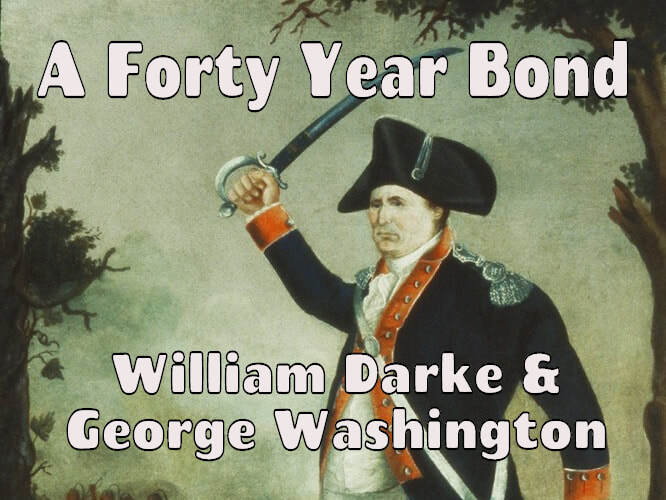
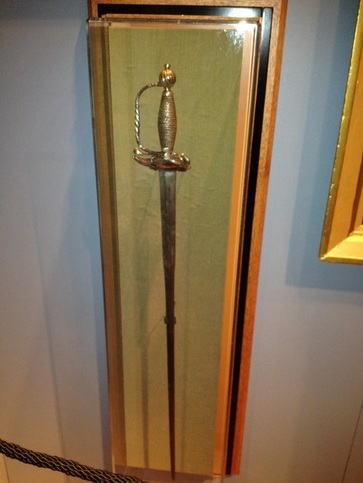
    The sword believed to have been given by William Darke to George Washington. (CivilWarTalk.com)

    In the largest battle ever fought between Native Americans and European Americans, the “whites” lost—miserably. At the Battle of Wabash, in 1791, more than a thousand Americans were killed or wounded.  (This puts the much more famous Battle of Little Big Horn--“Custer’s Last Stand”, where about 270 U.S. soldiers died--into context.) Reputations were ruined, too. The only reputation that seems to have survived intact was that of Lt. Colonel William Darke, a veteran of the 8th Virginia Regiment of Foot. During the battle, Darke saw his own son take a wound that would kill him after several days of agony.

    Darke is a poorly remembered hero of the American frontier. He served in virtually every frontier conflict from the French and Indian War to the Whiskey Rebellion. He was among the first captains to recruit a company for the 8th Virginia in 1776 and was captured at the Battle of Germantown a year-and-a-half later. 
    After a prisoner exchange he immediately recruited a regiment of frontier militia and was present for the victory at Yorktown. An Ohio county and a West Virginia town are named after him. He was well-known to George Washington, who personally asked him to serve in General Arthur St. Clair’s army of 1791. 

    ​Washington clearly knew Darke and respected him. They may have served together in General Braddock’s army in 1755—though this is unproven and seems unlikely. If they served together in the French and Indian War it was more likely during the less well-known frontier conflicts that followed, when Darke served as a ranger. After the revolution, they had a business relationship though the Potomac Company, formed by Washington and others to make that river navigable. Darke Visited Mount Vernon in 1786 and 1787. Washington visited with Darke near the latter’s home close to Harper’s Ferry in 1790. In 1791, Washington wrote to Darke asking him to recruit officers for St. Clair’s army in advance of the campaign to pacify the Indians in Ohio. In that letter Washington bluntly and unapologetically told Darke that he was his third choice to command a regiment—pending a reply from his second choice (his first choice was “Light Horse Harry” Lee, who declined).
     
    Intriguingly, what may be the best evidence of a close (but certainly unequal) relationship between Darke and Washington is a gift. According to longstanding tradition—apparently perpetuated by descendants of Washington’s nephew—Darke presented Washington with a sword. The date of the presentation is unknown, but it is believed by at least one researcher to have been worn by Washington at his presidential inauguration. The sword itself is real—it is on display at the Washington’s Headquarters Museum in Morristown, New Jersey. 

    More from The 8th Virginia Regiment
  • Published on

    Why This 8th Virginia Flag Survived

    Picture
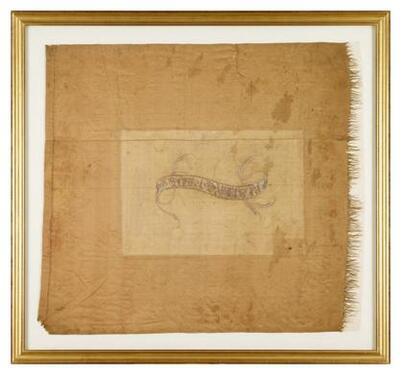
    This "grand division standard" of the 8th Virginia Regiment survives in private hands, one of very few surviving Revolutionary War flags. It was kept by the Muhlenberg family for many years and was reported on display as late as the 1840s. It was later owned by the late Bernard Goetz, who kept it behind a plain glass in a frame. Over the years, the exposed part of the flag faded, resulting in a discolored rectangle in its central portion. Nevertheless, the flag survives, and in better condition than most other surviving banners.
    Part of the key to the flag's survival is its construction from "unweighted silk." According to RareFlags.com:

    One of the most luxurious and expensive of all fabrics, the use of silk in American flags is typically reserved for the finest quality flags, most often for military or official use. Several qualities of silk make it an exceptionally good fabric for use in flags. The material is light-weight, exceptionally strong, tightly woven and weathers well. Its shimmering appearance is beautiful and impressive. For military standards, silk allows for large flags that are light and which dry quickly. The fineness of the material allows for the application of painted decorations, as is often seen in the painted stars and decorative cantons of flags produced for wartime use, especially those of the American Civil War.

    One unfortunate problem with antique silk flags is that large numbers of them, including many Civil War era battle standards, were made of "weighted silk". Sold for centuries by length, merchants shifted from selling silk by length to selling it by weight, beginning in the early 19th century (circa 1820-1830). In order to earn more money for their silk, merchants frequently soaked the silk in water laden with mineral salts. Once dried, the mineral salts remained in the silk fibers and added weight to the silk, thus bringing the merchant more money. Unfortunately, these mineral salts proved to be caustic and caused severe breakdown in the silk fibers over time. Many flags made of weighted silk are very brittle, often deteriorating under their own weight. Yet flags made of unweighted silk, some of which are decades older than later weighted silk flags, remain in a remarkable state of preservation.

    Thank goodness the dishonest practice of weighting hadn't begun when this flag was made!

    Read More: "The Grand Division Standard of the 8th Virginia"

    More from The 8th Virginia Regiment

  • Published on

    A Forgotten Revolutionary War Christmas Carol

    Picture
    "Their pickets stormed; the alarm was spread
    The rebels, risen from the dead,
    Were marching into town."


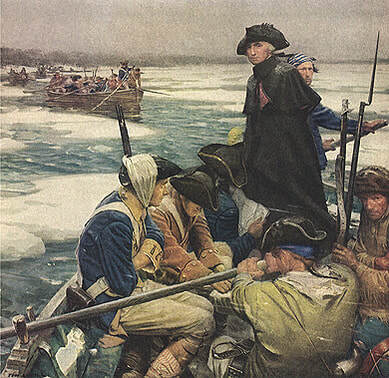
    On Christmas Day in 1776 the 8th Virginia was dispersed across the east coast. The main group, with Colonel Muhlenberg, had just returned to Virginia after their long ordeal in South Carolina and Georgia. A large group remained behind--dead in the ground or too sick from the effects of malaria to march home. On the west bank of the Delaware River, Pittsburgh Capt. William Croghan's detachment of sick, hungry, and frostbitten soldiers were preparing to cross the icy river from Pennsylvania to New Jersey.
    Croghan commanded the remnants of a 140-man detachment that included his own company from Pittsburgh, and another seventy 8th Virginia soldiers who had missed the spring rendezvous at Suffolk, Virginia. For the year, Croghan's men were attached to the 1st Virginia Regiment. That regiment's field officers (colonel, lieutenant colonel, and major) were all sick or wounded, so a man of Croghan's own rank was in command: Capt. John Fleming from Goochland, Virginia. In a week, even Fleming would be dead. There is good reason to think that Croghan was also too sick to command his men and that Lt. Abraham Kirkpatrick (also from Pittsburgh) stepped up to lead.

    The crossing and the all-night march to Trenton were arduous. The bloody footprints in the snow we learned about in school were very real. Men who sat too long on the way to Trenton froze to death. But the suffering resulted in a victory over the Hessians that revived the American cause. “[B]eat the damn Hessians and took 700 and odd prisoners,” wrote Sgt. Thomas McCarty in his diary. The march back was even worse than the approach.  A week later, at the battle of Princeton, only a handful of Captain Croghan's men were fit for service. 

    At Trenton, Croghan's men fired on the enemy just yards in front of General Washington and alongside the soldiers of Colonel George Weedon's 3rd Virginia. Their victory, though small in military terms, revived a dying cause. Afterward, the overconfident British became more cautious and Washington found a tactical model for victory against an enemy that was better trained and equipped.

    Thereafter, Christmas would always carry a special meaning for those who were there. After the war George Weedon wrote a song that was sung each year at a large party he held at his home in Virginia. The song was remembered by the orphaned son of Gen Hugh Mercer, who died at Princeton. The younger Mercer knew Weedon as his “uncle and second father.”  He recalled that for “many years after the Revolution my uncle celebrated at ‘The Sentry Box’ (his residence, and now mine) the capture of the Hessians, by a great festival—a jubilee dinner, if I may so express myself—at which the Revolutionary officers then living here and in our vicinity, besides others of our friends, were always present. It was an annual feast, a day or so after Christmas Day, and the same guests always attended. …I was young, and a little fellow, and was always drawn up at the table to sing ‘Christmas Day in ’76'…. It was always a joyous holiday at ‘The Sentry Box.’”

    Christmas Day in '76

    On Christmas Day in seventy-six
    Our ragged troops, with bayonets fixed,
    For Trenton marched away.
    The Delaware ice, the boats below,
    The light obscured by hail and snow,
    But no signs of dismay.
     
    Our object was the Hessian band
    That dare invade fair Freedom’s land,
    At quarter in that place.
    Great Washington, he led us on,
    With ensigns streaming with renown,
    Which ne’er had known disgrace.
     
    In silent march we spent the night,
    Each soldier panting for the fight,
    Though quite benumbed with frost.
    Green on the left at six began,
    The right was with brave Sullivan,
    Who in battle no time lost.
     
    Their pickets stormed; the alarm was spread
    The rebels, risen from the dead,
    Were marching into town.
    Some scampered here, some scampered there,
    And some for action did prepare;
    But soon their arms laid down.
     
    Twelve hundred servile miscreants,
    With all their colors, guns, and tents,
    Were trophies of the day.
    The frolic o’er, the bright canteen
    In center, front, and rear, was seen,
    Driving fatigue away.
     
    And, brothers of the cause, let’s sing
    Our safe deliverance from a king
    Who strove to extend his sway.
    And life, you know, is but a span;
    Let’s touch the tankard while we can,
    In memory of the day.

    ​[Updated 12/25/20]

    More from The 8th Virginia Regiment

  • Published on

    Thank you, Major Kirkpatrick!

    Picture

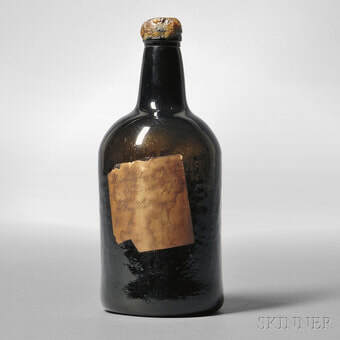
    A bottle of wine given by President George Washington to former 8th Va. captain Abraham Kirkpatrick after the Whiskey Rebellion. (Skinner Auctions)

    When he was eighteen Marylander Abraham Kirkpatrick killed a man in a fight and fled to Pittsburgh. Pittsburgh was the original "Dodge City" of the original wild west. Kirkpatrick had some family money, which he used to buy property and establish himself there. When the war broke out he was commissioned the 1st lieutenant of Captain William Croghan’s company of the 8th Virginia. He served the length of the war, and rose to the rank of major.

    Kirkpatrick was never one to shy away from a fight. He was wounded at the Battle of Princeton and carried off the field by Private Jonathan Grant. He permanently maimed a fellow officer in a 1779 duel. Later that year he was shot in the eye by a jealous husband, but survived. In the 1790s, he played a central role in putting down the Whiskey Rebellion, famously defending Gen. John Neville’s home from an angry mob.
    Despite his evidently very rough edges, Kirkpatrick became part of the post-war Pittsburgh elite. He co-founded the Bank of Pittsburgh and ran an early steel mill. His grandson Abraham Kirkpatrick Lewis was a pioneer in the Pittsburgh coal business, shipping coal on flat boats all the way to new Orleans.
     
    In 1794, President George Washington sent Abraham Kirkpatrick several bottles of imported wine to thank him for helping put down the Whiskey Rebellion. One bottle survives, having been kept by the family for over two centuries. Its contents are now evaporated into a dry sediment.  It was put up for auction a few years ago but didn’t sell. Details about the object, including a high-definition image, can be seen at the Skinner auction house website.

    More from The 8th Virginia Regiment

  • Published on

    Not so fast, William Eagle!

    Image description
    In my October 29 post about William Eagle, I wrote that he "enlisted in the 8th Virginia on Christmas Eve, 1776" and that he "was one of the first to sign up when the regiment came limping back to Virginia from its encounters with redcoats and ... malaria in South Carolina and Georgia." I gave him credit for being "one of the few who enlisted during the Revolution’s darkest hour."

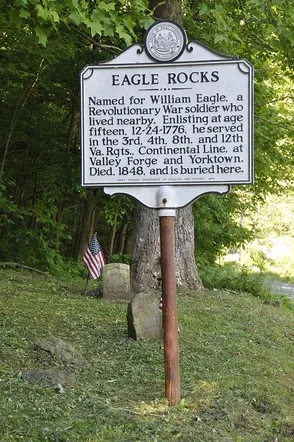
    Well, it's not true. His pension says it's true and the West Virginia historic marker that stands next to his grave says it's true. But they are both wrong. 

    First, His name appears nowhere in the muster or pay rolls for 1777, and the "commencement of pay" date for on his first pay roll entry is February 1, 1778.

    Second, His pension affidavit claims that he "enlisted for the term of three years, on or about the 24th day of December in the year 1776, in the state of Virginia in the Company commanded by Captain Stead or Sted or Steed, in the Regiment commanded by Colonel Nevil or Neville." Colonel John Neville (no known relation to me) commanded the regiment after it was folded into the 4th Virginia in the fall of 1778. Had Eagle enlisted in the regiment in December of 1776 and joined it in January of 1777 he would certainly have mentioned Colonel Abraham Bowman, who became a "supernumerary" officer when the regiment was folded into others in the summer of 1778 and released from service in the fall. Eagle served under Bowman only for a little while and, consequently, did not mention him. Eagle got the names right (Neville and Steed), but the year wrong.

    Third, the term of his enlistment is consistently recorded as for 3 years or the length of the war (which ever was shorter). Soldiers who enlisted in 1777 or later enlisted under these terms. Virginia soldiers who enlisted in 1776 signed up for two years. (Someone might argue that a date so late in the year might have been treated differently, but I'm not aware of any examples of this.)

    The date of his enlistment is not recorded anywhere in the surviving official records. From the evidence, however, it seems certain that he in fact enlisted "on or about the 24th day of December" in the year of 1777 (not 1776), and joined the regiment at Valley Forge about a month later.

    Eagle is not the only veteran who got the dates of his service wrong when applying decades later for a pension. It is an understandable error. The State of West Virginia might, however, want to invest in an updated marker.
  • Published on

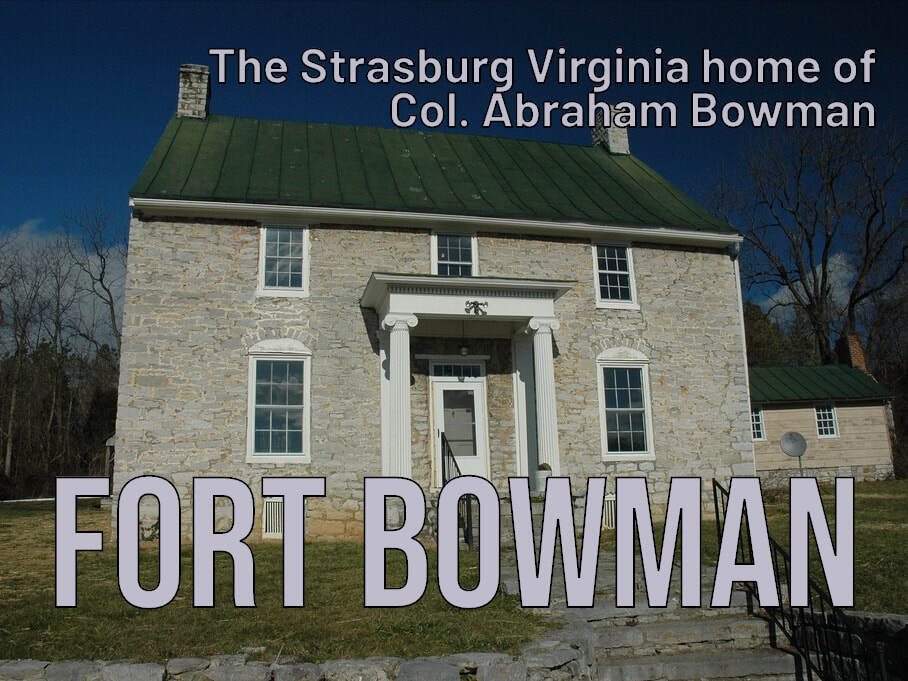
    "Fort Bowman" is really a house. But it's an important one.

    Image description
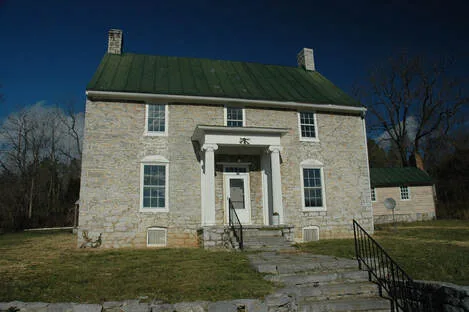
    Hidden in the woods down a long, steep and rocky dirt road near the intersection of Interstate 66 and U.S. Route 11 is a very old Virginia house that seems out of place. If you have an eye for regional architecture, you will notice that it looks much more like a Pennsylvania Dutch farmhouse than a Virginia plantation house. 

    The house was built by George Bowman, a son-in-law of Jost Hite who led George and their extended family to the Shenandoah Valley from Pennsylvania in the 1730s. The house was long believed to have been built in the 1750s but may not be quite that old. The symmetrical features and chimney placements show concessions to dominant English architectural style of the time (Georgian).

    This is the house Colonel Abraham Bowman grew up in. George was his father. It is a very important early example of Pennsylvania German architecture in the Shenandoah Valley. The Laurence Snapp House (note the central chimney), which is nearby at Toms Brook, is another. The house has been called “Harmony Hall” since before the Revolutionary War. It is sometimes, however, called “Fort Bowman” because according to tradition it was used as a fort during the French and Indian War. Depending on the house's actual age, that history may now be in question.
    Image description
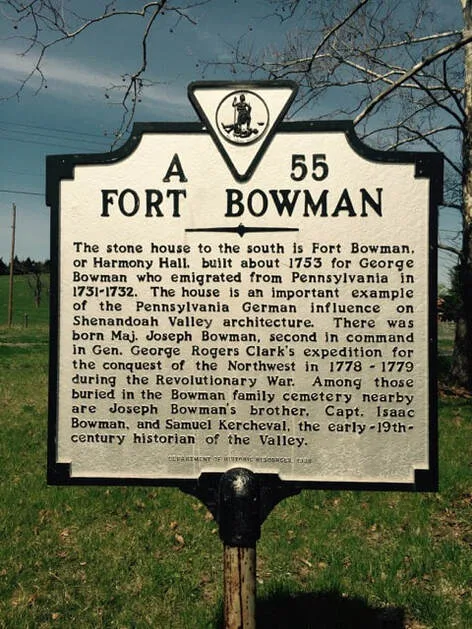
    A nearby Virginia historical marker mentions Abraham's brother, Joseph, but does not mention Abraham. There were in fact four brothers who lived here who served in the Revolutionary War in various capacities. They all had reputations as excellent horsemen, for which reason the siblings were known as the "four centaurs of Cedar Creek" after the nearby stream.

    In 2009, Maral Kalbian and Margaret Peters gave a presentation on the house’s history. 
    Parts 1 through 3 cover the chain of property ownership. If you are not interested in that, you may want to start watching with part 4--which is embedded below. The house is now on property that is part of Cedar Creek & Belle Grove National Historical Park.

    Two more of Abraham Bowman's homes survive. The log house he built after moving to Kentucky in 1779 survives and has been restored, and the much larger plantation house he built after prospering there is also still standing. That house, now known as Helm Place, was later the home of Abraham Lincoln's sister-in-Law (Mary Todd Lincoln's sister).
    (Updated August 20, 2020)

    More from The 8th Virginia Regiment